Service Learning - Eva Varga - Page 4


October 10, 2011

It has been a long while since I have shared a book we have read in our studies.  This is partly due to the fact that few of the books we have read have really inspired me lately.  This week … we came upon two.  The first I would like to share is A River Ran Wild by Lynne Cherry. 


This is an amazing story of the Nashua River in New England and its transformation from a clear, clean water resource to a sluggish dying river, polluted muddy and red by a nearby paper mill.  Readers are first introduced to the Nashua River of the 1400s when Native Americans and a vast array of fish, birds and animals inhabited this fertile river valley.  With each page turn, readers are follow the “progress of man”through the industrial 1800s and the water pollution that followed.  Finally, learn how the efforts of one woman, Marion Stoddart, the Nashua River has been restored to its original beauty, another example of the difference one person can make.


This is the remarkable environmental success story of the cleanup of New England’s once polluted Nashua River. A River Ran Wild is beautifully designed, and its message is admirable. Readers will be moved to consider their personal impact on the environment and what they can do to make a difference.—


Coincidentally, we read this story after we had taken part in a stream restoration project as a part of the Pacific Northwest Roots & Shoots Summit at Willamette University in Salem, Oregon.  We worked along side the other volunteers to pull invasive blackberry vines and plant native shrubs in the riparian area. 


Upon reading the story aloud to the kids, we discussed cause and effect using examples from the story.  To take it further, I invoked a discussion with the kids about service learning.  We also developed a definition for philanthropy and the meaning of private action for the common good.  We made a list of philanthropic activities that already occur in our home and in our community.  I then asked them to write out their ideas for how they could make a difference for animals, the environment, and/or the community.  


October 10, 20112

“Roots creep underground everywhere and make a firm foundation. Shoots seem very weak, but to reach the light, they can break open brick walls. Imagine that the brick walls are all the problems we have inflicted on our planet. Hundreds of thousands of roots & shoots, hundreds of thousands of young people around the world, can break through these walls. We CAN change the world.”   ~ Dr. Jane

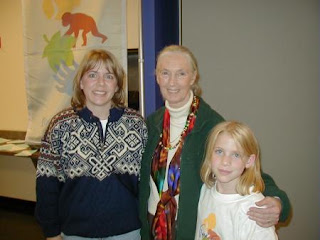
I first met Jane Goodall at an Oregon Science Teachers Association (OSTA) Convention in the fall of 1997. She greeted us with her infamous pant-hoot and spoke of her desire to see young people come together to make the world a better place.  I of course knew who Jane was .. but this was the first time I had heard of Roots & Shoots. Her message touched me that evening. I purchased her book, Reason for Hope, and as she signed my copy, I informed her that she had always been an inspiration to me but as of today, I would do my part as well.  I wanted to create a Roots & Shoots group of my own.

A dream fulfilled by my children, Oct 2011

I thereby returned to the classroom and immediately started an after-school Roots & Shoots group at one of the two elementary schools at which I worked. Twice a month, a group of students in grades 4-6th gathered in my classroom.  We engaged in a variety of activities and projects … each addressing one of the three goals of Roots & Shoots:  Care and Concern for Animals, Care and Concern for the Environment, and Care and Concern for the Community.  In the fall of 2000, we were invited to participate in a Roots & Shoots Summit in Seattle, Washington.  One student was able to join me … many were involved in sports or couldn’t afford the airfare (we had limited time to raise funds).   We spent the entire day with Roots & Shoots groups from all over the Pacific Northwest; sharing our projects with one another, networking, and listening to Dr. Jane share stories of what had inspired her as a young girl.  It was a wonderful experience for us both.

Meeting Dr. Jane for a second time with a student

Though I left the formal classroom setting when my daughter was born, I maintained my Roots & Shoots membership.  Shortly after my son was born in 2005, I had an opportunity to hear Dr. Jane talk again.  Her presence is so captivating … so at peace.  I knew it was time to again facilitate a group and I thereby started a group for preschoolers.  My children have thereby grown up with Roots & Shoots being an integral part of their lives.  I talk about Dr. Jane frequently and I love sharing her stories with the children.

Before we moved to Northern California, I had known that Dr. Jane was coming to Oregon.  Originally, I had planned to volunteer at the public lecture she was going to give in Bend … but with our move .. that plan changed.  However, I wasn’t going to allow an opportunity for my children to meet her to pass us by.  We thereby made the 7 hour drive to Salem for the Oregon Roots & Shoots Summit.

Clipping invasive blackberry vines
Raking the vines that others had clipped

We arrived in the morning and were thereby able to take part in a service learning project close to our hearts … stream bank restoration; removing invasive blackberry vines. In the afternoon, we took part in the giant peace dove parade and visited the booths of the other groups and several non-profits.

At our booth with Grandma awaiting Dr Jane’s arrival

We had a booth ourselves as well … we chose to exhibit photographs of our projects as well as our nature journals.  Several people showed an interest in how we undertook the interpretive sign project.  Everyone was impressed with the quality of the kids’ illustrations.

Dr. Jane arrives at our booth
Sharing our journals & projects

She posed for a picture with us and suggested the kids hold their journals for the photograph.  As she stepped away she remarked, “Your drawings look like those of an 18-year old.”  The kids were all smiles after that and remarkably, we soon had a small crowd of people curious about our work.

Linked to Hip Homeschool Hop 10/18/11


November 16, 20101

When we visited Maui in 2008, we took part in a Volunteers on Vacation weed pull through the Pacific Whale Foundation.  The kids and I had such a good time and enjoyed learning a little more about the native flora and fauna of the islands.

When we returned to Maui earlier this month, the kids were given the Maui Revealed book and were asked to make a list of all the things they wanted to do or see while we were there.  On the top of their list was the weed pull.  Rather than pull weeds on the beach however, as we did in 2008, we were able to take partner with Maui Cultural Lands to take part in the restoration efforts in the Honokowai Valley in North Maui.   

 “People who help the land and the culture,
who give unselfishly for the sake of the land,
they are the heroes, the real warriors.”
~Ed Lindsey, Project Director

From the Ka’anapali Coastline, Honokowai Valley is nothing more than a slim pleat in the West Maui Mountains. A simple stripe of green. Up close, it is overrun with invasive plants, like the haole koa, Chinaberry, and Java plum trees, that grow in mono-species thickets. One of the few Hawaii natives left here, kukui (candlenut) grow straight and narrow.  To get here, you have to drive to West Maui beyond the pineapple and sugar cane fields, beyond the ABC stores and vacation resorts along the coastline. You follow a dusty cane haul road up. You bounce along coffee fields and through invasive forests and padlocked gates.

Today, the land is cared for by a stalwart team of volunteers who form a community project called Maui Cultural Lands. The team embraces a big idea: To restore Honokowai Valley to a state of balance. To remove the invasives so the natives can grow. To clear the ancient rock walls that once made up house sites. To repair the taro patches. To return the place to such a state that the estimated 600 or so Hawaiian families who once lived between these slices of rock cliff walls might actually recognize the place.  One hundred years ago, this was a working village—in fact, the “breadbasket” for the Ka’anapali region. Here, ancient Hawaiians grew taro, sweet potato and squash in the rock terraces they built. They crafted fishhooks, lines and lures; poi pounders, kukui lamps and anchors. The valley gave them everything they had, everything they needed.

We joined the volunteer team on the Saturday before we departed for home.  Close to 20 of us volunteers piled in the back of 4WD pickup trucks, the act itself reminding me of day laborers hired to work the orchards and fields of southern California.  The day’s group consisted Puanani, her son Joe, several regulars: including Phyllis, Andy, David, Ipo, and Sylvia who will soon celebrate her 92nd birthday, two couples from Northern California and Melanie, a young woman from San Francisco and us.  It was a ragtag collection of ages, sexes, cultures and vocations coming together with a common purpose: to serve.

When we first arrived at our work site in the valley, Puanani gathered us all in a circle in the shadow of a towering stony cliff that framed one side of the valley. We joined hands and she welcomed us. We went around the ring introducing ourselves and sharing where we were from. Then, Puanani said, “These walls bear witness to all that has happened,” and she began to lead us in a chant in native Hawaiian.

Maui Cultural Lands, Inc (MCL) is a Maui-based grassroots land trust organization whose mission is to stabilize, protect, and restore Hawaiian cultural resources.  MCL was established as a non-profit organization in February of 2002 and is one of only a few land trust organizations on Maui targeting Hawaiian cultural lands along the coast and inland areas.  Their primary goal is to reforest Honokowai Valley and the Kaanapali area with native and endemic Hawaiian plant species. For more information about the work in the Honokowai Valley, follow these links:


September 20, 2010

Jane Goodall carries her message of peace with the natural world through her worldwide outreach efforts, the mission and work of the Jane Goodall Institute, and especially through the Institute’s global environmental and humanitarian youth program, Jane Goodall’s Roots & Shoots.

“To achieve global peace, we must not only stop fighting each other, but also stop destroying the natural world.”

Each year, in her role as a UN Messenger of Peace, Dr. Goodall calls upon members and friends of Roots & Shoots to celebrate the annual UN International Day of Peace on September 21. Through projects that promote peace among people and the natural world, as well as the symbolic “flying” of their signature Giant Peace Dove Puppets, Roots & Shoots members show their dedication to creating a better, more peaceful future for generations to come.

As I hoped to have several families gather to celebrate the completion of our interpretive sign project, I also planned to fly a giant peace dove for the first time in recognition of Roots & Shoots groups world-wide.

When we woke this morning the weather threatened to ruin our plans. It was pouring down rain for most of the morning. It fortunately cleared off by early afternoon and we were able to proceed. It was very windy however, and our peace dove was a little unwieldy for the kiddos.  I had hoped to get a group picture in front of the dove – moms and kids both – but alas, there is always next year.


September 19, 20104

I live in a subdivision with a large, open meadow surrounding a pond.  Back in the spring of 2008, the kids in my Roots & Shoots club spent an afternoon illustrating some of the plants and animals that are common to this area.   As the kids worked diligently, inspiration struck … Why don’t we create a field guide to the flora & fauna of our subdivision?

I encouraged them to draw several more animals so that the book would be more comprehensive.  I then scanned in all their images and asked many of the older students to write a few facts about each.  As many of our members were very young and were not yet writing … some children exhibited only one drawing while a small few had several illustrations and accompanying text.  For the pictures that lacked written information, I supplied it myself.  I then utilized Blurb.com to publish the book. Our intention was to sell copies to our neighbors as a fund-raiser, but one book was just under $20 so we forgo that idea.

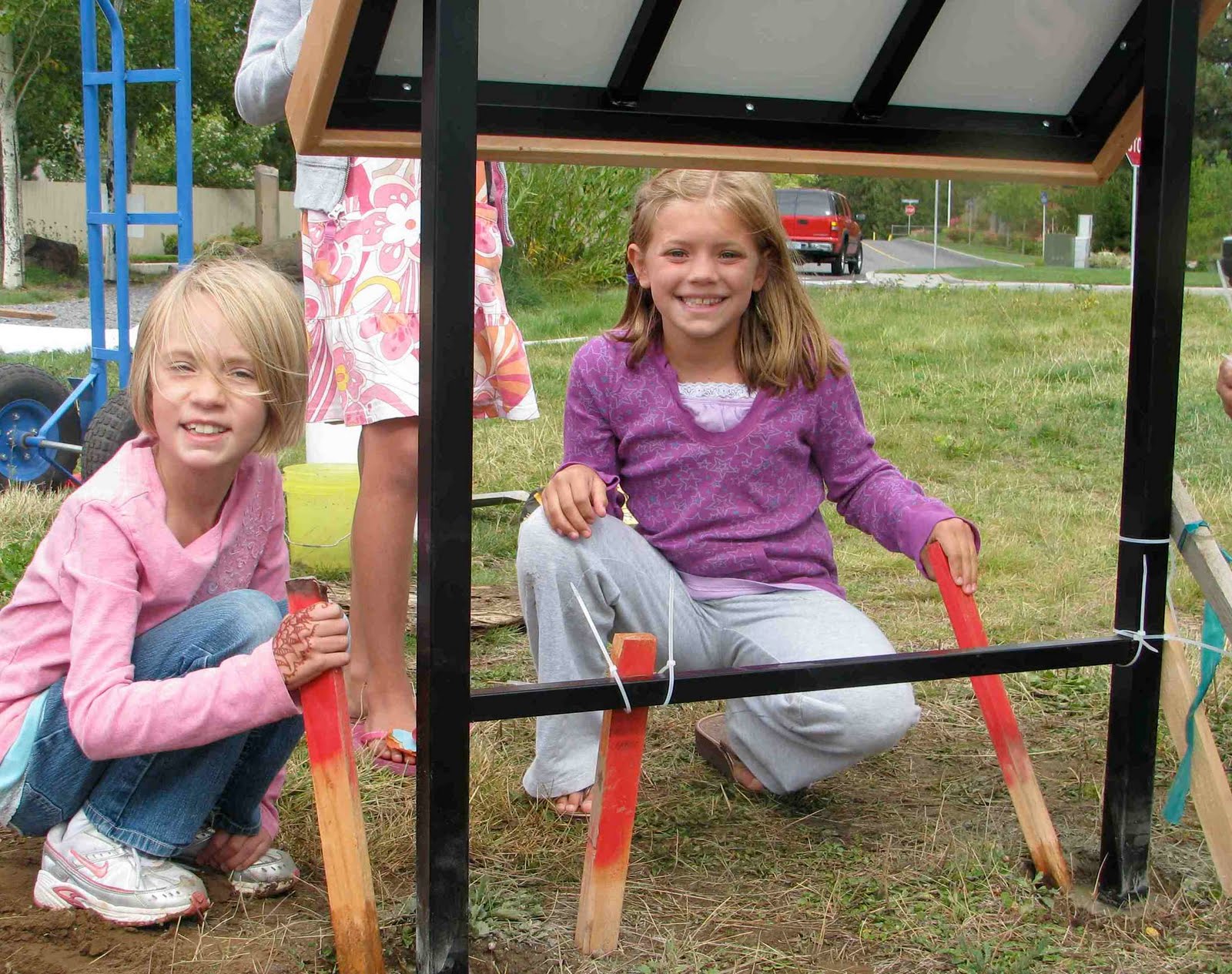
Yet, their illustrations were so good … I needed to find a way to share them with our community.  Late in year, I recalled the interpretive sign projects I had done with my students when I was teaching in the public school.  At the time, we used grant money to fun the construction of the signs but my vision was to ask each homeowner to donate just one dollar to the project.  I was confidant we would succeed if all the members pulled together.

In the spring of 2009, I asked each of the parents to canvas their loop within the subdivision … ensuring we would each speak to the neighbors we knew best.  To my chagrin, no one was willing to do this but each family whose child’s artwork was featured contributed $20.  We were thereby able to pay for the initial part of the sign to be done … putting the children’s artwork onto the plastic weather-resistant board. [Admin Note :: We saved a significant amount of money because I was able to do all the graphics work.]  Raising the remaining funds to frame the board and thereby erect the sign in the meadow was left up to me.

As I began to go door to door, the farther away from my own home I worked, the less inclined the residents were to support the project.  Even though my kiddos accompanied me and I had sample photographs, they weren’t certain what to think of me.  This was going to be impossible, I realized, so I didn’t even finish my loop.  Instead, I decided to present the project at an HOA meeting.

I brought the sign to an HOA meeting in November ’09 … and upon request, also submitted a letter of request to the our HOA quarterly newsletter.  Mistakenly, though they had my letter on hand, it wasn’t included in the newsletter that came out in January.  We thereby had to wait for the next issue in March 2010.  The months that followed were very humbling … I received a small handful of letters from residents within the community that wanted to support our project.  These donations doubled what we had been able to collect previously but were still not quite enough.  I was beginning to think the project was going to come to a dead-end.

Then from out of the blue, I received a phone call from one of the guys on the finance committee. He inquired about our progress and about how much the project was estimated to cost.  Since we first began to pursue this, I had learned that the framing portion was going to be significantly more than they had anticipated.  My contact guy at the sign manufacturer had actually delayed getting back to me for a couple of weeks as he didn’t want to disappoint me.  I demurely explained this to the finance guy in hopes we could brainstorm alternatives means of fundraising.  To me delight and surprise, however, he informed me that the committee had agreed to fund whatever amount we were short (with a maximum of $250).   Thankfully, it was just enough!

The framing was completed in the middle of the summer 2010 and for several months it rested in my den as I worked to coordinate all the necessary parties.  This was proving to be a nightmare so I finally just picked a date.  In retrospect, I should have done this earlier because everything began to fall into place.

The landscape maintenance company was able to meet with me to determine the best location to erect the sign; a neighbor on the open space committee agreed to meet us with cement, a friend of mine lent me a post-hole digger; and another mom brought brownies to share!

I am so, so excited to see this project through.  It took more than 2 years and nearly $500 ~ but it is a life-time achievement of which we can all be proud.


October 22, 20091

Recently I wrote a post on my personal blog titled Seasons Change. It centered around the fact that my kiddos are growing up. That as they do so, new opportunities become accessible. When I wrote it, I was focusing on their joy of riding bikes. How their new skill would enable me to renew my love of running as they would be able to accompany me and I would no longer be encumbered by the jogging stroller. Shortly after I posted however, a received a phone call that again made me realize that as one door closes, another door opens. We only need to be willing to recognize the opportunity. To be ready for new adventures.

As many of you know, I consider service learning to be a major component of our homeschooling. The past few years we have volunteered at the local natural history museum in a a variety of venues. Initially, we were Living History volunteers, portraying a homestead family in the high desert in 1880. We served in this role together for two years – but as Buddy grew, so did his adventurous spirit and he wasn’t too fond of staying “on-site”. Sweetie and I continued the following year but Buddy was disappointed that he was left out and Sweetie felt bad that he couldn’t share in the joy. We thereby moved to the Naturalist Team.In 2008, the museum had a special exhibit entitled The Healing Power of Plants. A team of volunteers was developed to lead a nature walk each day, introducing visitors to the natural flora and fauna of the high desert, highlighting their medicinal attributes. We were welcomed by the team lead (his daughter also homeschools) and we began to lead walks every Tuesday morning.

This past year, as interest increased, there were more then enough volunteers on the naturalist team to cover each day of the week and we thereby served as substitutes, covering the schedule when another team member was ill or had an obligation that prevented him/her from volunteering. This worked perfectly for us as each time we went, it was like a new adventure.
Prior to our talks, I would always spend a few minutes reviewing what was expected in regards to their behavior as well as pointing out what makes a good presentation (eye contact, projecting your voice, etc.). Recently, we had even begun to discuss famous people who were good speakers (Julius Caesar, Martin Luther King Jr., etc.). They were both becoming very comfortable and enjoyed sharing their knowledge of nature with the guests.

We led about 5 walks for adults all summer (in the beginning of summer, we led walks specifically for small children and did the walks right after storytime). Each time, the kids shared in presenting the information (see a video of their presentations here) and the visitors remarked on how well they did. The adults would interact with the kids, asking them questions about the plants. They’d share stories of their own experiences with nature. Not once was it expressed that the kids were a distraction. To me – it seemed as though their presence helped to enrich the walks… actually encouraging the adults to interact a little more with us (the guides) as opposed to blindly listening to me ramble off facts.A few days after our last walk (the season was coming to a close and I knew we would not likely be called to substitute again this year), I received a phone call from the volunteer coordinator. She began to tell me how visitors had reported how wonderful my walk this past week was… how informative and educational it was for them. As she talked, I knew immediately where she was headed. “Though the walk was wonderful, it was at times, difficult to hear because of the children. We have to ask that you no longer bring the children to the museum when you come to volunteer.” My heart sunk. I knew it.

I thereby proceeded to explain that this wouldn’t be possible as we were a package deal. She suggested I volunteer when the children are in school. I pointed out that we homeschool and that this was a key component in our curriculum. “If I am not able to bring my children, I frankly, don’t have an incentive to continue to volunteer at the museum.” She expressed her disappointment in my decision and her hope that I might change my mind.

I honestly don’t think my children have been disruptive. Between their ‘talks’ – they generally run ahead and observe the squirrels and chipmunks, poke around for insects, and explore the outdoor exhibits independently (tee pee, otter habitat, etc.) Occasionally, Buddy does make train noises, “Choo chooooo!” but he is always a fair distance ahead of us. He hasn’t been any more talkative than the adults chattering amongst themselves. I am accustomed to a class of 30+ students socializing. I’ve always waited for everyone’s attention before I begin to talk.

Granted, I understand where ‘the museum’ is coming from. What I don’t understand is why they couldn’t give us the opportunity to make a change. Perhaps, we could have come in and the volunteer coordinator could have explained what the visitor had expressed directly to the children and allow them an opportunity to make a change. Treat us – the children specifically – as you would any other volunteer… with respect.

In my 5 years volunteering at the museum, I have had many opportunities to observe how they treat their staff (laying off a number of employees stating it was for financial reasons and a few months later replacing them) and volunteers. There are over 200 volunteers and it is obvious that they feel we are expendable.

Surprisingly, I wasn’t as disappointed that this door closed as I would have anticipated. Perhaps because it was due to my previous realization that seasons change. We are open to new opportunities now and look forward to what might be just around the corner.