Service Learning - Eva Varga - Page 5


December 18, 2008

Chimps, Inc. is a nonprofit wildlife sanctuary dedicated to furthering chimpanzee conservation through education. It was founded by Lesley Day in 1995 in response to the multitude of captive chimpanzees desperately in need of homes. Earlier this week, Nicole Wilkins, a staff member at Chimps, Inc. came to talk to us about the work they do at the sanctuary and to give us a glimpse into the lives of the chimpanzees.
It was a very informative and educational talk. The biggest thing the kids learned was how to tell the difference between a monkey and an ape. “Monkeys have tails. Apes don’t.” At the conclusion of the talk, we presented Nicole with a donation. Each family collected a variety of things from Chimps, Inc.’s wish list. Some items included tea bags, blankets, plastic containers, plush animals, magazines, and coloring books. In January, we also hope to make another donation of enrichment toys and gifts for the chimpanzees.
After the Chimps, Inc. talk, we enjoyed learning about Winter Solstice. The children each walked the spiral as they reflected upon the past year. We set up the spiral in our garage because temperatures were hovering around 3 degrees all day and the kids voted to do it indoors. When they reached the center, they were assisted in lighting their candle. They then walked out of the spiral as they thought forward to the new year. My kiddos were particularly fond of the spiral as we had recently read a book about labyrinths and mazes titled, Mazes Around the World by Mary D. Lankford. This activity was the perfect way to tie-in literature, nature, and history/heritage.
The winter solstice occurs at the instant when the Sun’s position in the sky is at its greatest angular distance on the other side of the equatorial plane from the observer. Depending on the shift of the calendar, the event of the winter solstice occurs some time between December 20 and December 23 each year in the northern hemisphere, during the shortest day of the year.
The seasonal significance of the winter solstice is in the reversal of the gradually lengthening nights and shortening days. How cultures define this is varied, since it is sometimes said to astronomically mark either the beginning or middle of a hemisphere’s winter. Worldwide, interpretation of the event has varied from culture to culture, but most cultures have held a recognition of rebirth, involving holidays, festivals, gatherings, rituals or other celebrations around that time.

A huge thank you to Bonnie for planning, coordinating and setting up our spiral for the celebration.


December 12, 20082

Ever since the kiddos and I participated in the Let’s Pull Together Community Weed Pull in June they have been asking, “When can we do the weed pull again?” When DH hears them he always replies, “Right now! There are weeds that need pulling in our backyard!” The kiddos do that regularly in the warmer months but it isn’t the same as working together with others to make a difference for the environment.When we decided to spend 2 weeks in Maui, I started a quest to find as many educational opportunities as I could. The Pacific Whale Foundation is a phenomenal resource and with a variety of activities for all ages. One of the links I explored was their Volunteer on Vacation site which provides listings of all the projects that we can take advantage of while on vacation.

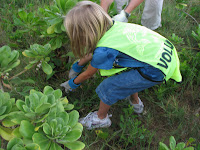
There were several that were of interest but we settled on the Hoaloha ‘aina Weed Pull on the Monday before we departed. We met the team at the Kamaole II Beach Park in Kihei and were provided volunteer vests (they didn’t have enough for everyone so I opted to not wear one). There were two distinct areas to choose from… one on shore that involved using power tools to remove an invasive woody shrub that had taken over the bluff.

We opted for the other area… one uphill from the adults in an area that had been roped off and thereby kept Buddy contained within a manageable area.We worked for two hours pulling invasive weeds. In doing so, we of corse encountered many insects. We took a few minutes to observe them closely but unfortunately I didn’t have the camera so no pictures. DH took these photos shortly after we got started – he thereafter departed to do some work at the condo – Yes! He worked on vacation!

Just as everyone was finishing up, an adult discovered the nest of a young Wedge-tail Shearwater (ua’u kani). It was presummed that all of the fledglings had left for open water by this time. We all got a chance to observe the fledgling closely before returning him to his nest, recovering it with vegetation, and closing off the area again. Admin note: Please follow this link – it is a very interesting bird!
When DH returned, we immediately took him over to the area where the nesting burrows are located and told him of our discoveries. The kids were delighted. The next day, we received our Volunteering on Vacation t-shirts as a thank you from the Pacific Whale Foundation. The smallest size is an adult small – so of course, they are huge on the petite 6 year old and a 3 year old – but the are so proud of their shirts!


December 9, 20084

While we were in Maui, Sweetie completed several activities at the Haleakala National Park to become a Junior Ranger. When we arrived, the ranger at the counter gave her a booklet and explained that for her age, she would need to complete 4 booklet activities (as there were no talks scheduled for the time we were there). The activities we selected were:

#1 What is Wilderness?
Whereby she learned about what activities are permitted in the wilderness area.

#2 Who is Native to Hawai’i?
Whereby she learned about the species that are native to Hawai’i and those that are not.

#3 What Animals Live Here?
Whereby she learned about habitats.

#4 Where is the Volcano?
Whereby she learned about volcanic rocks.

#5 Ancient Ways and Words for Today
Whereby she learned two Hawaiian words: malama ‘aina (to respect and care for the land) and alu like mai (pull together, work together)

Upon completion of the activities, Sweetie sat down with a ranger and was interviewed about what she had learned. I videotaped the interview and hope to post it here as soon as I can figure out how to download it off the video camera. During the interview, Sweetie described to her what she had learned about invasive species before our arrival. “I want to go to a luau so that I can eat bad pig!” (We didn’t explain to her that the kahlua pig isn’t likely the wild pig that is destroying the forests.)

Sweetie also told her about a snail that she had helped get across a trail so that it wouldn’t get stepped on. The ranger asked us to describe the snail and in doing so, we learned that based upon it’s size and color, it was likely the invasive African Cannibalistic Snail. “The native tree snails are found higher in elevation.” Sweetie was distraught, “Oh no! I should have stepped on it then!” The ranger got a chuckle out of that.

Most National Park Service sites that have a Junior Ranger program award participants a plastic badge for completing the program. Some award a patch; a few award a lapel pin. Some do both. Haleakala awarded a badge. However, they had patches available for purchase so we bought one as they are our preference. As she completes future Junior Ranger programs, I’ll make a banner for her to display her badges & patches.

Click here for more information about the National Parks Junior Ranger program. Another very informative site was created by a teen… Sam Maslow’s Junior Ranger Site.


November 24, 200813

As a teacher, I’ve had some amazing opportunities over the years. For a while now, I have wanted to write a post about them here to share some insight into who I am – to describe how I came to be the person I am today. I wanted to share some of them with you in hopes that I might inspire you. Accordingly, some of the posts you see around here in the near future may be a bit of a departure from your garden-variety homeschool blog. Sometimes, I just like to get these things in print so I’ll remember that they actually happened. For today, here’s a snapshot of one of those teaching experiences that changed my life.

rain cats

People are pretty jealous when I tell them I’ve recently returned from a trip to Ecuador. They immediately ask, “Did you go the Galapagos?” Did you stay at a beach resort?” I have to be honest and answer, “No, I collected caterpillars.” While this may seem a bizarre way to spend ones vacation, I really did venture into the rainforests of Ecuador for two weeks as part of an Earthwatch expedition.

Rainforest Caterpillars

The purpose of this particular expedition was to assist a team of scientists in their investigations of caterpillar defenses against their natural enemies, particularly parasitoids. The principal investigators, Dr. Lee Dyer (Assistant Professor at Tulane University), Thomas Walla, and Craig Dodson (Associate Professors at Mesa State College), had four major research goals. The first was to gain a better understanding of the effectiveness caterpillars have against their natural enemies. Secondly, to examine caterpillar diets (generalist versus specialist feeders), hoping to clarify to what extent plant chemistry and natural enemies affect the diet of herbivores (more specifically, caterpillars). The third goal was to relate the results to agriculture as an alternative to the current use of pesticides. The fourth goal was to inventory the biodiversity of an ecosystem that is disappearing at an alarming rate.

After several years of caterpillar study at La Selva Biological Station in Costa Rica, Dr. Dyer and his colleagues are pioneering a companion project in the lesser-known and threatened Ecuadorian rainforest. My expedition team was the first to work at Yanayacu Biological Station in Ecuador, a privately owned preserve on the eastern slope of the Ecuadorian Andes.

Caught between plants, predators, and parasites, caterpillars have been forced to develop a bizarre armory of survival skills. For the most part, while many butterflies are well known as adults, the details of their life as caterpillars (the longest part of their life), is poorly known, and many inter-related questions need to be answered. Getting data to provide answers for these questions is what the expedition was all about, and in order to obtain that data, many mundane chores and practical tasks needed to be carried out.

A typical day of research usually involved a lot of hiking. In order to study caterpillars, you need to find them first. We usually set out with our collecting kits, to scour the roadsides and other disturbed areas (prime caterpillar habitat) for these elusive creatures. Finding one elicited shouts of joy in the beginning. After a few days in the humidity and nearly constant drizzle of the forest, the excitement wore off (but it was always exciting to find a new or interesting species).
Rainforest Caterpillars

In the lab, another group of volunteers was ready to process the new arrivals. Essentially, each individual caterpillar was given a unique number, identified taxonomically, and the behaviors, coloration, and morphology were recorded. The caterpillar was then ready to be placed in the “zoo”. The caterpillar specimens are then cared for until they pupate and either emerge as adult Lepidoptera or a parasitoid emerges. Each day, volunteers cleaned the bags of frass (entomological term for caterpillar droppings) and condensation, and assured that each bag had fresh plant material. As we did so, we also checked the status of the caterpillar and noted any changes (presence of a parasitoid or pupa).

In the Classroom

So, how will I use all this in the classroom? As a fifth grade teacher, one of my favorite (also the most popular with students) thematic units is on invertebrate animals. Since caterpillars are considered to be one of the most serious pests of agriculture, it was only natural that part of the study included trying to find a more natural way to control their population. Using their natural enemies against them, parasitoids seem to be a logical solution. This would be something that my students could explore locally.

But much more important than any facts which I can teach my students are my experiences and adventures in the rainforest. One of the main things I have learned is that we need a new “law of the jungle.” Biodiversity and the interconnectedness of all the creatures of the rainforest show us that we must honor the balance of nature. These are the great lessons of the rainforest which I hope to pass on to my students: attitudes and perspectives which provide a new vision of the world, one celebrating life’s diversity and offering an alternative to the 19th century views which still persist. That’s my lesson plan.

I wish to thank the other Rainforest Caterpillars of Ecuador volunteers – Kristen, David, James, Bruce and Joanna; the Principal Investigators – Lee, Tom, and Craig; and our host – Harold Greeney, for helping to make the expedition so enjoyable. I would also like to thank the Earthwatch Institute for providing the opportunity for the expedition. And I offer special thanks to the Society of American Foresters, Menasha Corporation, and Dr. Craig Stephenson for making my part in the expedition financially possible. It was the adventure of a lifetime and a dream come true.


September 9, 20085

We went up to the lake on Sunday to enjoy one of the last warm weekends of the season. It was quite windy so we weren’t daring enough to take the plunge, but the kids enjoyed looking for frogs, watching dragonflies, and building a castle and moat along the shoreline.

Inspired by Theresa at LaPaz Home Learning, I took several “Not Back to School Portraits”. It was a joy to watch the kiddos enjoy themselves and interact with one another. They discovered a tiny little green frog whom they played with for some time.
The following day, we sat down on the couch to do a little ‘current events’ work that I had saved. I save articles I think the kids will find interesting in the newspaper and try to do at least one ‘current events’ assignment each week. The article I saved was from the 25th of July, titled Beetles Killing Trees, Causing More Damage Than We See. The kids were delighted to learn that the article was about the forest that surrounded the lake we visited the day before. “That’s where we went yesterday!” If you look carefully at the photos above, you can see the trees that have succumbed to the pine beetle infestation. [Had only I thought to read the article before we went up to the lake – we could have talked with the Forest Ranger to learn more.]
I read about two thirds of the article, stopping frequently to help them understand the larger vocabulary. We discussed the illustrations and photographs. Once Sweetie was comfortable, I asked her to give me an oral narration. Here is her response (note, the brackets indicate what I said to help her to elaborate or to correct miscues);

These beetles [Mountain Pine Beetles] are killing trees like Ponderosa and Lodgepole Pine near … Lake where we went yesterday. The beetles make tunnels in the new bark [inner bark] where they lay lots of eggs. Then the little larvae hatch out and they dig holes where they make a pupa. Then they dig out as a grown-up. The beetle also brings in some chemical [blue fungus] that gets on the bark and it changes blue. This kills the trees.

They [Forest Service] closed a road near … Lake because they don’t want the people to get hurted. They don’t want the [dead] trees falling down on people. [Do you recall what the foresters are doing to protect the trees?] Moving all the shrubs, sick trees and stuff to make the trees stronger. [… we discussed in more detail the process / purpose of thinning in more detail.]

When doing narrations, it is always interesting to me what details they focus on, in this case she provided the most details about the life-cycle of the beetle and how it affects the tree. We’ve always been fascinated with insects in our home (expect perhaps DH) – one of our first thematic units was on insects, in fact. So, it was no surprise that this part of the article was most interesting to her.

On the other hand, we haven’t talked much about forest ecology or how foresters work to protect the health of the forest. Her narration of this part of the article was thereby much more vague. By asking for a narration, I was able to pick up on that and we spent a few more minutes discussing the process of thinning. How it is done. How it helps the forest to be less susceptible to the pine beetle.

They now have a block of information on which to build upon during future trips to the mountain. They are better informed. The experience, coupled with reading and discussing the article, will help them better understand future lessons on ecology.

~~~

On a related note, when we had stopped by the Ranger Station to inquire about a good area to play in the water and relax on shore, I picked up a few brochures. One of which describes the need for Forest Guards; volunteers who spend a week or more at the forest station, providing assistance to the public and interpreting the ecology of the area. I asked the kiddos if they would be interested in doing something like that for a week and they were both enthusiastic. I’ll have to look into this again when the kids are older.

Edited 28 Sept 2008 – Linked to Barb’s Outdoor Hour Challenge #32: Pine Trees.

As the Ponderosa Pine is the dominant tree in our area, the kiddos are very familiar with its characteristics. Sweetie gives an oral presentation on the Ponderosa on our weekly nature walk pointing out ways to identify the tree and noting its adaptations for survival.

Medicinal Uses

  • Roots – can be used to treat indigestion.

Nutritional Value / Food Uses

  • Inner bark – raw or cooked. Best in spring. Often dried, ground into powder and used a thickener in soups or mixed with bread flour.
  • Seeds – raw or cooked. Rich in oil, can be crushed into a meal or used in making making bread.
  • Resin – chewed as gum.
  • Young male cones – chewed for juice.
  • A vanillin flavoring obtained as by-product of other resins in pulpwood. You can even smell the vanilla if you get up close and smell the bark crevices.

Interesting Facts

  • Needles fall from tree after ~3 years
  • On younger trees, bark is brownish black. Older trees develop thick, spongy bark. As trees mature, the bark color becomes a rusty orange.
  • Basketry: root fibers and needles.
  • Dyes: yellow dye from pollen, blue dye from roots, tan/green dye from needles.
  • Thick bark helps protect the Ponderosa from forest fire making it less susceptible. It also self-prunes and drops the lower, dead branches and thereby decreases the amount of fuel available for fire to reach canopy.
  • Releases chemical that prohibits growth of many other plants in its vicinity – thereby creating a park-like setting in the under-story.