Barnesklubb - Eva Varga - Page 2


September 3, 20135

Orienteering is an exciting adventure sport that will get your kids running – and provides lots of great learning opportunities for homeschooling.  The sport originated in Sweden during the 19th century as navigation and fitness training for the military. After the first public competition in 1897 in Norway, the sport spread to Finland and Sweden. By the middle of the century, orienteering became a recognized sport throughout Europe, and the International Orienteering Federation was established in May 1961.

Free Orienteering LessonsAs well as learning to recognise some topographical map symbols, your children will learn to use a compass and to gauge distances with more accuracy.  Orienteering is a sport that involves a race marked out on a map. In following the course map, the runners have to find a number of checkpoints. The person who finds all the checkpoints, in the right order, in the shortest time, is the winner.

I recently introduced Orienteering to my Barnesklubb in a simplified orienteering course. Essentially, I set up a course with seven checkpoints beneath the trees at a local beach, marking each with a small flag.  Next to each checkpoint I placed a rubber stamp and an ink pad.   I wrote down the coordinates to navigate from one checkpoint to the next so that the first and last checkpoints were the same (we thereby finished at the same location where we started).

The kids were given a brief introduction to using a compass – most had used one previously, but several had no prior experience.  I thereby accompanied them along the course until they felt comfortable on their own.  Each pair of students was then given a card on which the coordinates were written.  As they moved through the course together, they used the rubber stamp and ink pad to record the checkpoints.

Introduction to Orienteering @EvaVarga.netThe Introduction to Orienteering activity is available now in my store and includes the course marker cards and detailed instructions on how to set up this course for yourself. Conveniently priced at just $2.95, you’ll be ready to introduce your kids to this lifetime sport. In addition to the Compass Course activity described above, it includes several additional enrichment activities to further encourage navigational skills.

If you are already familiar with how to use a compass and have had some experience with Orienteering, I have also created a FREE printable Orienteering guide that you may use to enrich your compass repertoire.  For more information, you may wish to to seek out clubs in your local area.

National Geographic has also launched a free website for printing detailed topographical maps, PDF Quads. All you’ll need now are a few compasses and an adventurous spirit.


July 23, 20134

Over the past few months, our Barnesklubb (Scandinavian Youth Club) has been learning Norsk or Norwegian folk dance. It has been a very fun endeavor and admittedly, a little challenging as well for I have not had prior folk dance experience. This undertaking has, therefore, been a little scary for me. Motivated to earn the cultural skills pin from our Sons of Norway lodge, however, and coincidentally satisfying course requirements to renew my teaching certification … we got underway.

folkedans gruppe
The history of Norwegian folk dance is a rich heritage. It is a fixed gem in Scandinavian culture now and will continue far into the future.  Early dance in Norway consisted of song dances. The songs that accompanied traditional dances told the stories of heroes.

With the arrival of musical instruments in the 18th century, the song dance began to decline. Influences from Europe brought new ideas in music and dancing. Couples danced the polka and waltz. The accordion, flute, violin, and zither ingrained themselves in the culture along with the movements meant to be companion to them.

All of these traditions are nurtured in present day Norway. Efforts by the Norwegian Traditional Music and Dance Association, founded in 1987, along with Sons of Norway lodges the world over, ensure that the traditions of old will continue into the future intact and adored. In March, I introduced my Barnesklubb (Scandinavian Youth Club) to folk dancing.

I had watched a few videos on YouTube, took copious notes, read a few books (Folk-dances and Singing Games and many more are available for free on Google Play), and worked through the basic steps on my own.  When Barnesklubb met at the library each month, I brought along the music and walked the kids through two dances, Klappdans and Seksmannsril.

Klappdans, or the Swedish Couple Dance, is danced in a double circle, with the partners side by side with the girl on the boy’s right, inside hands joined and the free hands on hips.  It is sometimes referred to as the Parisian Polka and Children’s Clapping Dance.

Seksmannsril translates to 6-man Reel and is a bright, lively 3-couple set dance.  As with several other folk dances of similar nature in Norway, it is generally considered to have been an import from Scotland centuries ago, but over the years has acquired a typically Norwegian character. The tune most frequently used for the dance is well known to both British and Americans: “Soldier’s Joy.”

As I researched the history of folk dance, I learned that folk dance is meant to be danced, not watched; it is performed for joy of participation, not the art of exhibition. We certainly had a lot of fun learning these two dances and performing them at our lodge’s Syttende Mai (17th of May) brunch.  To our delight, we have already been invited to perform for the Swedish lodge and have thereby pledged to continue.

Our own experience has been wonderful and we look forward to putting our dancing shoes on again in the fall.


July 10, 2013

The recent sale of The Scream at a Sotheby’s auction in New York for $119+ million has underscored the resurgence of interest in the Norwegian artist, Edvard Munch, and marks the 150th anniversary of his birth in 2013.  To celebrate the sesquicentennial of his birth, Sons of Norway members all over the world are developing programs to explore his life’s work.  Today, I share an Edvard Munch lesson plan with you.

Who is Edvard Munch?

Edvard Munch was born in Ekely, Norway on December 12, 1863 – the son of a military doctor. As a youngster, both his mother and his teenage sister died of tuberculosis.  Their absence left a profound mark on Edvard – the youngest of the Munch family. At the age of seventeen, after beginning to pursue a career in engineering, young Munch decided to give it all up to devote himself to painting. After studying at the Oslo Academy and under leading Norwegian artist Christian Krohg, he began showing his work – at times causing quite a stir.

Spending summers in Norway and dividing the rest of his year between Paris and Germany, Munch attended literary circle meetings, exhibited regularly and experimented with woodcuts and etchings (in addition to paintings). As with most artists, much of Munch’s subject matter came directly from his life experiences. From the death of family members to love lost, the images in his art were at times too much for the general public to bear. Often called the first of the expressionists, Munch left an indelible mark on the history of art.

the scream

His Most Recognizable Painting

The Scream is his most recognizable painting, arguably it is one of the most recognized paintings of all time. Munch painted many variations of The Scream, depicting a ominous red sky in each. Admirers of his work have often debated the cause for the fear depicted in the painting. Donald Olson, a physics and astronomy professor at Texas State University, and his colleagues determined that debris thrown into the atmosphere by the great eruption at the island of Krakatoa, in modern Indonesia, created vivid red twilights in Europe from November 1883 through February 1884. The local newspaper in what is now Oslo reported that the phenomenon was widely seen, the astronomers said.

Edvard Munch Lesson Plan

I introduced Munch to our Barnesklubb group earlier this week by reading the short biography described above.  I then shared several of his paintings with the kids that I had saved to the camera roll on my iPad.  Some of his work deals with themes that can be rather dark.  Many of his paintings are self portraits that reveal his troubled mind.  Prior to the lesson, I thereby took time to select paintings that predominately featured landscapes or people casually walking.  I’ve pinned the images I used in my Barnesklubb board on Pinterest.

young artists inspired by edvard munchThe kids each selected a favorite painting and thereafter tried to recreate the image themselves.  I had printed each painting onto paper, approximately 3″ x 2″ in size so the kids could reference it quickly.  I provided each child with drawing paper (11″ x 9″) and a variety of media choices was made available – crayon, colored pencil, watercolor, and chalk pastel.

Interestingly, the boys all chose crayon and most of the girls chose chalk pastels (with the exception of the youngest, age 3, who contentedly explored  the blending of colors with watercolors and my daughter, though she crumbled it up and explained she would try again at home with fewer distractions).  I also found it interesting that the boys all drew a small square on their drawing paper, creating something of a frame.  The girls on the other hand used the entire sheet of paper, though some cut it to a smaller size before beginning.  In the group photo (above), the boys had asked that I trim their paper but you can still see that there is a small white frame around their art.

You can read more about Edvard Munch on the official Norwegian anniversary page, Munch 150. You may also be interested in a beautiful digital magazine, Norway Today, offered free by  the Norwegian Embassy.  The current issue features an article on Munch on page 6.


January 10, 20131

For Barnesklubb this past week, we met at the local library and I read aloud The Race of the Birkebeiners Lisa Lunge-Larsen.  It is the story of two brave Birkebeiners and how they saved the infant Prince Håkon by skiing across the mountains in the dead of winter.  It is a true story of bravery and tenderness set in the year 1206, deep in the snow-covered mountains and valleys of Norway.  The kids and moms all enjoyed the story and it was pointed out to me later that all the boys (there were four in all) sat cuddled up with their mother as I read aloud.

This 1869 painting by Knud Bergslien portrays
the story of young Håkon Håkonsson.

On the nights of a full moon in Central Oregon, the Nordic Ski Club coordinates a moonlight snowshoe or nordic ski outing.  While the moon and stars are bright enough to make your way to the shelter (if you desire to go that far), a smaller loop trail is also marked at regular intervals with luminaries.  As we don’t have snow in town to go nordic skiing as I would have liked and an outing to Mt. Lassen or Mt. Shasta would have taken considerable more time and effort (and thereby fewer participants), we made luminaries.

From one gathering to the next, I never quite know how many children to expect at Barnesklubb.  Generally, there are only 5 children (two of which are my own) but on occasion there are significantly more.  I was quite surprised, therefore, when I arrived at the library to see a small crowd of young, smiling faces awaiting my arrival.  I didn’t have quite enough tin cans for everyone to create their own, but I did think ahead and had brought along my stash of candy tins just in case.  Thus, every family was able to create a luminary while every individual (if desired) was also able to embellish the candy tin as a special treasure box.  Ideally, you would want to first sand off the paint of the candy tin – this gives a much nicer presentation and the design stands out much better against the silver aluminum rather than the distracting colors of the candy label.

I have been collecting Barnesklubb ideas on Pinterest for sometime and luminaries are one that I see pop up frequently.  The morning of our gathering, I went to Pinterest and clicked upon my pin, Tin Can Luminaries, to print a few templates and/or ideas for the kids and realized I had made a mistake.  As an experienced teacher, I should have know better, but life tends to derail even the best of educators.  Sadly, I didn’t plan ahead enough to freeze water inside the cans. I had to instead make do with a stack of newspaper that the kids rolled up and stuffed into their cans so as to provide support when they began to puncture the tiny holes in the cans with a hammer and nail. This worked well enough, but I am sure a can of frozen water would have worked better.  Ah … next time.


December 12, 20122

Earlier this year, the kids learned the first verse to a fun Norwegian song, “Sommer Kommer“.  Since then, the Barnesklubb kids have expressed interest in learning the other verses.  As winter is upon us – though it doesn’t feel that way here in Northern California where it was 81 degrees just two days ago – I thought it was a good time to followup.

Fortunately, I was able to find a video on YouTube so that I could assure our pronunciation was relatively accurate.  As you may know, I am learning Norwegian myself and I didn’t want to lead the kids astray. It’s a fun song and one I know we’ll return to again and again.

Summer

Sommer kommer, sommer kommer
sol og regn og latter og sang
sol og regn og latter ha ha ha
latter sol og sang

Autumn

høsten kommer, høsten kommer
blader og skole og vind og genser
blader og skole og vind who ho ho
vind blader og genser

Spring

stormen kommer, stormen kommer
skyet og regn og torden og lyn
skyet og regn og torden (clap clap clap)
torden skyet og regn

Winter

vinter kommer, vinter kommer
is og snø og kakao og kaldt
is og snø og kakao brrr brrr brrr
kakao is og kaldt


December 12, 20121

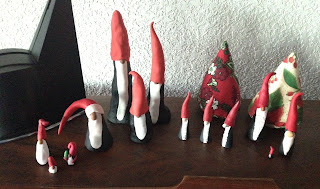
Barnesklubb met yesterday afternoon and our activity centered around the Nisse of Norwegian folklore (also known as Tomten in Sweden).  I began by briefly touching upon a few details about the characteristics of these “household spirits” who are believed to care for the prosperity of a farm. Typically, nisse are short dwarf-like men with long red stocking caps who reside in a barn.  If you care for the resident nisse, leaving a bowl of rice porridge on Christmas Eve, the nisse will return the favor and look after things.  If you disregard the nisse, he will cause troubles.    

I then read aloud a story, Snippen’s Dilemma by Edna and Howard Hong.  It is a cute story of a Nisse named Snippen who makes the decision to leave a farm where he is unwelcome in search of a farm where his life will be easier.  Along the way, he encounters a little girl who is praying, “You understand, dear God, that we are glad our dear mother can be with you this Christmas.  We know that for her it is the best Christmas ever.  But down here, we miss her terribly.  I’m little and inexperienced and can’t do the things the way dear Mother did them.  The oatmeal is lumpy and little brother won’t eat it,” she prays. “Everything has gone wrong since Mother went to heaven.”  Hearing this, Snippen grapples with the decision to continue on to the farm where life will be easy or to stay and help the little girl and her family.   [Snippen’s Dilemma can be found in the book, Christmas Comes to Blueberry Corners: And Other Christmas Stories for Children]

After the story, I passed around the three little wooden nisse that I purchased while in Norway (pictured in front of the red tree above).  I then demonstrated how to make a similar little nisse in polymer clay (like those surrounding the tree).  The activity was a hit … even the adults got into it including a gentleman and his 18-month old daughter who also happened to be at the library.  Sadly, I again failed to take photographs of the kids engaged in the activity.  When will I remember!?

Sons of Norway has captured a little nisse magic in this month’s Viking by sharing the photography of Per Breiehagen. A native of Hallingdal, Norway, Breiehagen now lives in Minneapolis and has photographed his adorable daughter, Anja, as the model for his wonderful “Winter Magic” photo series.  His photography is also featured in this month’s issue of Norwegians Worldwide magazine.  I encourage you to check out these links … Per’s work is both stunning and heartwarmingly adorable.  

I was happy to be able to give each family a copy of the current issue to take home with them.  For additional ideas of integrating Norwegian traditions and learning more about the nisse, see My Little Norway’s post, Nisse Parties.