Barnesklubb - Eva Varga - Page 3


September 6, 20121

I have loved the stories of Hans Christian Andersen since I was a little girl.  I remember very clearly listening to my dad read aloud Tumbelina as he tucked me into bed at night. To this day, it is one of my favorite stories. You can imagine my delight when I finally got to “meet him” while we were in Copenhagen last May.

Scherenschnitte with Hans Christian Andersen @EvaVarga.netHans, as I will affectionately refer to him here, was known not only for his skill at storytelling, but also for his ability to cut intricate paper designs.  Remarkably, he would entertain guests by snipping away at paper while he orally told his stories.

At the conclusion of his story, he would reveal the delicate image he had been cutting. Most often, the image he cut told a pictorial story completely different from the one he told in words and his audiences were amazed.

History of Scherenschnitte

Papercutting has a long history dating back to ancient Chinese who used it to form stencils to decorate fine silks. The technique likely found its way to Europe in the early 17th century through trade with Asia.

The term “Chinese shadow” was originally used but was replaced by “silhouette” in France when a banker, Etienne de Silhouette, lent his name to the term. As the minister for finance of Louis XV, he proposed that the king should commission only black-and-white shadow portraits instead of expensive oil pictures.

In France it was originally a bourgeois art but soon became a favorite pasttime for everybody.  Famous artists like Philipp Otto Runge, Adolph von Menzel, and Goethe and later well known artists, such as Matisse and Picasso, created art using this technique.

Scherenschnitte with Kids

Kids are generally familiar with the art of paper cutting – having made paper snowflakes to adorn their windows in winter. However, scherenschnitte is an art that can be enjoyed year-round.

I recently introduced our Barnesklubb kids to the scherenschnitte work of Hans Christian Andersen and was delighted with the number of families that turned out for the activity. I began by reading aloud his short story, The Beetle, which he wrote in 1861.

Upon concluding the story, I revealed to the kids a beetle that I had cutout previously [alas, I would not have been capable of doing it simultaneously].  I also shared with them the book featured below; the kids were all intrigued and spent the next hour trying their own hand at paper cutting.

Author Beth Wagner Brust tells the story of Hans Christian Andersen as an artist, describing how and why he made paper cuttings, which, like his tales, were innovative and original. His work is striking – the cutouts, typically from white or light-colored paper, are set off by dramatic black backgrounds. The accompanying text outlines the major events in Andersen’s life, from his childhood in a slum of Odense to his later career as a celebrated writer.

Scherenschnitte Tutorials & Templates

If you are interested in learning more about this fascinating and ageless art medium, here is a great tutorial:

Cindy Bean, the artist in the video has also graciously provided numerous templates on her website, Scherenschnitte, that you can download for free to help you get started. Here are a few of our favorites:

Please leave a link in the comments if you have given this art a go yourself.  We love to be inspired by others.


June 25, 2012

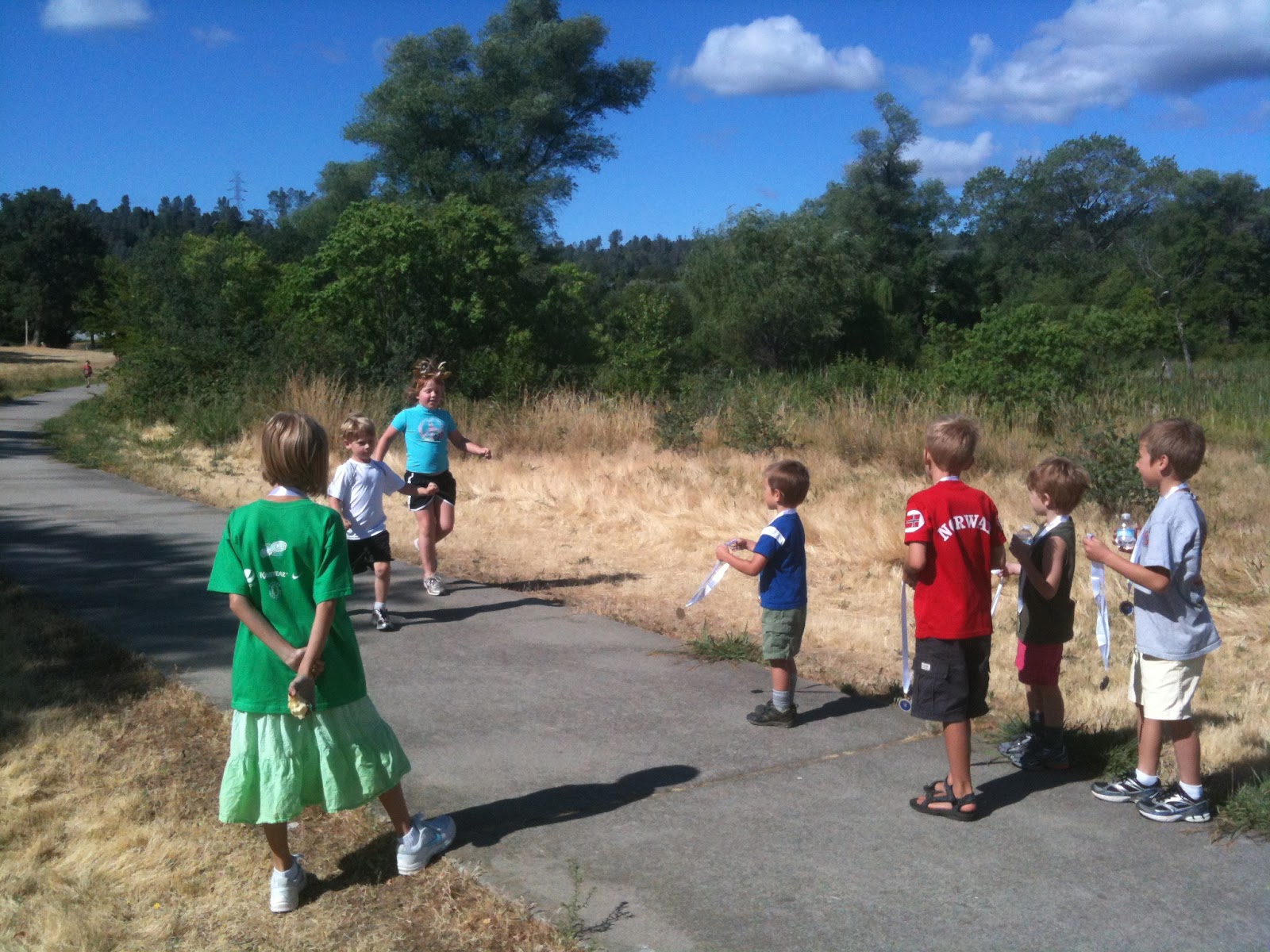
On Saturday, our Sons of Norway lodge hosted its first Barneløpet or Kid’s Race.  We didn’t know what to expect in terms of number of participants – we were worried about getting overwhelmed – but as it turned out, there were eleven enthusiastic little athletes.  The weather was perfect and their excitement was contagious!  

The cutest thing was each one of the little runners was excited to give the other runners their finishers medals and a congratulatory ‘high-five’.  The camaraderie was high and everyone expressed interest in taking part again.


June 11, 2012

Orienteering is a sport that requires skills using a map and compass to navigate from point to point in diverse and usually unfamiliar terrain, and normally moving at speed. Participants are given a topographical map which they use to find control points.  Originally a training exercise in land navigation for the military, orienteering has developed many variations.
Orienteering began in the late 19th century in Sweden.  The actual term “orientering” (the original Swedish name for orienteering) was first used in 1886 and meant the crossing of unknown land with the aid of a map and a compass. In Sweden, orienteering grew into a competitive sport for military officers, then for civilians. The name is derived from a word root meaning to find the direction or location. The first orienteering competition open to the public was held in Norway in 1897.  Barnesklubb met last week for an introduction to the sport of Orienteering.  A simple pentagonal course was set up in a local park and the kids were given instruction on how to navigate using the compass.  The points were clearly visible and at each, a ‘clue word’ was recorded.  When the kids completed a four-point course, the words completed a sentence. This lesson is provided in my earth science curriculum, Earth Logic:  Our Dynamic Earth. It can also be purchased individually.

We are excited to take part in more elaborate Orienteering courses in the future. Perhaps you’ll join us?


April 4, 2012

In Central Oregon, our Sons of Norway lodge had an active barnesklubb (kids club).  Prior to the monthly social, the kids would gather in the back of the lodge for craft & learning activities that introduced them to the culture of Scandinavia.  Here in Northern California, though we are members of our local lodge, we have discovered that sadly, there is no kids club.  In fact, there was been little programing to encourage heritage members.  I’ve made it my goal to remedy that.

In March, I began a Barnesklubb – selecting a time of day that works for me (1:30 – 3:30) though I know I may need to change this to encourage public schooled kids to join.  My goal is to meet just once a month to engage the kids in activities that educate and inspire.  Our first gathering was successful – with five families joining us – and everyone enjoying the watercolor activity I planned on the Aurora Borealis.  Our gathering coincided with the Sons of Norway general business meeting later that week so I asked a few of the kids to come and present.
Our April gathering focused on getting outdoors – in celebration of Spring and warmer temperatures.  I began by sharing with the attending families (three new families, in fact) about the lodge’s Sports & Fitness recognition program.  Buddy & Sweetie were delighted to show everyone their Gangermerke pins.  As lodge members, they keep track of the miles they walk and when they reach certain benchmarks (varies with age), they earn these lapel pins (free of charge).
I then spoke briefly about the Scandinavian lifestyle … about their love of the outdoors.  Not much different than our own really.  🙂  I noted that on the pins you can see the older carrying what looks like a walking stick … thus my inspiration for this month’s activity.  I asked everyone to bring a walking stick (and I brought extras just in case) and I provided the decorating materials (feathers, silk flowers and leaves, colored electrical tape, paint and brushes, and for those with parental permission, carving tools).

My first inspiration for this activity came to me when we were in Sweden in May.  We had visited Skansen – the first open air museum and zoo in Sweden (founded in 1891) and located on the island of Djurgården in Stockholm.  One of the activities the visitors could take part in was making walking sticks.  We weren’t able to participate – knowing we still had 2 weeks of travel ahead of us – but I mentally made a note of the activity.   

Then a few months back, as I started gathering ideas for future Barnesklubb activities, I discovered a pin on Pinterest and I promptly repinned it to my Barnesklubb board.  Many thanks to the mom at Full Circle for providing me with an alternative to carving … ensuring this activity would be enjoyable for all ages.  🙂


July 16, 2009

Today was far more relaxed and enjoyable (on my part, anyway) than yesterday. Everything went much more smoothly though we didn’t get to all the activities I had planned. Better to be over-prepared, I’ve learned. I also neglected to take many pictures.

We started out with a lesson on Hans Christian Andersen. Most of the children were not familiar with his name but were in fact familiar with his stories (The Ugly Duckling, The Emperor’s New Clothes, The Little Match Girl, and Thumbelina). I explained that in addition to writing many wonderful stories that we enjoy to this day, he was very skilled at an art known as scherenschnitte (shear-n-SNIT-a) or paper cutting.As there were no televisions or radios in his day, people would frequently sit around a fire and share stories verbally. While Andersen told stories, he would generally also fold and cut paper. At the conclusion of his story, he would unfold the paper to reveal an elaborate paper cutting – a picture that usually had nothing to do with the story he was telling. The paper cutting told a completely different story.I then led the children through 2 different paper cuttings – one the common fold for snowflakes (which only about half had done previously – this actually surprised me). The other, a simple chain of paper dolls. All the children were successful, though some of the youngers needed a little assistance with cutting through the thick paper folds.

We then gathered on the floor and I introduced Norwegian Folk Dancing. I had tried to find a lodge member that is skilled in folk dancing to volunteer but a las, they were on vacation this week. I am not a dancer – nor have I ever taken a dance class. However, with the exception of a few, most all of the children have taken classes and I knew they would be comfortable with the simple choreography. We thereby spent a little time practicing a few basic steps without music and will continue to practice again tomorrow. I wish I had introduced this earlier so that we could have had more time to practice. Note for next time.
We enjoyed a snack of krummkakke and then we gathered on the floor again for a lesson on Edvard Munch. I spoke briefly of biography and we then spent a few minutes studying his painting, The Scream. I asked the children what kinds of things they do when they are scared and everyone shared. Many said they would hide under a favorite blanket or hug a lovie. Some said they would go to their mom.

We returned to the tables and I distributed paper, pencils and chalk pastels. Some children opted to color a black outline of Munch’s The Scream but most chose to create their own works inspired by his. They drew pictures of themselves in a scary situation and used lots of colors. Some tried to recreate Munch’s work themselves. This activity was a great success. The children who had previously expressed that even coloring was difficult, focused their efforts and created art.
When most were finished, I gathered those that were done on the floor and I read aloud Donald and the Troll; An Adventure in Norway (Disney’s Small World Library). Those that were not finished stayed at the table to continue working quietly as they listened to the story from a far. Parents arrived as we were reading and the children dispersed as quickly as they had arrived.


July 15, 2009

I don’t have as many photos today due to the fact that I was feeling a little overwhelmed. Things didn’t go quite as smoothly as I had hoped. The problem was that a few of the activities were a little too difficult for the younger kids and I didn’t have enough adult volunteers to help assure that the kids had assistance when necessary. This, of course, led some to get a little wiggly and I had to make a few last minute adjustments. All in all, though, the kids had a good time.

I began by reading a chapter from Pippi Longstocking. I had failed to take into consideration that some may not be accustomed to listening to longer stories from chapter books and before I knew it, the wiggles began. I started skipping paragraphs but the story didn’t flow as well and I started second guessing myself.
While I was reading, Shanette arrived and took a few minutes to set up a few weaving looms that she brought with her. When she was ready, we got up from the floor to get the wigglies out and then formed a circle as Shanette led us through a game in both English and Norwegian. (I’ll have to ask her to write out the words so that we can practice.)

The children were very attentive throughout the game. When we were finished, we moved back to the tables where I began a Aurora Borealis (Northern Lights) crayon resist activity whereby the kids were to draw a landscape with crayons and then we’d add a black watercolor wash for the night sky. I didn’t anticipate that this too, would be difficult. A few of the younger ones stated, “This is too hard. Can you do it for me?” They didn’t put much effort into it and I was thereby disappointed. During this activity, Shanette had had to leave – I didn’t even realize it until I looked around to ask for help and couldn’t find her.

The kids then began to squirm and run about in the open space. I tried to get snack started in the kitchen – the plan was to go in rounds and make abelskivers but as the first small group got started, I knew this wasn’t going to work. Thankfully, I had on hand the fattigmandbakkelse (cookies) I had planned to use on Thursday, so I used those instead. Shanette returned as I was handing out cookies and everything started to smooth out once again.After snack, Shanette sang a Norwegian rhyme to divide the kids into smaller groups. A few went with her to do finger weaving, a few with Christian (her nephew) to do loom weaving and a few with me to make the heart woven baskets.

All the kids with Shanette and Christian were at task. The younger ones with me, however, were not. Though we were using felt (which was more maneuverable and didn’t tear as easily as paper), the kids had difficulty following the directions. This is partially due to the fact that everytime I gave a direction, they squirmed about and had their eyes on the other groups. I had to repeat the same directions over and over… those that had got it the first time, hearing the directions repeated, thought I meant for them and they’d proceed forth. This caused a succession of goofs and I felt like a failure.

Fortunately, moms arrived shortly thereafter and kids began to disperse. I took deep breath, vented my frustration, and re-evaluated my plan for the following two days.