Geography - Eva Varga - Page 4


February 5, 20131

We enjoyed many historical sites in Georgia, taking advantage of this opportunity to experience the history we had read about first hand.  Many of the sites we visited were a part of the Georgia State Parks & Historic Sites, enabling the kids to complete an activity book to facilitate their understanding of the cultural and natural history of the area.  Upon completion, they were able to turn in their work to earn one of four Georgia Junior Ranger badges (according to age).  Proudly, despite his age, Buddy chose to work for level three just like his sister.
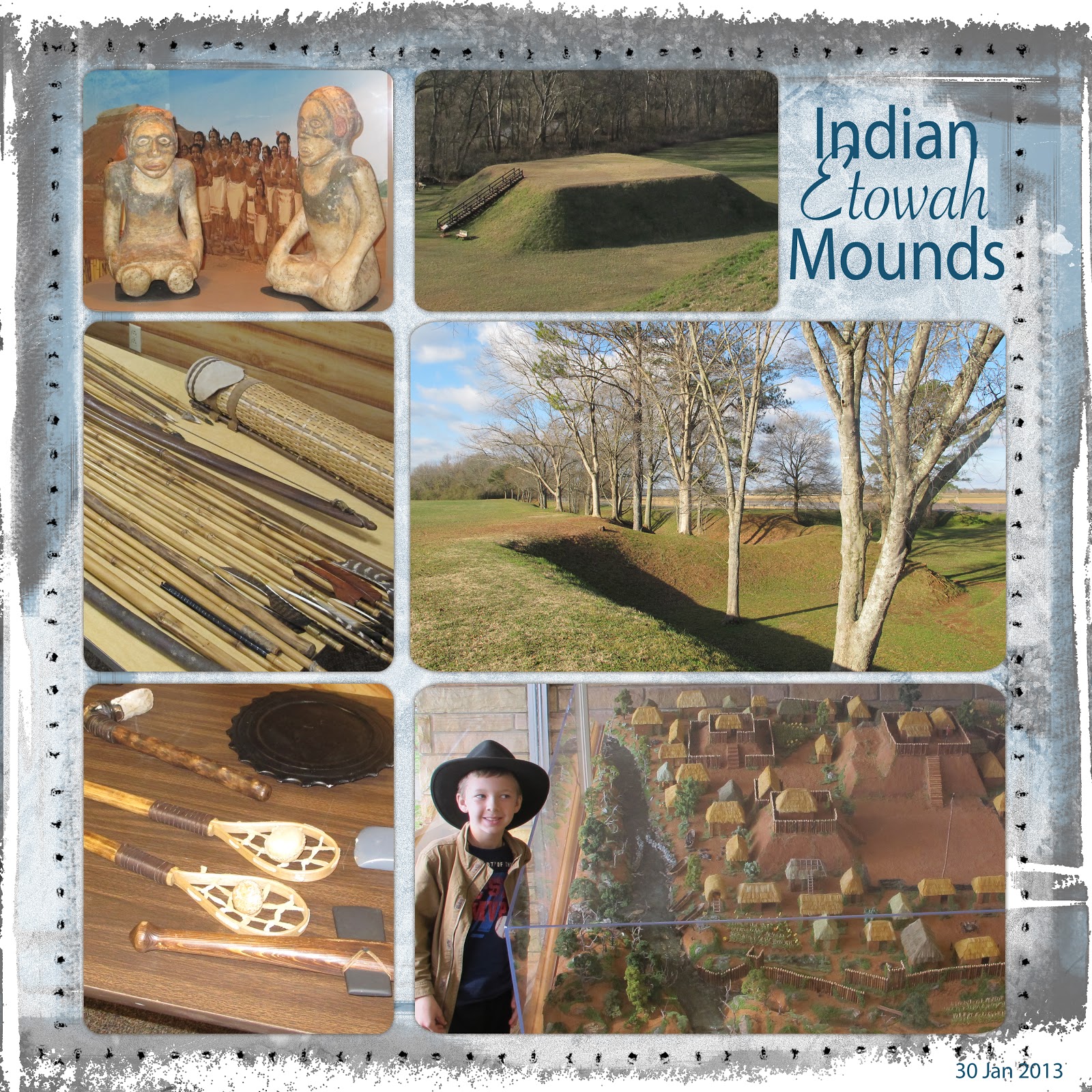
One of the highlights of the state parks was the Etowah Indian Mounds near Cartersville.  This major Mississippian Period Cultural Center was home to several thousand Native Americans from 1000 to 1500 AD. The largest mound stands over 63 feet high and covers three acres. The impressive archaeological museum interprets life in what is now known as the Etowah Valley Historic District.  Beyond the mounds lies the Etowah River and Pumpkinvine Creek where a V-shaped rock wall impedes the water of the rivers.  At least 500 years old, the wall is one of the lasting reminders of the Mississippian Culture who resided in this portion of Northwest Georgia.

Known colloquially as the mound builders due to the large earthen mounds, flattened on top for homes of the elite, the culture flourished at this site until the arrival of Hernando de Soto, who visited the area in 1540-41.  Those that survived the illnesses brought by the Spanish abandoned the site and eventually blended in with the nearby Creek Indians along with their agricultural skills and past times (lacrosse, for example).

Fortunately, we arrived shortly before a bus load of school kids.  The interpretive volunteer invited us to take part in the talk he would be giving them and we were able to get a sneak peak at some of the weapons and materials (not on display) used by the Native Americans prior to the arrival of Europeans.  We enjoyed this museum very much as it was a very distinct contrast to the way the Native Americans lived on the Pacific Coast.  While only 9% of the site has been excavated, examination of Mound C (pictured in the collage above) and the surrounding artifacts revealed much about the people who had lived here.  One of the things that surprised us, however, was the extent of their trade routes … artifacts include Obsidian from Central Oregon and Idaho as well as asphalt from the La Brea Tar Pits in California.


January 9, 20131

We are so very excited!!  Way back in September we were matched with four other families as part of a Worldwide Culture Swap … we had signed up in June and it took a few months to have enough families outside of the US to be able to put together a group.  In our group, the families represented England, Turkey, the US Virgin Islands, and Ontario, Canada.  We, of course, represented the United States, specifically California.

We shipped our boxes in late October – as agreed upon by the participants – and then we waited.  As the days and weeks turned to months, we were actually beginning to lose hope.  The communication with many of the participants had been spotty.  I was fearful that we wouldn’t receive a box in exchange.  We had spent quite a bit on the contents and even more so on postage so we were fearful.

I had taken part in an ornament exchange through another group with which I’m connected. The participants had agreed to send handmade gifts.   As such, I sent a dreamcatcher that I purchased when we were on the coast; though I didn’t make it myself, it was handmade and unique.  While I know it is the thought that counts, I can not say I was not disappointed in the ornament I received in exchange, a m&m novelty ornament with a mini-bag of m&m’s.   As a result, I was beginning to think that these online swaps and secret exchanges weren’t worth the effort.

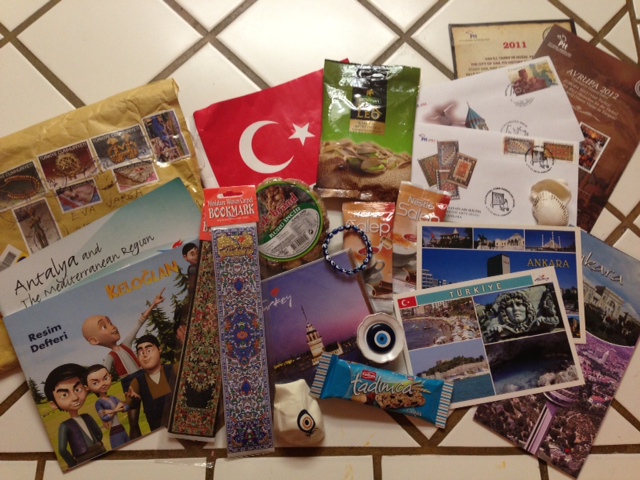
Imagine our surprise then when we received a notice in the mail that a package was awaiting us at the post office that required a signature.  We had nearly forgotten about the Culture Swap by now so when the clerk handed us the package, the first thing we noticed was the postage.  “Mom! Look at the stamps,” they both exclaimed.  “Wow!  It’s from Turkey!”

We were eager to get home and open our gift.  What a delightful surprise … a plethora of little goodies that gave us a taste for Turkey.

  • postcards
  • travel brochures and a mini magazine
  • travel DVD w/ commercials
  • snack bar
  • dried figs
  • pistachios
  • instant coffee (I think)
  • first day covers with turkish stamps – very cool!!!
  • a drawing pad with I presume turkish cartoon characters on the cover
  • a bracelet, a magnet, and a balloon with blue and white concentric circles – intrigued .. what does it mean?
  • a flag of Turkey
  • 2 woven bookmarks – beautiful!!

What a special swap box.  Indeed, it makes up for the two that have seemingly been forgotten.  Many, many thanks to Fatma and her boys!!


November 14, 20121

A friend of mine does a significant amount of traveling for his work and we recently received two postcards in the mail that he sent from the United Arab Emirates (UAE).  The UAE is comprised of seven emirates that share legal, political, military, and economic functions since 197.  Dubai has the largest population and is the second largest emirate by area, after Abu Dhabi (the capital). Revenues from petroleum and natural gas contribute less than 6% (2006) of Dubai’s $37 billion (U.S.) economy.  The majority of the emirate’s revenues are from innovative real estate projects, sporting events, and increasingly from tourism and other service-oriented businesses.

We completed our usual country fact sheet and spent a little time browsing topics that caught our attention:  architecture, food, and music.  The construction that has taken place in Dubai and Abu Dhabi in just the past 20 years is astounding.  We enjoyed browsing the photographs and artist renditions of the more well known sites featured here,  Dubai Architecture.

Arabic food is the main type of food in the UAE.  One of the most popular dishes is Shawarma, a dish similar to kebab that is made with lamb or chicken generally mixed with tomatoes, pickle, garlic sauce, and fries. Then they will wrap the mixture in a small Arabic roti  (a bread baked in clay ovens). Another favorite is falafel, an Arabic French fry that looks like a cutlet. They are made out of mixing chickpeas and different spices. Then deep-fry and served as a side dish. We are fortunate to have a new middle eastern restaurant in town and will be making a visit soon. 

We also enjoyed listening to several videos on YouTube that featured Bedouin musicians performing traditional music.  We really enjoyed it!

On a bunny trail … I recently read a great book by Diana Abu-Jaber called, The Language of BaklavaHer memoir weaves stories of being raised by a food-obsessed Jordanian father with tales of Lake Ontario shish kabob cookouts and goat stew feasts under Bedouin tents in the desert. Her anecdotal stories and recipes (Yes!!! Recipes) bring to life the two cultures of Diana’s childhood–American and Jordanian–while helping to paint a loving and complex picture of her father who, like many an immigrant before him, cooked to remember the place he came from and to pass that connection on to his children. The Language of Baklava is a wonderful story.  


November 1, 20122

After receiving our matches in early September, we have finally gotten around to shipping our boxes for the exchange.   The families we were matched had agreed to ship the boxes in October so could have time to accumulate the materials.  Initially, we were matched with four other families – U.S. Virgin Islands, Canada, England, and Turkey.  Sadly, the family from the Virgin Islands had to pull out so in the end we are exchanging with three other families.

Through our email exchanges, it was exciting to discover that our children have very similar interests.  Buddy even wrote a letter to one boy in hopes of starting a pen pal friendship as their passions were so similar.

As we gathered the material to fill the boxes, we made an effort to find products that are made here in California (almonds, raisins, prunes, Ghiradelli chocolate, & Jelly Belly jellybeans) as well as southern Oregon (cranberries) as we have strong ties there.  We also included several nuts and cones from local trees (Sweetgum, Walnut, Cypress, Redwood), a few postcards, a local magazine, a Disney lapel pin, cancelled US postage stamps and a couple first day issues (though not from the US, the covers we hope will inspire the other families to consider philately).

Already, this project has turned out to be very rewarding.  At the post office, it took some time to fill out the customs declaration form.  We hadn’t had to do this in the recent past (mailing only a letter or postcard overseas) so the kids were very inquisitive.  Their knowledge of the postal service will soon surpass that of an adult.

Our boxes are on their way.  We hope they enjoy their gifts. We are now stalking our postman in anticipation of the arrival of our exchange boxes.

Click here, if you would like to learn more about the Worldwide Culture Swap.


August 27, 20121

We discovered a wonderful book this week at the library, The Coast Mappers by Taylor Morrison.  In the mid-1800s, the U.S. Coast Survey authorized a survey of the west coast. As little was known of the topography of this area, the ships that sailed those waters did so at a considerable risk, sometimes depending on only a school atlas to navigate and all too often crashing into the rocks. So the U.S. Coast Survey, whose purpose was to map every mile of American shoreline, commissioned George Davidson to chart all of the major points on the coast and all of the waterways in between. In this beautifully illustrated book, Taylor Morrison chronicles the challenges and adventures Davidson and his team faced and the methods they used to accomplish this monumental, and essential, task.

Combining applied science with history and biography, the discussion follows Davidson and his companions through the years as they work toward their goal. About three-quarters of the book comprises Morrison’s attractive paintings and ink drawings. While the many illustrations suggest a younger audience, their sophistication and the text are better suited to older readers.  I thereby read this one aloud and will ask the kids to give an oral narrative to their father.  Included in the appendix are extensive acknowledgments, a bibliography, and a glossary.

The Coast Mappers provides a thoroughly enjoyable historical record of the early survey of the west coast of the United States. It is certainly one we will be adding to our personal library. We were fascinated by this historical account and were inspired to do a little more research on the topic.  If you are also inclined, here is a little peek at Davidson’s map of Monterey Canyon as published in 1897. 


May 14, 2012

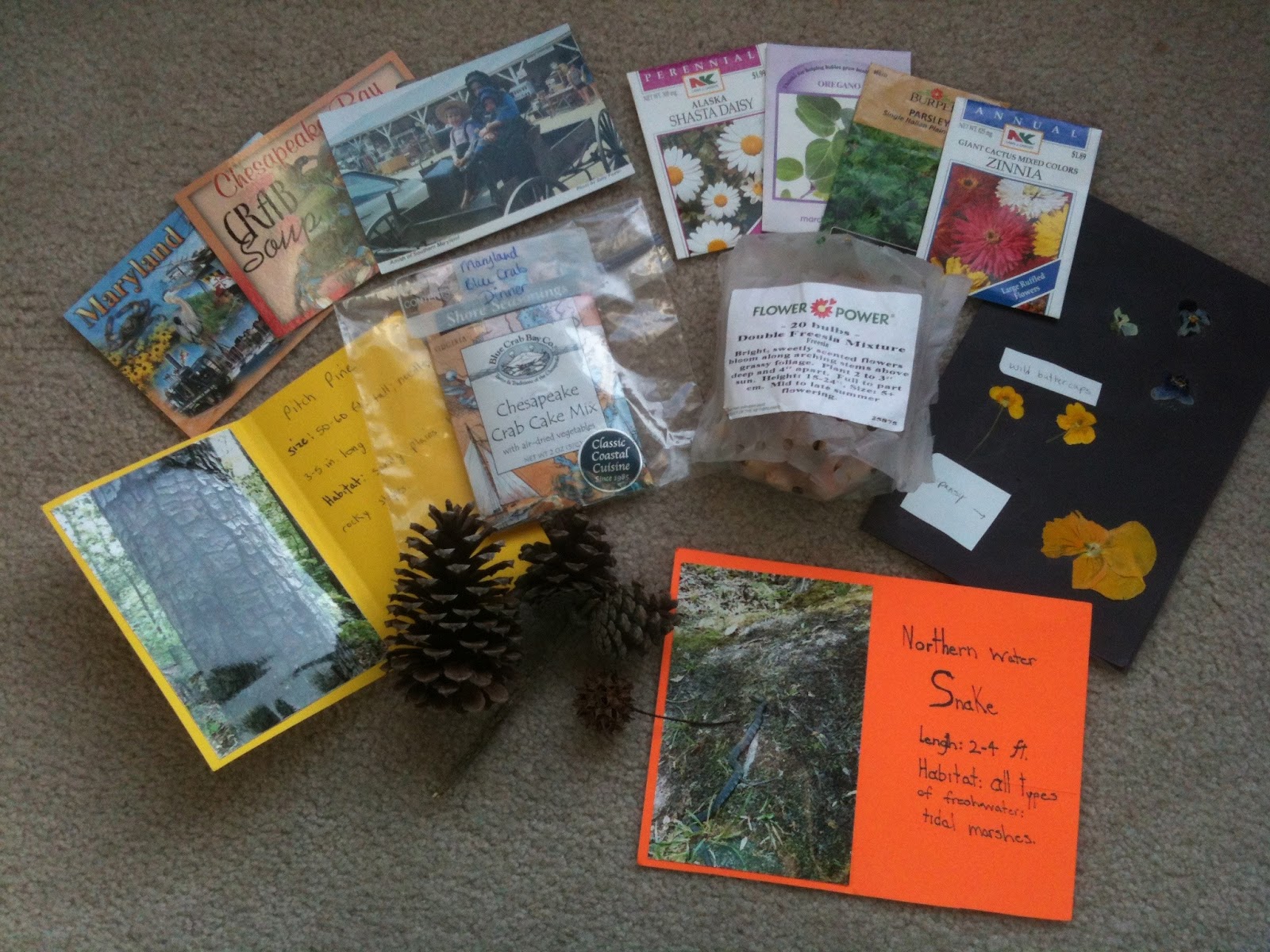
I wanted to be certain that I posted pictures of the wonderful boxes we received in the Environmental Exchange Box project that I coordinated in the spring.  To assure everyone who signed up had a partner in a region different than the one in which they resided, my kiddos and I ended up exchanging with three different families.  There was really no extra effort on our part … we just collected duplicates of everything we wanted to send. 

“Our “Maryland” box from 

Each box we received was very different in regards to what the families chose to send.  Some chose to include seed packets of wildflowers.  Others chose to include local food products.  Everyone included some travel brochures and information about their local region.

Our “Illinois” box from 

We enjoyed opening each box and take out each item one by one.  The contents of the boxes opened up a discussion about the similarities and differences between our environments.  We discovered, for example, that Lodgepole pine is found across the continent.

Our “Colorado” box from 
We were very pleased with the results of this project.  We hope that everyone who took part had a great time and learned a little more about the ecology of our country.  I encourage you to think of coordinating a similar project of your own.  We learned so much.  🙂