Geography - Eva Varga - Page 5


February 24, 20121
This week the clues we were given generated a discussion about time zones.  Buddy’s birthday is in just two days so he was particularly intrigued to learn that a baby born at the exact same time as he would have been born on a different date if he were born in Norway (for example).  

This year’s 10 Mystery Classes are located in eight different time zones.When daylight saving time occurs, the 10 Mystery Classes will be located in eight different time zones.  A photo captures a single moment in time. New York City’s famous Tourneau clocks show the local time—at a given moment—in different time zones around the world.  
Photo from Journey North

Time Zone Map from Journey North

Using the clues and data from Journey North, we were able to divide the Mystery Classes into northern and southern hemispheres.  This week, however, the munchkins realized they had made a mistake … #7 was indeed in the northern hemisphere but was near the equator, not near the North Pole as they had originally guessed.

Recap of our estimations thus far:

north pole … #5, #10, #1, #9, #3, home, #7 … equator … #8, #2, #4, #6 … south pole


February 18, 2012

Yesterday, we were able to position the 10 mystery class locations compared to our home location. We hope to have them in the right order. We will be able to verify once we receive more data. We now have 4 locations in the Southern Hemisphere and 6 in the Northern Hemisphere, our home is also in the Northern Hemisphere.

Journey North gave us a clue this week that helped us to place that unknown location by leaving us this clue:
Where Do I Roam? I’m Ursus maritumus. I have a clue for you. More than half of the Mystery classes are located in the same hemisphere where I roam. Can you figure out which ones, using the photoperiod data?


Photo from Journey North


February 17, 20121
I ♥ Facebook. One of the benefits of this popular social networking site is the ability to connect with friends and family.  Frequently, friends will post that their plans to travel. Alternatively, many will also post while on vacation from their destination.  When they do this, I am not shy to speak up and ask for a postcard.  

When a friend was in the Netherlands, Antilles for business a month ago, he was eager to lend a hand in our geography studies.  Not only did he send a couple of postcards, he also posted a picture on his Facebook wall of the mailbox into which he mailed the cards.  How cool is that?!

Map of the Netherlands (Europe)

When I showed the kids the photo, they immediately wondered if the cards had been mailed from Scandinavia as the red box reminded us of those we’d seen in Denmark.   I informed them that my friend was in the Netherlands Antilles and I shared another photo, one taken on a beach.  They were immediately intrigued.  “Weren’t we at an airport in the Netherlands, Mom?  Why does it look like Hawai’i?”  Indeed, we had to change planes in Amsterdam and we’d had a discussion that it was the capital of the Netherlands, sometimes referred to as Holland.
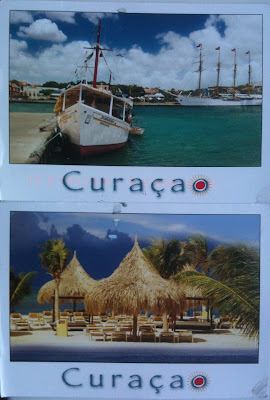
Our postcards
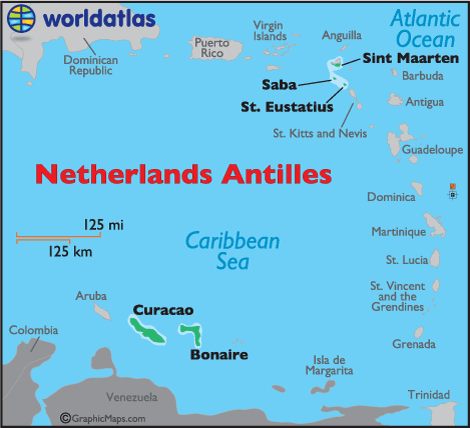
 The arrival of the postcards on Valentine’s Day lead to further intrigue.  “It does look like Hawai’i!” they exclaimed.  “So where is Curaçao?” 
Map of the Netherlands Antilles (Caribbean

Curaçao is an island in the Caribbean just north of Venezuela.  The island is a constituent country of the Kingdom of the Netherlands. Its capital is Willemstad. The official language is Papiamentu.  Though the origin of the island’s name is debated, it has a history rich in the slave trade and piracy, like most islands of the Caribbean. 

Upon researching the country for our fact sheets, the kids both proclaimed that they wanted to go there on our next tropical vacation.   If only we could win the lottery for they desire to travel to all the places we study.

A few recipes we’ll try soon.  🙂

KeshiYená (Stuffed Cheese) 
Adapted from The Jewish Kitchens of Curaçao
1 small Edam cheese (2 to 2½lbs)
2 lbs. shredded cooked chicken
3 tomatoes, chopped and peeled
2 sliced onions
1 garlic clove
1 chopped green pepper
¼ cup sliced olives
1 tablespoon capers
1 tablespoon parsley
¼ minced hot pepper (or hot sauce to taste)
½ cup raisins and chopped prunes
1 tablespoon tomato paste
2 teaspoons Worcestershire sauce
2 tablespoons ketchup
2 tablespoons mustard
Salt and pepper to taste
2 tablespoons butter
5 eggs
Slice the top off the cheese and reserve. Gently scoop out the inside, leaving a 1/4 to 1/2 inch shell. The cheese should resemble a hollowed out pumpkin. Sauté the remaining ingredients, except the eggs, in the butter; simmer for about 20 minutes. Beat 4 eggs and stir into the mixture. Spoon it into the cheese shell, replace the top and spread remaining beaten egg on top to seal. Grease a shallow baking dish and fill it with about 1 inch of water; set the cheese in the dish and bake at 350° F for 1 to 11/2 hours. The cheese will expand and flatten slightly but will keep its basic shape. Serve piping hot, cut into wedges. Leftovers are good reheated.

Funchi (Corn Meal Mush)

Adapted from The Jewish Kitchens of Curaçao
1 1/2 cups cold water
1 cup corn-meal
1 teaspoon salt
1/2 cup boiling water
1 tablespoon butter or margarine
Mix the cold water, corn-meal and salt in a heavy saucepan. Stir in the boiling water and butter or margarine. Bring to a boil and cook for about 3 minutes. Continue for another 3 minutes while stirring with a wooden spoon. Mixture is done when it pulls away from the sides of the pan and it is stiff in texture. Remove from heat and serve immediately.
Serves 4 to 6.
Tutu (Corn Meal With Black Eyed Peas)
Adapted from The Jewish Kitchens of Curaçao
1 cup corn-meal
16 oz. packaged dry black-eyed peas
6 cups water
3 cups water
1/4 cup sugar
1 teaspoon salt
3 cups funchi or corn-meal
4 tablespoons butter or margarine
Cook the black-eyed peas in the 6 cups water until soft. Drain.
Add 3 cups of water to the peas and bring to a boil, then use a whisk or “lele stick” to break the peas. Add sugar and salt and whisk again. Taste for seasoning, and adjust if necessary.
Add corn-meal, and in a combination of beating and mashing the mixture, blend it well to avoid lumps using a wooden spoon. Reduce heat. Continue the beating/mashing technique until the meal disappears and the mixture pulls away from the sides of the pan. Add butter when done and either invert on a platter or use an ice cream scoop (dipped in water before each scoop) for individual portions. Serve with butter and cheese.


February 12, 2012

We are taking part in  Journey North Mystery Class  once again this year – it will be our third attempt.  Life always seems to pull us away from this awesome project and we’ve never finished.  


Each week, the sunrise and sunset data from each of the ten mystery sites is reported.  We thereby plot the sunrise and sunset time for each site on a graph. As the weeks progress, we connect the dots and a line graph is generated, providing a visual of the photoperiod (hours of daylight) for each location.


At the end of week #2, we were able to sort our data between Southern and Northern Hemisphere. We are able to do this by checking which locations are gaining increasing their photoperiod (Northern) and which ones are loosing daylight hours (Southern). 

photo from Journey North Mystery Class


One location hasn’t changed its photoperiod. The kids presumed this one must be very close to the North Pole.  Here is a recap of our findings this week:


MC # 1 – Northern Hemisphere
MC # 2 – Southern Hemisphere
MC # 3 – Northern Hemisphere
MC # 4 – Southern Hemisphere
MC # 5 – Northern Hemisphere
MC # 6 – Southern Hemisphere 
MC # 7 – ??? – very close to North Pole
MC # 8 – Southern Hemisphere
MC # 9 – Northern Hemisphere
MC #10 – Northern Hemisphere


February 10, 20124

Have you ever marveled at the differences between the natural environments of your home region and those of areas through which you travel?  I know I do.  I grew up on the southern Oregon coast, lived in the Willamette Valley through college, and we started our family while living in central Oregon.  Even within this one small state, the ecosystems are varied and thereby the plants and animals that reside there are diverse.   I now live in Northern California and I am amazed at how distinctly different the ecology is here.

To celebrate the diversity of the regions in which we live, I am organizing an exchange activity.  However, I will need your help.  I don’t have many followers so you’ll need to help spread the word.  I’ve also shared the project with my local homeschool community.   The activity is based upon Project Learning Tree‘s activity #20, Environmental Exchange Box (click upon the link for the PDF of the lesson plan).   Follow this link for visual ideas, PLTs Forest Exchange Boxes.

Essentially, each family puts together a box of things found in your local natural environment … a selection of pressed leaves and flowers, seashells, seeds and cones, a vial of sand, feathers, a few stones, a sound recording of local birds, stories the kids have written about their favorite things to do in their area, photographs, samples of non-perishable regional foods (maple syrup, walnuts, etc.), and/or  copies of newspaper clippings relating local environmental issues.

We can also use a webcam and/or YouTube to facilitate the exchange – allowing the students an opportunity to interact with their exchange partners to explain the contents of the box they prepared.    What you select and how you organize your box is up to you.  Be creative!

Everyone wishing to participate would be given the address of another family to whom to send their box. You mail a box just once.

Those interested in taking part should submit the information below via email.  I will thereafter assign each participating family a partner family with whom to exchange boxes.

  • Name
  • School Name (if you have one)
  • Address
  • Telephone Number (include area code)
  • Age of Students
  • Email Address
  • Preferred state or region with which you would like to exchange (not guaranteed)

This exchange project has concluded.


October 28, 20115

We’ve been to Chinatown before … in Vancouver, New York, San Francisco and even Portland. As the kiddos are learning Mandarin, it is an opportunity to practice their language skills as well as experience a tiny bit of another culture.  We thereby visit whenever the opportunity arises.  Thus, our visit to San Francisco last week was not complete without spending a portion of the day in Chinatown.  This time, we visited a few new places … both of which the munchkins have asked, “Can we stop here every time we come to Chinatown?”

When we first left the motel on 2nd and Howard, Sweetie asked if she could hold the city map.  I asked if she wanted to be the navigator and she exclaimed with glee, “Yeah!”  We led us to the Children’s Creativity Museum and from their she directed us to Powell Street Station to catch the cable car.  I was very impressed with her sense of direction.  Upon boarding the cable car, she was careful to read each street sign and signaled to us when we had arrived at Jackson Street, where she felt we should get off.

Fresh frog legs, anyone?

We walked two blocks – stopping briefly when anything unusual (at least us) and then turned onto an alley where we immediately found the San Francisco Fortune Cookie Factory.  It is literally a hole in the wall … located on Ross Alley, it is one of the oldest fortune cookie companies in San Francisco.  If you are looking for a tourist attraction (i.e. a tour), gourmet fortune cookies, single cookies, or picture taking opportunities (they charge 50 cents) – this place is not for you.  If you are looking for a tiny shop, free samples, flat cookies, cookies in bulk, or great customer service – you’ve found the right place.

The Golden Gate Fortune Cookie Factory

Within a few paces of the entrance you can see fortune cookies being made right in front of you. First, the thin circular cookie is pulled off a hot press. Then, a fortune is placed on one side of the hot, flat dough. Next, each soft, hot cookie is shaped over a steel rod into the shape of a fortune cookie. This process must be done very quickly, otherwise the cookie will harden before it has the right fortune cookie shape. When you are inside the factory, you will be amazed at how quickly the fortune cookies are made.  An elderly man was at the entrance giving us free samples of warm cookies fresh of the grill.  We watched for a few minutes while enjoying our samples and then before departing, purchased a bag of flats for ourselves.

Enjoying their first tea sampling at Aroma Tea Company

From there we wandered about, going into shops that appealed to us including a coin / jewelry store that had solid gold coins.  Buddy wanted to buy one of course but it was several thousand dollars.  He settled for a gold-colored U.S. dollar coin instead … an even exchange.  Sweetie found the Aroma Tea Company and saw that the sign said, “Free Tea Tasting” so she asked if we couldn’t take part.  We sampled three types of tea and purchased two.  Great idea, Sweetie!  My stop was to a book store where we purchased a few children’s books and a tablet for each of the kiddos to practice writing their characters.

Another delightful afternoon exploring and learning.  Life is good.