Book Review - Eva Varga - Page 4


August 1, 20131

What is a fallacy?  The very first sentence of the book defines it as “an error in logic — a place where someone has made a mistake in his thinking.” Sometimes unintentionally, but sometimes these fallacies are used intentionally to mislead others — consumers, the general public, and as you’ll see, even your family.The Fallacy Detective: Lessons in Logic - A Book Review @EvaVarga.net

The ability to recognize fallacies is important and we have thereby been working through the lessons in The Fallacy Detective as a family these past few months.  We typically bring it along with us on road trips and I read aloud the lesson, chuckling at the clever illustrations and anecdotes.  The lessons are presented in such a way that even my 8-year old son understands the material.  Let me share with a funny story relaying our lessns in logic detection.

Thus far, our favorite fallacies are the “Red Herring” and “Special Pleading”.  We have come to discover that a couple of us use these tactics regularly to varying degres of success.  Upon completing the exercises in The Fallacy Detective, we now recognize them as errors in logic and eagerly call one another it, much to their chagrin. I love it when my 8 year old, in the midst of a disagreement, yells out, “Red herring!!”

While driving north to Oregon recently, we departed early and my daughter was too excited to eat breakfast.  She thereby brought along an apple to eat in the car despite the fact that eating in the car is not permitted.  Her father is very adament about this and we’ve had many family related arguments discussions.  About forty minutes into the drive, she begins to eat the apple and of course her father (who is driving) reminds her of the rules and reprimands her gently about her failure to follow through.  She apologizes and carefully wraps the core in a tissue to discard at our first stop.

We continue on our drive and I read aloud the Lesson 6 – Special Pleading.  We work through the exercises easily and continue to the next lesson, Ad Hominem.  About 2 1/2 hours into the drive, we stop for fuel and as we are only about 15 minutes from our destination Dad suggests we go through the drive-thru at Carl’s Jr for lunch.  “We can bring it to the campground and eat there before we unpack. I know we are all hungry and we won’t want to delay eating once we get there.”  We all agree it is a sound idea and thus we order our usual as our bellies begin to growl with anticipation.

No sooner do we pull back onto the road and Dad asks me to hand him his burger.  Say what?!

“We don’t eat in the car!” we exclaim in unison as we all remind him.

“I know but I am very hungry.  I wouldn’t have suggested it otherwise. I know we all want to get there as soon as possible.”

“Well, can we eat ours then?” we asked.

“No!  We don’t eat in the car.  I am just very hungry and I’ll have to unpack when we get there,” he states.

“Special pleading!!” the kids yell out.

“You got mad when I ate my apple, Dad.  You can’t eat a messy burger!!”

Awesome!  I love how the lessons in The Fallacy Detective have come to life for us.  The Bluedorn brothers have put logic into an assessable, easy to teach, easy to learn format that has clear examples and plenty of exercises for review.  It is an excellent book to introduce lessons in logic and critical thinking.

I was not compensated for this review.  I purchased the book myself because it appealed to me and it fit our current curriculum.  The opinion shared here is honest and is solely my own.


June 21, 20134

One of my goals as a science educator and homeschool parent is to pass on to children a love for science and for learning.  I am often asked what books I would recommend for particular science disciplines.  What books do I most enjoy sharing with my own children?  Which books are the living books?  First coined by Charlotte Mason, living books are described as “… complete works, firsthand sources, classics, books that display imagination, originality, and the human touch.” 

Charlotte Mason did not give us a list of the hundred best books, nor did she compose a checklist of what to look for in a living book.  Along our homeschool journey, I have therefore looked for living books for science that were not only of high literary quality, but that also communicated important knowledge about a given subject, especially biography, science, nature, and geography.  I’ve compiled some of my favorite books for you here – books you’ll enjoy reading again and again.

Biographies

Giants of Science series by Kathleen Krull

This is a great series of books about some of the most recognized names in science including Albert Einstein, Marie Curie, Leonardo da Vinci, Isaac Newton, and Sigmund Freud.  Amusing comic illustrations accompany the text and Krull’s anecdotal stories bring each scientist to life.

Chemistry & Physics


The Periodic Table: Elements with Style!

There are numerous books in this series by Adrian Dingle. When I taught a chemistry unit with my kiddos a year ago, they devoured these. The Periodic Table introduces budding chemists to the world of the elements with wit and humor while also presenting factual information.

Nature


Books by Jean Craighead George

One of my all-time favorite authors, George has been the recipient of many literary awards.  My Side of the Mountain, the story of a boy and a falcon surviving on a mountain together, was a 1960 Newbery Honor Book.  Growing up in a family of naturalists, it is no wonder her books resonate with a love of nature.


Books by Jim Arnosky

I enjoy Arnosky’s books as much for the text as I do the illustrations. An artist and naturalist, his accurate illustrations, and his attention to detail makes it easy for children to see how carefully nature has designed plants and animals to function in their natural habitats. “I prefer to show rather than tell,” he explains, “to teach rather than preach, to guide rather than simply warn. In showing my readers what I look for in my ramblings, I hope that they will keep an eye out for such things and make discoveries of their own when they are outdoors.”


Joyful Noise: Poems for Two Voices

Written to be read aloud by two voices ~ sometimes alternating, sometimes simultaneous ~ this collection of charming poems celebrates the insect world, from the short life of the mayfly to the love song of the book louse. I found an audio version to which we listened first – and then we had a blast reading them together.

Who’s Been Here series by Lindsay Barrett George

My children have enjoyed this series of books since they were toddlers.  I would often read one aloud prior to a nature outing.  Then as we began to explore, I would point out signs of wildlife and ask the kids, “Who’s Been Here?”  Slowing down to look at small details, the kids began to ask question and make hypotheses of their own.

Birds Every Child Should Know by Neltje Blanchan

Originally published in 1907, Birds Every Child Should Know is a collection of storylike descriptions of more than one hundred birds commonly found in the United States.  Detailed descriptions of birds—their physical attributes, calls, nesting and mating habits, and other behaviors—read almost like fairy tales.  My daughter loved this book.

Geology & Geography

Books by Bryd Baylor

Bryd Baylor is one of my favorite children’s authors.  She lives and writes in Arizona, presenting images of the Southwest and an intense connection between the land and the people. Her prose illustrates vividly the value of simplicity, the natural world, and the balance of life within it.


The Coast Mappers by Taylor Morrison

I discovered this book quite by accident but upon reading it, wanted for my own collection.  In this beautifully illustrated book, Morrison chronicles the challenges and adventures the US Coastal Survey team faced and the methods they used to accomplish this monumental, and essential, task.

Astronomy & Space


Books by Gail Gibbons

Gibbons is another wonderful and prolific writer of children’s books. The titles I have in my own collection include, The Moon Book, The Planets, and The Reason for Seasons.  Her clear writing style and the accompanying illustrations help to explain concepts that are difficult to grasp. I’ve used these books to help dispel misconceptions with adults.


Seymour Simon books

The author of more than 250 highly acclaimed science books, Simon has been called the ‘Dean of Children’s Science Writers”. He uses his website, SeymourSimon.com, to provide free downloads of a wealth of materials for educators, homeschoolers and parents to use with his books.

Do you have a favorite science living book or children’s science author?  I would love to learn of new authors or books.  Leave a comment  below and let me know.


May 29, 20136

Dragonflies are one of the most colorful and fascinating insects in the natural world, so it’s not surprising that there are folks out there who stalk them with the same fervor as birders.  A leading dragonfly stalker in California is a woman named Kathy Biggs.  She has  published a field guide called Common Dragonflies of California, filled with full color, close-up photos of this incredible insect.

12-Spotted Skimmer - Libellula pulchella
Photo by Roxanna Tessman

California Dragonflies

So far 118 dragonfly species have been found in California. Shasta County is home to 77 species, the highest count of any county in the state. Siskiyou County is not far behind with 69.  Biggs says this high dragonfly count in our part of the state is due to a number of factors that include more water sources and a relative abundance of undeveloped land. Dedicated dragonfly enthusiasts are drawn to the northern part of the state to find species they can’t find elsewhere, like the dragonfly known as the American Emerald which has bright green eyes.

Eight-spotted Skimmer - Libellula forensis
Photo by Roxanna Tessman

Summer is the peak season for viewing dragonflies – just bring along an insect net, binoculars, and a hand lens for close-up observations. Unlike butterflies and moths that have scales on their wings, the dragonfly can be trapped in a butterfly net and gently lifted out by its wings without causing harm.

Biggs has also written an eGuide, Dragonflies of California and the Greater Southwest A Beginner’s Guide, that can be used on a mobile device like the iPad, Kindle, or a smart phone.  In addition, she has created an educational coloring book used equally by kids and adults, Dragonflies of North America: A Color and Learn Book With Activities.

I was graciously given a copy of Common Dragonflies of California for this review and giveaway.

a Rafflecopter giveaway

The dragonfly photos featured in this post were taken by Roxanna Tessman.  Like her Facebook page, Bird Watching in Oregon, to see more of her stunning photography.


April 15, 2013

We love to listen to audio books in the car.  You’d hope that we could always agree on a title, and sometimes we do.  Especially when we have found a series we enjoy and can’t wait to hear the next installment.  Generally, however, we argue about which one we will listen to first. We all have our favorites you see. We generally pick out titles with which we are familiar, but on occasion we stumble upon a new title that jumps out at us and grabs us as if to say, “Read Me!  You Must Hear My Story!”

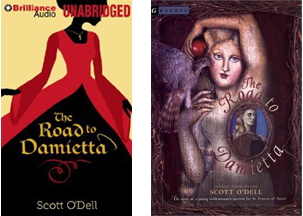
One of my favorite authors growing up was Scott O’Dell.  I loved his book, The Island of the Blue Dolphins and for many years, dolphins were my favorite animal.  While browsing the audio titles at the library last month, we came upon a title by O’Dell that I was not familiar, The Road to Damietta.  I absolutely love historical fiction and when I read the book jacket, “Rich in the atmosphere of thirteenth-century Italy, The Road to Damietta offers through Ricca di Montanaro’s eyes a new perspective on the man who became the famous Saint Francis of Assisi, the guileless, joyous man who praised the oneness of nature and sought to bring the world into harmony. “Lord, make me an instrument of Thy peace,” he said. “Where there is hatred, let me sow love, where there is injury, pardon; where there is doubt, faith; where there is darkness, light; where there is sadness, joy.” ”  We indeed must read this book I proclaimed to the kiddos.  It seemed the perfect choice for us … Scott O’Dell, love for nature, historical context (despite the fact that we study history chronologically and we were presently in the 1800s), etc.

The cover on the left is for the audio version. The cover on the right is for a print version.

I really enjoyed this book but there were a few things that took me by surprise and I wish I had known before I had selected this as an audiobook for my children.  I do not believe books should ever be banned, however, I do believe parents have the right to screen what their children are exposed to.  I’ve never worried too much about this as we have a pretty relaxed and open dialogue with our kids.  My children have not ever experienced nightmares and enjoy watching movies with scenes that many of their friends find frightening.  As a parent is our responsibility to protect our children and if at all possible screen movies and books until the child is old enough.  I wish I had had a little inkling of what The Road to Damietta held for us … not because of images that were frightening but because it brought to the surface adolescent love and some vocabulary that I just wasn’t ready to expose my children.

Through Ricca di Montanaro we see the vibrancy of 13th century Italy. The pettiness of the noble and merchant classes, the undercurrent of treachery in the church, and the breathtaking beauty of an already ancient landscape. In the beginning, Ricca and her friend, Clare, swoon over Francis Bernardone’s playboy antics. But when Francis infamously strips naked in the public square and takes a vow of poverty for Christ, their paths diverge.  What took me by surprise, was that Ricca also partly disrobes in the public square causing quite a stir with the noble class, particularly Ricca’s father.  Her father sends her to anItalian convent and even then she cannot shake her conviction that Francis will change for her, if she can only prove her love.

Her continued obsession with Francis disregards completely his devotion to peace, nature and God. Her jealously of Clare’s burgeoning involvement with Francis’s way of life is one of many clear illustrations of just how blind her 13 year old mind is to his commitment. Soon, all of Italy is religiously obsessed: the Fifth Crusade has begun. The Road To Damietta is a journey that Ricca undertakes to follow Francis, and it ends in heartbreaking realizations for both of them.

I don’t want to give too much of the story away.  It really is a very lovely book and we enjoyed the story and the historical context.  However, I want my readers to be aware of another surprise I encountered.  Along Ricca’s journey, a vocabulary word is introduced for which I wasn’t prepared. My kiddos usually allow words they are not familiar with to pass them by and likely picking up meaning with context clues.  This time, however, my children asked, “Mom, what is a brothel?”  Hmmmm.  This wasn’t something I was ready to explain to my 10 and 8 year old.

With the few little surprises set aside, there were many things we enjoyed about this book.  One of the things we most enjoyed about this book was the fact that Ricca was training to illuminate manuscripts. As O’Dell describes Ricca at work, he brings to life the artistry and tediousness of her work.  My kids enjoyed googling illumination and looking at images from ancient bibles and even more modern twists on this beautiful art form.

We also enjoyed learning about the contrasting lifestyles of the noble class, merchants, and peasants of 13th century Europe.  I wish I had read aloud this book (and thereby screening out a few passages) when we were studying the crusades for Ricca & Francis’ story helped us to better understand the motives and feelings of the common people during this tumultuous time.

I often try to capture the spirit of a book that touches us by integrating other subjects – art, music, cooking, and if possible, field trips.  This time, I was inspired to provide the kids with an opportunity to illuminate a favorite verse or quote.  We had done this in the past but neither remember it very well and even then, I realized they were too young for the intricate work.

When we were at the Multicultural Faire last week, the Sons of Italy had a fun trivia game prepared with informative posters along the wall.  One poster was of Saint Francis of Assisi and the kids enjoyed sharing with the lodge members about what they knew of him.  They were quite surprised and looked up at me during the conversation to ask, “Do you all homeschool?”  It is a question I hear often.  To my delight, homeschoolers are indeed making a difference and changing societies perception of what is possible.


December 22, 20124

We love snow.  When we lived in Central Oregon – we were delighted with each snowfall.  Living now in Northern California, we don’t get to enjoy as often.  Mount Shasta is just far enough away that it would be a full day outing if we desired to go skiing whereas Mount Bachelor was near enough, we could go for just a few hours and still have time enough in the day for other errands or activities.  The first year we lived here, sadly, there was very little snowfall – even at Shasta.

Mt. Shasta shrouded in clouds as viewed from our deck.

When the snow fell this week – we were both delighted and heartbroken.  My father, brother, and sister-in-law were planning to drive down to spend the weekend with us for Christmas.  I-5 was closed off and on all through the end of the week and through the weekend. Even with chains, the delays and closures forced them to stay home.  As a small consolation, the kids and I chose to curl up with a few holiday books and do a little nature study to take advantage of the snow fall which coordinated perfectly with the Outdoor Hour Winter Snowflake Challenge.

Science Literature

One of the books we read was Snowflake Bentley by Jacqueline Briggs Martin. We’ve read it before but I learned that Buddy didn’t remember it so it was a new discovery for him (not surprising when you read my previous post and discover what what he was focused on that day).  Winner of the 1999 Caldecott Medal, it tells the story of Wilson Bentley.

From the time he as a small boy, he saw snowflakes as tiny miracles and was determined to capture these small wonders on film. His work and dedication revealed two things – no two snowflakes are alike and each one is based on a six-pointed crystal.

After the story, we watched a Brain-Pop video on snowflakes and googled snowflake images.  We had wanted to capture a few flakes to observe under the microscope, but it had stopped snowing by now and the snow on the ground was wet, melting off by early afternoon.  We noted, therefore, that we had an easier time illustrating snowflakes than Bentley would have.

Nature Journaling

We recorded in our journal that since the angle that the individual atoms in water form is 104°, ice freezes into a roughly hexagonal molecular lattice. This six-sided crystalline shape is reflected into the snowflake’s overall shape, causing snowflakes to have a 6-fold symmetry.  Here is a fun video from Khan Academy to help illustrate this fact, Snowflakes, Starflakes, and Swirlflakes.

Our nature journal entries … sadly, the image is not very clear. 

Coincidentally, we had created numerous paper snowflakes earlier in the week to send to Sandy Hook Elementary School.  Members of the school PTA are coordinating an effort to convert the new school students and staff of Sandy Hook will be housed in after the holiday break into a winter wonderland.

I love that as unschoolers, we were able to “seize the moment” and thoroughly integrate our curricular studies:  nature, science, writing, literature, biography, math, art, and service learning.  It was indeed a full day of learning but took only an hour or so of actual clock time.


September 6, 20121

I have loved the stories of Hans Christian Andersen since I was a little girl.  I remember very clearly listening to my dad read aloud Tumbelina as he tucked me into bed at night. To this day, it is one of my favorite stories. You can imagine my delight when I finally got to “meet him” while we were in Copenhagen last May.

Scherenschnitte with Hans Christian Andersen @EvaVarga.netHans, as I will affectionately refer to him here, was known not only for his skill at storytelling, but also for his ability to cut intricate paper designs.  Remarkably, he would entertain guests by snipping away at paper while he orally told his stories.

At the conclusion of his story, he would reveal the delicate image he had been cutting. Most often, the image he cut told a pictorial story completely different from the one he told in words and his audiences were amazed.

History of Scherenschnitte

Papercutting has a long history dating back to ancient Chinese who used it to form stencils to decorate fine silks. The technique likely found its way to Europe in the early 17th century through trade with Asia.

The term “Chinese shadow” was originally used but was replaced by “silhouette” in France when a banker, Etienne de Silhouette, lent his name to the term. As the minister for finance of Louis XV, he proposed that the king should commission only black-and-white shadow portraits instead of expensive oil pictures.

In France it was originally a bourgeois art but soon became a favorite pasttime for everybody.  Famous artists like Philipp Otto Runge, Adolph von Menzel, and Goethe and later well known artists, such as Matisse and Picasso, created art using this technique.

Scherenschnitte with Kids

Kids are generally familiar with the art of paper cutting – having made paper snowflakes to adorn their windows in winter. However, scherenschnitte is an art that can be enjoyed year-round.

I recently introduced our Barnesklubb kids to the scherenschnitte work of Hans Christian Andersen and was delighted with the number of families that turned out for the activity. I began by reading aloud his short story, The Beetle, which he wrote in 1861.

Upon concluding the story, I revealed to the kids a beetle that I had cutout previously [alas, I would not have been capable of doing it simultaneously].  I also shared with them the book featured below; the kids were all intrigued and spent the next hour trying their own hand at paper cutting.

Author Beth Wagner Brust tells the story of Hans Christian Andersen as an artist, describing how and why he made paper cuttings, which, like his tales, were innovative and original. His work is striking – the cutouts, typically from white or light-colored paper, are set off by dramatic black backgrounds. The accompanying text outlines the major events in Andersen’s life, from his childhood in a slum of Odense to his later career as a celebrated writer.

Scherenschnitte Tutorials & Templates

If you are interested in learning more about this fascinating and ageless art medium, here is a great tutorial:

Cindy Bean, the artist in the video has also graciously provided numerous templates on her website, Scherenschnitte, that you can download for free to help you get started. Here are a few of our favorites:

Please leave a link in the comments if you have given this art a go yourself.  We love to be inspired by others.