Nature - Eva Varga - Page 4


May 13, 20133

Of all the National Parks we’ve recently come to know, I would have to say Zion is one of my favorite.  It just seemed more accessible to us.   Zion is Utah’s first National Park and within the park boundaries, visitors can enjoy a multitude of hiking adventures suitable for all ages.

Follow the paths where ancient native people and pioneers walked. Gaze up at massive sandstone cliffs of cream, pink, and red that soar into a brilliant blue sky. Challenge your courage in a narrow slot canyon. Zion’s unique array of plants and animals will enchant you as you absorb the rich history of the past and enjoy the excitement of present day adventures.

We would have loved to hike the Narrows, but circumstances (most notably time and lack of advanced planning) prevented us this time around.  Instead, we enjoyed several shorter hikes including the Lower and Upper Emerald Pool Trails, Grotto Trail, Kayenta Trail, Weeping Rock Trail, and Riverside Walk.

IMG_8972We spent an entire day exploring the canyon and discovering Zion National Park more intimately. The weather was perfect and we had the chance to see many wildflowers in bloom and wildlife sightings – including a Mountain Goat!  As we had done at Death Valley and Grand Canyon, the kids enjoyed completing the activities in the Junior Ranger book while we rode on the bus and during intermittent breaks throughout the day.

Zion National ParkZion National Park features stunning scenery, sandstone cliffs among the highest in the world, diverse plant and animal communities, and Ancestral Puebloan, Paiute, and Mormon pioneer history. It’s a wonderful outdoor classroom for homeschoolers and school groups. In addition to the Junior Ranger program, the park has also developed several FREE curriculum materials, Zion National Park Curriculum Materials, to help educators bring their students to Zion, or alternatively, bring Zion into your home or classroom.  We look forward to exploring the geologic processes in more depth with the aide of the lessons and materials developed by the park. 


May 6, 2013

When visiting our nation’s National Parks, we always try to take advantage of one or more ranger led program, depending upon the amount of time we have available. At the Grand Canyon, we were able to take part in a guided hike in search of fossils, an evening program and book signing, and a condor talk.  I share with you the highlights of the programs in which we took part.

Grand Canyon

Fossil Walk

We enjoyed a delightful presentation by a young ranger who began by describing to us the geological processes that formed the Grand Canyon. She was an excellent presenter and captivated even the youngest of listeners.  Sweetie was very engaged in the talk and was eager to take notes to write a blog post of her own.  I’ll allow her to summarize what we learned, Dude! Can You Identify the Layers of the Grand Canyon? fossils at grand canyon

Condor Talk

The condor talk took place along the rim trail just outside the Kolb Studio.  The ranger spoke about the plight of the California Condor, North America’s largest bird, that inhabits northern Arizona and southern Utah, coastal mountains of central and southern California, and northern Baja California.  He touched upon the variety of causes that have contributed to the condor’s decline and to the successful efforts that have brought this majestic species back from near extinction.   To our delight, just as the talk was wrapping up, three condors made their appearance, rising up from the valley, as if upon queue. Sadly, I wasn’t able to capture this moment with my camera but Sweetie was ecstatic.

Junior Ranger Program

In addition to the ranger programs, when traveling with children, we always seek out junior ranger opportunities. The Junior Ranger Programs are activities prepared especially for 5–12 year old visitors to the parks, providing activity books (which are generally free) that direct children to areas they might otherwise miss, or to things of special interest to the age group.  To earn the ranger badge, participants are encouraged to take part in a ranger program. After completing the specified amount of pages for the child’s age group, the participant is awarded a patch, badge and/or certificate unique for each park.

fossil walk

Have your children explored the Junior Ranger Programs? What park has been their favorite?  Did you know there are Web-Ranger opportunities as well?


March 29, 20133

My daughter has a fascination with fungi. Surprisingly, though, she doesn’t like to eat mushrooms. Each time she discovers a mushroom, fungi, or conch in the wild, she’ll giggle as she reminds us of her culinary tastes. When she does, it always reminds me of our holiday in Kauai in 2006 when she found a stuffed octopus at a gift shop and fell in love.  She named him Foamie and as we walked to the counter to purchase it, she was hugging him and said, “I like octopusses.  Octopusses are nice. But I not like to EAT octopusses.”  I’m not certain if she was speaking to Foamie or to me, but it was the cutest thing I think I’ve ever heard her say. 

Over the past few weeks, while spending time outdoors, we have been purposely looking for fungi more so than usual, knowing that it is the focus of the Outdoor Hour Challenges this month at Handbook of Nature Study.  We have found many examples on our recent walks and look forward to pursuing this course of study more fully in the weeks to come.  Sweetie, in fact, has asked that I order a slime mold kit from Carolina Biological for a science experiment she has in mind.  We are still researching and learning to identify our discoveries, but I wanted to share them with you now.  Perhaps you can help us identify a few?

Our favorite discovery is pictured in the top middle, Orange Jelly (Dacrymyces palmatus), which we discovered on a decaying Douglas Fir branch.  The only other one we have been able to identify thus far, and this is a guess, is the one pictured in the bottom right, Pin Mold (Rhizopus oryzae). 

This post is linked to the Outdoor Hour Blog Challenge hosted by Barb at Handbook of Nature Study. We always have a wonderful time following her suggestions for studying nature.  


March 26, 2013

At archery class last week, we moved the hay bales (targets) and to our delight discovered a small group of millipedes who had taken up residence beneath the bales.  Sweetie was quick to make friends and Buddy followed suit behind her.  It gave us a chuckle when we discovered that their instructor, a young many in his late teens/early twenties was too apprehensive to hold one himself.

Millipedes have two pairs of legs on each body segment and are thus sometimes called “1000 legged”.  They have a rounded body and head from which short antennae can be observed.  They vary in length and color.  Most millipedes are herbivores and are found under decaying logs, stones, and leaf litter in moist soils.  They perform a beneficial service to the environment, shredding plant material that has fallen to the ground creating more food for fungi, bacteria, and other small organisms.  Though they have a hard exoskeleton for protection, they will also curl up into a coil when threatened and sometimes secrete a yellowish liquid to deter predators.  

Though they seem unpleasant to some people they are not dangerous.  They do not bite and they perform a valuable service for humans, eating decaying plants and returning the organic matter to the soil.  Because they live in burrows beneath the ground and below decaying logs and leaf litter, they do not use their eyes and prefer dark spaces.  Some scientists believe they may be blind for they will tap the ground as they move forward, much like a blind person will use a cane.  Though their hard exoskeleton provides some protection against predators, they will curl up into a ball when threatened and sometimes secrete a yellowish liquid that can be harmful to some small predators (harmless to humans).

We have seen these fun critters a few times at the High Desert Museum and at a friend’s house when we lived in Central Oregon.  This was the first time we had come across them in the wild ourselves.  They brought smiles to our faces and provided a great opportunity to journal the discovery.


February 8, 20131

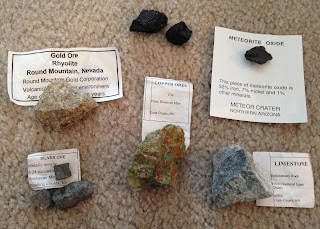
A recent field trip to Georgia (with a hop over to Alabama) inspired us to delve into rocks and ores a little more [see our post, The Mining of Iron Ore, for more detail].  Serendipitously, it also coincides with a relatively recent challenge, Outdoor Hour Challenge Blog Carnival: Rocks Edition.

Ore samples selected from my collection
The munchkins’ sketches

We began by gathering a number of ore samples from my extensive rock collection.  As a former classroom teacher (science specialist), I have had the opportunity to amass a rather good collection of rocks and minerals.  Many are already labeled for me (as shown above) and have been divided into sedimentary, igneous, and metamorphic rock.  Sadly, however, geology is not my strong suit and the collection mostly collects dust.  I really need to get it out more often and do more activities with the children.

After selecting the ore samples, I read aloud excerpts from How Stuff Works “Iron Ore” describing how the ores are mined as the kids worked on sketching each sample.  It was fascinating to learn how they are then processed in refineries the world over.  After we finished our sketches, the munchkins summarized the process in their journals.


January 11, 20133

For the second year in a row, we have hiked into an area of Whiskeytown National Recreation Area to discover ladybugs.  The year before we moved, the Roots & Shoots group that we now belong had hiked in for the first time.  In this short, three year span, our group leader has observed a significant decline in the number of ladybugs present.  The decline has been so significant, even the kids could recognize a change from 2012 to 2013.

Most coccienellids overwinter as adults, aggregating on the south sides of large objects such as trees or houses during the winter months, dispersing in response to increasing day length in the spring.  In 2012, we observed them covering the perimeter of a pine tree and all amongst the leaf and pine needle litter on the forest floor.  Once we noticed them, it was difficult not to step on them. I blogged about our discovery here, Ladybugs Ladybugs Ladybugs, and also reported our spotting to Project Noah – I encourage you to follow the links – the pictures give some idea as to how many there were present.

From the Lost Ladybug Project website:  “Across North America ladybug species distribution is changing.  Over the past twenty years several native ladybugs that were once very common have become extremely rare.  During this same time ladybugs from other places have greatly increased both their numbers and range.  Some ladybugs are simply found in new places.  This is happening very quickly and we don’t know how, or why, or what impact it will have on ladybug diversity or the role that ladybugs play in keeping plant-feeding insect populations low.”

This year, we took part in the Lost Ladybug Project for the first time (we only recently learned of this citizen science opportunity).  Our group leader reported our data and the species we observed was confirmed as Hippodamia convergens, a native species but not the elusive 9-spotted species that is of most concern.  Commonly known as the convergent lady beetle, Hippodamia convergens is one of the most common lady beetles in North America and is found throughout the continent.

Adults are slightly elongated in shape and can range from 4-7 mm in length. They have a prominent black and white pattern behind the head, and black spots on red forewings. Beetles may have a full complement of 13 spots or they may have only a few. The white lines that converge behind the head are common to all individuals.