Nature - Eva Varga - Page 5


January 7, 20133

The focus of the Outdoor Hour Challenges this month is on rocks.  We haven’t explored this topic in quite a while so we were excited to revisit it this month.  We love the challenges and particularly enjoy the grid that Barb includes each month – much like a tic-tac-toe of outdoor activities that correspond with the monthly theme.

When my mother came to stay with us earlier this year, we spent a day at the beach.  While there, she introduced us to an activity she and Richard enjoy when they go on outings with Lily, stacking rocks. It was a lot of fun – and a little frustrating too – to delicately balance and counter balance the rocks precisely.

While at first it may seem like simply a fun activity, there is actually quite a bit of science and engineering involved.  While playing around with different rocks, you learn that to balance one, you must keep its center of gravity (its balancing point) directly above its base (the part of the rock that is supporting it).

The kids had a lot of fun and really got into it before the Canada Geese began to get a little intrusive. They had no fear and would literally walk right onto our towel in an attempt to steal our lunch.  Later in the week, we explored Turtle Bay and enjoyed an exhibit in the gardens on Penjing.  It was fun week that incorporated a lot of hands-on learning with little planning .. simply surprises and opportunities for which I kept my eyes open and hears listening.

Submitted to the Outdoor Hour Challenge at Handbook of Nature Study.


December 25, 20123

Every year for Christmas, the kids delight in our advent calendars.  We actually have three – Sweetie has a Forest Winter Wonderland Calendar by Playmobil,  Buddy has a LEGO City Advent Calendar, and together they share a felt pocket calendar that we hand-stitched ourselves.  Within each pocket is an advent action card that reveals a special holiday activity or special gift.

One of the cards reads, “Choose 3 favorite Christmas books and enjoy them together with a cup of cocoa.”  This card was revealed on Thursday, just before we went to the library.  The kids thereby chose to select a few new Christmas stories from the display at the library, one of which was Eve Bunting’s Night Tree.

Night Tree is the story of a young boy and his family who decorate a favorite tree with popcorn, apples, tangerines and sunflower-seed balls as a gift to the animals of the woods.  We enjoyed the beautifully illustrated story of this family’s tradition of bring to life the true spirit of Christmas.  Earlier today, on the morning of Christmas Eve, the kids recalled this story and shared with us their inspiration to decorate a tree of our own.  They said to me, “Mom!  We need to do this with Daddy!  It is one of the challenges on our nature grid this month!” They were referring to the square that said, enjoy a nature with a friend.  They were uber-excited that Daddy was able to join us as he is generally at work when we go on nature walks.  

We thereby popped a kettle of popcorn, strung apple slices on a garland, and gathered a few persimmons and tangerines to give to the animals that reside near our home (there is a small open space near our house where we have seen jack rabbits, deer, and numerous birds).  We enjoyed the activity so much that I am confidant it will become a new family tradition – they have even asked me to make an advent action card for it.  🙂

We then enjoyed a quiet walk down to the creek where we were inspired to create little drift boats with what we could find in our surroundings. It was a wonderfully peaceful way to spend the afternoon on Christmas Eve.


December 22, 20124

We love snow.  When we lived in Central Oregon – we were delighted with each snowfall.  Living now in Northern California, we don’t get to enjoy as often.  Mount Shasta is just far enough away that it would be a full day outing if we desired to go skiing whereas Mount Bachelor was near enough, we could go for just a few hours and still have time enough in the day for other errands or activities.  The first year we lived here, sadly, there was very little snowfall – even at Shasta.

Mt. Shasta shrouded in clouds as viewed from our deck.

When the snow fell this week – we were both delighted and heartbroken.  My father, brother, and sister-in-law were planning to drive down to spend the weekend with us for Christmas.  I-5 was closed off and on all through the end of the week and through the weekend. Even with chains, the delays and closures forced them to stay home.  As a small consolation, the kids and I chose to curl up with a few holiday books and do a little nature study to take advantage of the snow fall which coordinated perfectly with the Outdoor Hour Winter Snowflake Challenge.

Science Literature

One of the books we read was Snowflake Bentley by Jacqueline Briggs Martin. We’ve read it before but I learned that Buddy didn’t remember it so it was a new discovery for him (not surprising when you read my previous post and discover what what he was focused on that day).  Winner of the 1999 Caldecott Medal, it tells the story of Wilson Bentley.

From the time he as a small boy, he saw snowflakes as tiny miracles and was determined to capture these small wonders on film. His work and dedication revealed two things – no two snowflakes are alike and each one is based on a six-pointed crystal.

After the story, we watched a Brain-Pop video on snowflakes and googled snowflake images.  We had wanted to capture a few flakes to observe under the microscope, but it had stopped snowing by now and the snow on the ground was wet, melting off by early afternoon.  We noted, therefore, that we had an easier time illustrating snowflakes than Bentley would have.

Nature Journaling

We recorded in our journal that since the angle that the individual atoms in water form is 104°, ice freezes into a roughly hexagonal molecular lattice. This six-sided crystalline shape is reflected into the snowflake’s overall shape, causing snowflakes to have a 6-fold symmetry.  Here is a fun video from Khan Academy to help illustrate this fact, Snowflakes, Starflakes, and Swirlflakes.
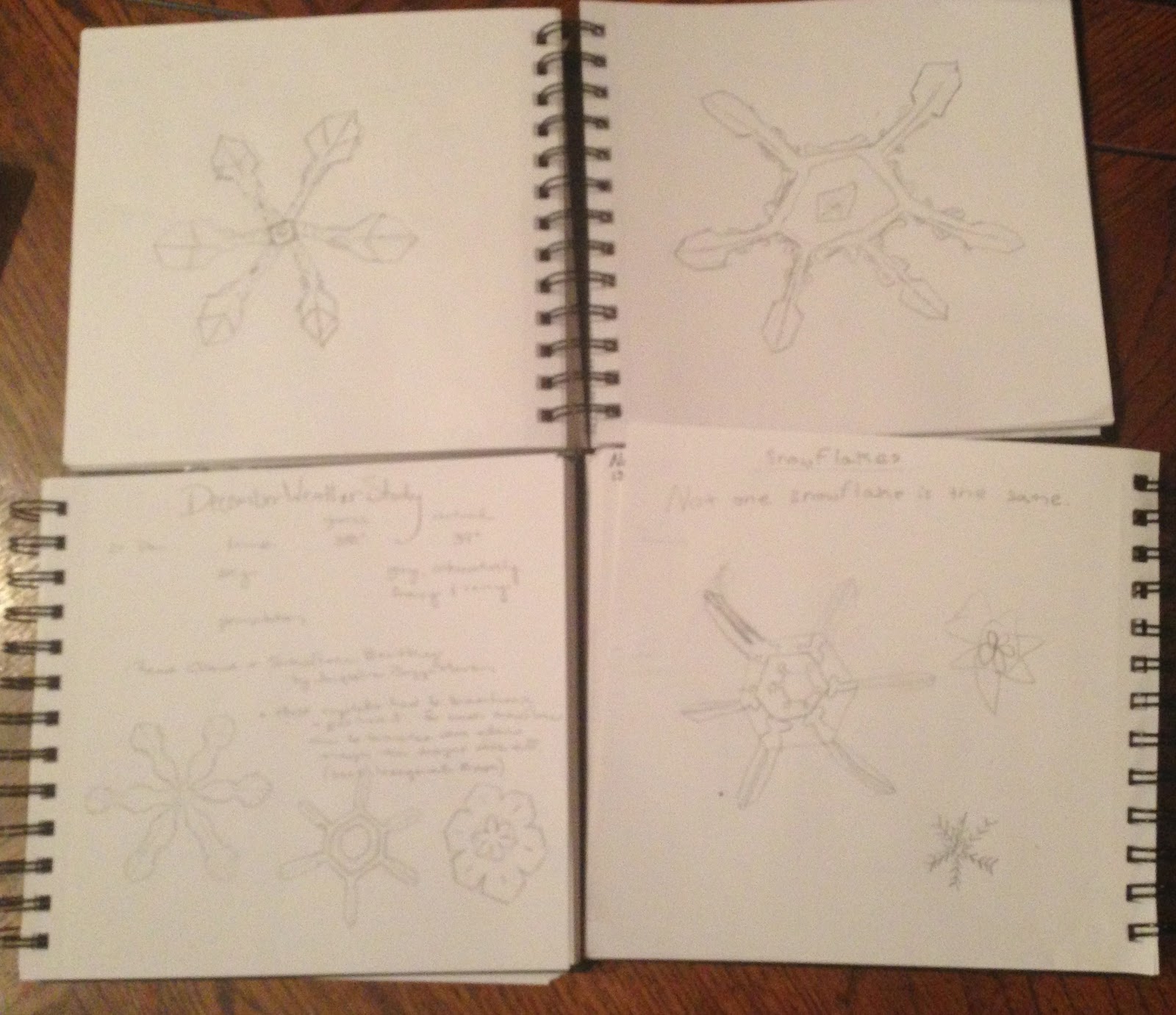
Our nature journal entries … sadly, the image is not very clear. 

Coincidentally, we had created numerous paper snowflakes earlier in the week to send to Sandy Hook Elementary School.  Members of the school PTA are coordinating an effort to convert the new school students and staff of Sandy Hook will be housed in after the holiday break into a winter wonderland.

I love that as unschoolers, we were able to “seize the moment” and thoroughly integrate our curricular studies:  nature, science, writing, literature, biography, math, art, and service learning.  It was indeed a full day of learning but took only an hour or so of actual clock time.


November 23, 20122

When we were in Southern California earlier in October for a family holiday at Disneyland, we also made a few little day excursions .. one to Legoland (of course), one to La Brea Tar Pits, and one to Long Beach specifically to visit the Aquarium of the Pacific.  Sweetie had received earlier in the year, free passes to the aquarium for her honorable mention in the California Coastal Commission’s annual Coastal Art & Poetry Contest.

We arrived just in time to see the diver presentation at the Honda Blue Cavern, modeled after the local Blue Cavern Point, a kelp forest along the northeastern coast of Santa Catalina island.  We enjoyed listening to the diver identify several of the species found in this community, including the Giant sea bass (Sterolepis gigas).

Focused on the Pacific Ocean, the aquarium is organized into three main galleries: Southern California/Baja, Northern Pacific, and Tropical Pacific.   The Ocean Science Center uses NOAA’s “Science on a Sphere” to explore our planet and tell stories about ocean phenomena and their impacts.  Other exhibits include The Shark Lagoon, Lorikeet Forest, Molina Animal Care Center, and Watershed Exhibit. Additionally, there is a special exhibits gallery which featured the Arctic & Antarctic: Our Polar Regions in Peril exhibit while we were there.

I was delighted to point out to the kids the large Sunflower seastars (Pycnopodia helianthoides), the largest seastars in the world.  To the touch, they feel like soft, velvet and velcro covered sponges.  They are commonly found where the substrate is soft, feeding on clams.

While enjoying the outdoor exhibits, Buddy climbed aboard a ship and received an unexpected squirt from a giant fish nearby.  Thankfully, he thought it was as funny as we did and we all chuckled.  🙂

One of our favorite exhibits was the June Keyes Penguin Habitat located outdoors.  We included the photo below in our annual Christmas DVD – you would be surprised to learn how many people asked us if the penguins pictured beside us were actually real.  “I can’t believe they let you hug them,” one family member actually said.

Throughout the aquarium, there are eight embossing stations where visitors can emboss an image of a sea creature in the corner of their visitor’s guide.  This was a great activity for the kids, keeping them engaged and focused on their signage.  If you enjoy Letterboxing and collecting National Park Passport cancellations like we do … you’ll love this.


November 14, 2012
Spurred by our recent outing to collect the olives growing in our neighborhood – What to Do With Fresh Olives? – we took a few minutes to sit down and sketch a small branch we had brought back with us for this exact purpose.  Sadly but not surprising, the Handbook of Nature Study and other local field guides we have in our library do not mention the olive as it is not native and is grown here (typically) for agricultural purposes.  It would be interesting to learn why they were planted in our neighborhood – was it simply for ornamental purposes? 

The olive tree, Olea europaea, is an evergreen tree or shrub native to the Mediterranean, Asia, and Africa. It is short and squat, and rarely exceeds 8–15 metres (26–49 ft) in height. The silvery green leaves are oblong, measuring 4–10 centimetres (1.6–3.9 in) long and 1–3 centimetres (0.39–1.2 in) wide. The trunk is typically gnarled and twisted.  The fruit is a small oval shape measuring 0.40–1.0 inches in length. Olives are harvested in the green to purple stage. Canned black olives may contain chemicals that turn them black artificially.  Olea europaea contains a seed commonly referred to in American English as a pit or a rock, and in British English as a stone.


November 12, 20124

Sweetie and I took part in a wonderful outdoor seminar and nature walk earlier today.  Led by a local Wintu elder, we learned about the acorn from harvest to food source.  We were invited to take part in grinding the acorns on a stone with some of the same materials the natives would have used.
Once ground, the acorn meat was put into a jar with hot water to soak over night to help leach out the natural tannins.  The following day, the liquid would be drained out but reserved for use as a Poison Oak remedy.  The acorns after two consecutive days of soaking, would eventually be ground to a flour and then used in cooking.
The Wintu elder brought several dishes to share with us that he had prepared:  acorn candy (roughly ground acorns combined with honey and molasses), acorn muffins (acorn flour with Oak ashes substituted for baking soda), and an acorn bread.  To accompany the breads, he also had butter, local honey (which he preached of its natural healing abilities – in lieu of hydrogen peroxide), blackberry jelly, and manzanita syrup.  In addition, he had prepared a White Fir and Honey tea.
Everything was very tasty – though not as rich and smooth as what you would buy in a store.  After the talk, the elder led a short walk to point out to us some of the native plants and to share with us their uses for food and/or medicinal purposes.  I was proud that most of the plants and their uses we already knew.  I know I could certainly survive if circumstances forced me to live without the comforts we’ve come to rely upon.

Submitted to the Handbook of Nature Study Outdoor Hour Challenges November Carnival.