Nature Study - Eva Varga - Page 2


February 22, 2018

Winter is finally upon us and snow is swirling everywhere. Over the past couple of weeks, my VIPKID students have been sharing photos of the snowmen they have built and I have lamented that we have nothing but rain here on the Oregon coast. On President’s Day, however, we woke up to a light dusting of snow and intermittent snowfall throughout the day. What fun!

Oregon Nature Quiz #3: Winter Wonderland Edition

It’s been a while since my last nature quiz — and the new snow has brought inspiration. Here are five of the photos showing evidence of wildlife action in the depth of winter (albeit not all in the snow). Can you identify the wildlife represented here?

image of a girl with her hands in the shape of a heart around the base of a tree covered with ladybugs with text: Nature Quiz #3 @EvaVarga.netimage of a pine cone eaten by a squirrel with text Nature Quiz #3 @EvaVarga.netimage of cougar track in mud with text nature quiz #3 @EvaVarga.netimage of bird track in snow with text nature quiz #3 @evavarga.netimage of rabbit tracks in snow with text: nature quiz #3 @EvaVarga.net

Answers:

1. When we lived in Redding, one of our most anticipated nature outings was our annual ladybug hike. It was always fascinating to see the ladybugs hibernating – hundreds of thousands of ladybugs all gathered in one place. Ladybirds hibernate through the winter as adult insects. Different species will usually hibernate in different places; some shelter under tree bark, others sleep under leaf litter, etc. Have you oberseved ladybugs hibernating in a similar fashion? Some will even gather around window crevices, buildling siding, and wooden structures.

image of ladybugs hibernating on bark of tree with text nature quiz #3 @evavarga.net
Close up image of the laybugs in the bark crevices of a Ponderosa Pine (Pinus ponderosa).

2. The cone of a Pinus ponderosa that has been broken apart by a squirrel for the nuts. Most recently, my daughter has given the art of taxidermy a try. A squirrel was her first specimen – results have not yet been reported.

3. Pictured here is a cougar (Puma concolor) track in the mud. Native to Oregon, cougars range throughout the state, the highest densities occur in the Blue Mountains in the northeastern part of the state and in the southwestern Cascade Mountains. This photo was taken in the coastal range while we were hanging buckets for sugaring time. Cougars are territorial animals and maintain home ranges of up to 100 miles. Most active at dawn and dusk, cougars are lone hunters. They are generally solitary animals, except for mothers who remain with kittens for about two years.

Learn more about The Science of Sugaring (tapping maple trees to collect the sap to make maple syrup).

4. There were no other nearby tracks so I am not certain, but I believe these bird tracks may be eagle simply due to their size. What do you think? When we lived in Redding, we loved to watch the resident eagles near the Sundial Bridge. The bald eagle (Haliaeetus leucocephalus), our national bird, is the only eagle unique to North America. It’s scientific name signifies a sea (halo) eagle (aeetos) with a white (leukos) head. At one time, the word “bald” meant “white,” not hairless. Bald eagles are found throughout most of North America, from Alaska and Canada to northern Mexico – with about half living in Alaska. The northwest coast is by far their greatest stronghold for bald eagles. They flourish here in part because of the salmon. Dead or dying fish are an important food source for all bald eagles.

Read my earlier post on Exploring Animal Tracks and learn how to use tracks to tell a story. Make animal track stencils and get out fabric paints to decorate t-shirts.

5. Did you guess rabbit? Six species of rabbit like mammals (these include, rabbits, pikas, and hares) can be found in various habitats throughout central Oregon where this photograph was taken. These small mammals feed primarily on grasses and forbs, have at least two litters per year, and are usually found where there are good amounts of concealing cover available. The shrubs under which they take cover are an important food source and conversely, they serve as the primary prey for many carnivores.


January 20, 20182

My father has a pair of ravens that sit perched a top the branches of a snag on his property. They will often squawk upon our arrival and swoop down quickly to snatch up the tasty morsels we toss out to them periodically. Watching their antics is a highlight of our visit and provides a great nature study segue for our teens.

I’ve always been fascinated by ravens. When I was a young girl, my mother introduced me to her favorite author, Edgar Allan Poe. Chills ran up my spine as she read, The Raven. I now enjoy reading it each autumn when the leaves begin to fall from the trees and the cold winds begin to blow.  Teens may wish to memorize this poem.Ravens in Winter

“Deep into that darkness peering, long I stood there, wondering, fearing, doubting, dreaming dreams no mortal ever dared to dream before.” Quoth the raven, “Nevermore.”

~ Edgar Allan Poe, The Raven

Corvus Identification

Common ravens (Corvus corax) and American crows (Corvus brachyrhynchos), overlap widely throughout North America and they look very similar. Rest assured, however, that with a little practice, you can tell them apart.

You probably know that ravens are larger. They are actually the same size as a Red-tailed Hawk and will often travel in pairs. Crows, on the other hand, are seen in larger groups.

As they fly overhead, the crow’s tail feathers are basically the same length, so when the bird spreads its tail, it opens like a fan. Ravens, however, have longer middle feathers in their tails, so their tail appears wedge-shaped when open. Ravens ride the thermals and soar, whereas crows do more flapping.

Another key difference is their call. Crows give a cawing sound whereas ravens produce a lower croaking sound.

The Tower of London

The photo featured at the top of this post was taken at the Tower of London while on family holiday a few months ago. “Should the ravens leave the Tower of London, it will crumble into dust and great harm befall the kingdom,” proclaimed the official Ravenmaster we spoke to as we wandered about the grounds.

As you can imagine, the ravens who reside at the Tower of London are an attraction to travelers around the world. You can learn more about them and the role the Ravenmaster plays in their care here, At the Tower of London, a Ravenmaster for the Digital Age.

Living Books

Ravens in Winter by Bernd Heinrich is a wonderfully written narrative compiled from the author’s field notes and studies all aimed at understanding raven behavior. In 1984 he was determined to find out why ravens call to each other when they discover food, a rare example of sharing in the wild. For the next four years he spent winter weekends observing these birds at a remote site in Maine, braving fierce weather, lugging enormous amounts of bait to lure ravens to his study area and sleeping in a cabin where temperatures often plunged below zero at night.

A Professor Emeritus of Biology at the University of Vermont, Henrich is the author of numerous books, including Bumblebee Economics, Mind of the Raven (which we also enjoyed), and TheHoming Instinct. He has received the John Burrough’s Medal for Nature Writing and has been nominated for a National Book Award for Science.Ravens in Winter provides an in-depth look at raven ethology – particularly their intelligence and playfulness. It is a great living science book for teens, providing a visual picture of the scientific method.

To expand on your Corvid nature study, you may consider extending with Native American and Norse mythology.

Corvus Study in the Wild

Ravens and crows have the keenest intelligence of all our common birds. Taking inspiration from Heinrich’s study, winter is the perfect time to get outdoors and study the behavior of the Corvus genus ourselves. Their nests are often easier to see in the winter when the foliage is absent from the trees. However, most do build their nests in evergreens. Here are few questions or things to ponder as you observe them – be sure to record your observations in your nature journal:

  • Describe its colors when seen in the sunlight.
  • Describe the general shape of the crow or raven.
  • Are its wings long and slender or short and stout?
  • Is the tail long or short? Is it notched or straight across the end?
  • Describe its feet. Are they large and strong or slender? How many toes does it have? How many are directed forward and how many backward?
  • What is it doing? Describe its behavior or activity.
  • Describe its call.
  • Describe its beak.
  • Where and of what material did it build its nest?
  • If they are feeding in a feed, is there a sentinel or guard posted?
  • What do they feed upon?

Sit down with your sketch book and illustrate a few. Try to capture its movement and different poses with quick, light sketches. Take photographs if the weather is not conducive to sketching outdoors.

Build a Feeder

There are two beneficiaries to setting up a bird feeder in you backyard … birds and people. In regards to the first beneficiary, you should consider:

  1. accessibility to the birds;
  2. shelter from the wind, snow, and rain;
  3. vulnerability to window strikes; and
  4. safety from predators, especially cats.

In regards to the latter, ponder the following:

  1. ready visibility from a window;
  2. ease of filling and maintaining; and
  3. capacity, which determines refilling frequency.

With these thoughts in mind, you can begin to research what type of feeder you would like to build and the potential placement. There are many options to choose from and building plans are easily found at your local library, online, or from local bird watching groups like the Audubon Society.

There are also many opportunities to engage in real science – collecting data on bird migration patterns and nesting behaviors for a variety of citizen science projects. Two that come to mind immediately are Project FeederWatch and the Great Backyard Bird Count.

The Nature Book Club

Welcome to the first The Nature Book Club Monthly Link Up. The monthly link up will begin on the 20th day of each month.

The monthly book club is devoted to connecting children to nature. There is a theme for each month in 2018. The theme this month is winter birds and nests.

We welcome your nature book and activity related links. Read on for more details and for a giveaway!

image of a stack of books in the grass with text overlay listing monthly theme

The Nature Book Club is brought to you by these 15 nature loving bloggers which are your co-hosts! Are you following them? If you don’t want to miss anything, be sure to follow each one.

Here are the co-hosts, their choices of books, and activities for the month.

Something 2 Offer
Birds, Nests, and Eggs Nest Scavenger Hunt

The Usual Mayhem
The Boy Who Drew Birds Free artist study set (John James Audobon)

Preschool Naturally
Whose Nest Is This? Nest Building Activity

Tina’s Dynamic Homeschool Plus
(Backyard Bird Series) Cardinals – Free Northern Cardinal Unit Study & Lapbook.

Rule This Roost
Fine Feathered Friends: All About Birds – DIY Bird Feeders

Hide The Chocolate
Those Darn Squirrels Fly South – Free online book club.

The Homeschool Scientist
Birds, Nests, and Eggs – Make a Suet Feeder

Forgetful Momma
Snowy Owls Snowy Owl Craft

Table Life Blog
A Nest is Noisy – Art Project.

Eva Varga
Ravens in Winter: Nature Study Activities and Lessons for Teens – Winter Bird ID

Wind in a Letterbox
Birds for Beginners in Southern Africa – Nature Journal Entry

Rainy Day Mum
Coming Home – Needle Felted Robin

Handbook of Nature Study
Backyard Birds Field Guide for Young Naturalist – Backyard Bird Nature Study

The Playful Scholar
TBD – How to Make Hanging Suet Ornaments

Freshly Planted
Nests – Nest weaving

WHOOP! – The Nature Book Club Giveaway!

We’re so excited about this month’s freebie. It is an ebook, Backyard Science – Easy Activities for All Ages, by The Homeschool Scientist.
A huge Thank You to The Homeschool Scientist!

Backyard Science Giveaway
Click on the link above. It’s free until February 4, 2018. No coupon code required.

Party Rules

  • Choose an engaging nature book, do a craft or activity, and add your post to our monthly link up.
  • The link up party goes live at 9:00 a.m. EST on the 20th of each month and stays open until 11:59 p.m. EST on the last day of the month. Hurry to add your links!
  • You can link up to 3 posts. Please do not link up advertising posts, advertise other link up parties, your store, or non-related blog posts. They will be removed.
  • By linking up with us, you agree for us to share your images and give you credit of course if we feature your posts.That’s it!
  • Let’s party.


October 11, 2017

Welcome to Finishing Strong ~ a weekly link-up dedicated to families homeschooling middle & high school kids. Each Wednesday, moms just like you share their best tips, encouragement, advice, and more for teaching older kids at home.

Finishing-Strong-500x500I am delighted that families homeschooling middle and high school age students are coming together and finding inspiration in one another. That has been the goal of Finishing Strong since its inception. Thank you!!

Finishing Strong is hosted by me here at EvaVarga along with my friends – Heather from Blog She Wrote, Megan from Education Possible, and Heidi from Starts at Eight.

I know you will find the posts that have been shared with us inspiring! Grab a cup of tea, kick back, and take some time to check out the wonderful posts shared below. What are your favorites?

STEM

Girls in STEM

My daughter has been interested in engineering, sciences, and mathematics since she was just a wee little one. I thereby seek out opportunities and experiences to challenge and inspire her to pursue these areas as a possible career.

I’ve shared several tips and activities to encourage girls in STEM. Take a few minutes to browse the materials available here – Encouraging Girls in STEM – as well as learn more about upcoming events.

The annual Introduce a Girl to Engineering Day will be here before you know it (it’s February 22nd) and events are being planned across the nation. In preparation for this annual celebration of Girls in STEM, there is an opportunity to take part in a webinar (Wednesday, November 8th at 12pm EST) to help make this the best Introduce a Girl to Engineering Day yet!

Sign up for the free webinar and you’ll get ideas to help jumpstart your planning and:

• Learn about new resources and programs
• Hear two Girl Day Role Models share their experience
• Discover how you can make a difference in a girl’s future
• Get Inspired!
• And more!

Finishing Strong

We hope you’ll take some time to check out the amazing posts that have been shared with us. We are so thankful to all of our readers and contributors who help make Finishing Strong a key resource for everyone homeschooling through the middle & high school years.

The top posts shared last week

Below are a couple of the posts I most enjoyed from last week. The first post is the one that received the most clicks. You won’t want to miss it! alt title
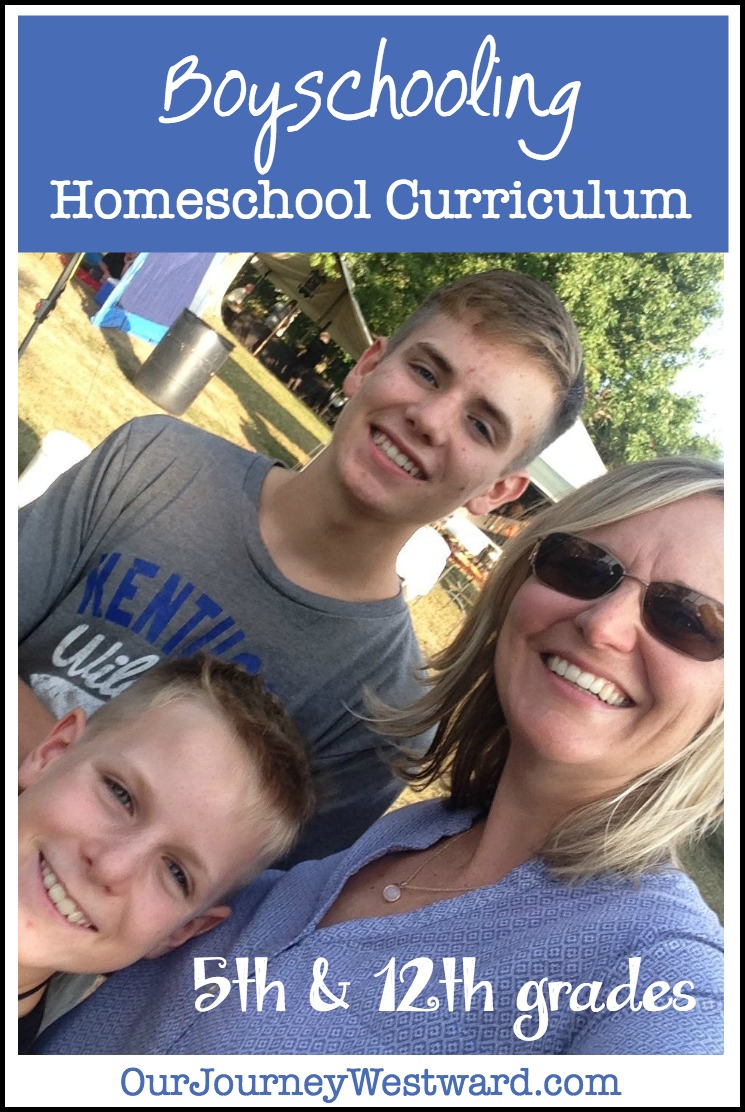
Boyschooling Homeschool Curriculum for 5th and 12th Grades (2017-18)

from Cindy at Our Journey Westward ~ Cindy coins the term, boyschooling … I love it! Hop over to learn more about the curriculum choices she has made for each of her two boys.

What Some Days in a Girl’s Year 7 Look Like

from Carol at Journey and Destination ~ Carol provides us with a little peak into “a day in the life” of her daughter as they work through Ambleside Online Year 7.

Fall Nature Walk – Scavenger Hunt Lists & Resources

from Heidi at Starts at Eight ~ Nature study is near and dear to my heart. I really miss doing it with my kiddos and need to carve out more time in our week. Heidi shares a great list of resources and materials to implement nature study in your homeschool.

@ @ @

As always, thank you for helping us to make Finishing Strong a key resource for families who are homeschooling through the middle & high school years.

What are you going to share with us this week?

Guidelines:

  1. Link up to 3 posts from your blog. Make sure you use the exact URL to the post, not to your home page. You can add any post related to homeschooling middle and high school students. Posts unrelated to that will be removed.
  2. Please no advertising, individual Pinterest pins, Facebook, Twitter, or other link-up links!
  3. Grab our button to add to your post after you link it up. Each week we will be choosing our favorite posts to highlight on all 4 sites. If you were featured, we would love for you to use the “I was featured” button.
  4. The linky will go live on each co-host’s blog each Wednesday at 6am EST, and will be live until Tuesday at 11:55 pm.

Please Share!

Add our button to your post.

Homeschooling the Middle & High School Years

Were You Featured?

Grab an “I was featured” button!

Homeschooling the Middle & High School Years


June 27, 2017

On August 21, 2017, Oregon will be the first to see the total eclipse of the Sun. This much anticipated solar eclipse will be visible across much of the United States. I first learned of this rare occurrence a year ago and quickly made plans to be sure we would be in the path.

Solar Eclipse 2017We purchased tickets to attend OMSI’s Eclipse Party at the Salem Fairgrounds and attempted to make hotel reservations in the area to no avail. We have thereby fallen back on a backup plan – staying with family in Eugene and driving up. I fear, however, that the road will be so congested we won’t reach our destination.

Anticipating the 2017 solar eclipse, I am delighted to share with you a number of lessons and activities with which you can engage your middle school students.

About the Solar Eclipse

A total solar eclipse is when the moon moves right in front of the sun, covering it completely for a very short time. It darkens the whole sky, lets you look right at the sun, and shows you the beautiful corona that surrounds the sun. Stars come out, the horizon glows with a 360-degree sunset, the temperature drops, and day turns into night.

Only look at the sun when it is 100% covered. You must use special solar viewing glasses whenever the sun isn’t completely eclipsed or it may cause irreparable eye damage.

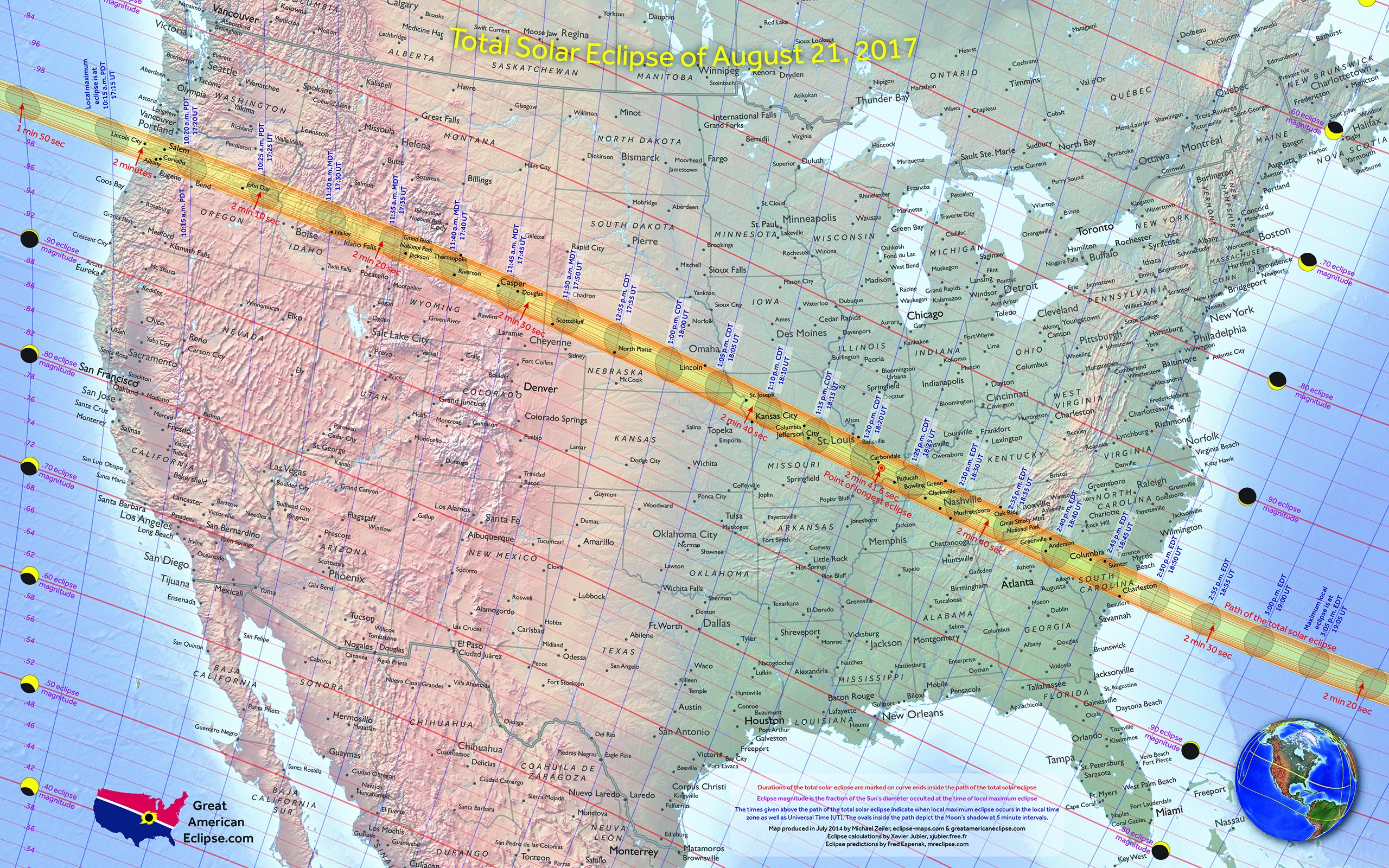
The umbra (fully shaded inner region of a shadow) will hit the shores of Oregon at 10:15:53 am PDT near the small town of Otter Rock. From the time the shadow first touches land, it will take only two minutes for the shadow to race eastward. As the eclipse passes over the state, cities will experience various lengths of totality based on their varying distances from the centerline. At the Oregon State Fairgrounds, we will be treated to one minute and 53 seconds of shadow at just after 10:17am.

The eclipse will continue across the United States where Illinois will experience the longest eclipse duration at two minutes and 41 seconds. South Carolina will be the last state to witness the eclipse and the final shadow will be over the Atlantic Ocean near the west coast of Africa. See a map of the full eclipse path.

Solar Eclipse

Three Types of Eclipses

Solar eclipses occur during the new moon phase when the Moon moves between the Earth and the Sun and the three celestial bodies form a straight line, Earth-Moon-Sun. There are three kinds of solar eclipses, Annular, Partial, and Total. On even more rare occasions, a hybrid eclipse occurs when there is a combination of two.

Annular Eclipse

An annular eclipse occurs when the Moon covers the Sun’s center, yet the moon’s shadow doesn’t quite reach the Earth. The Sun’s visible outer edges thus form a “ring of fire” or annulus around the Moon. The ring of fire marks the maximum stage of an annular solar eclipse.

We have been fortunate to observe an eclipse in the past. In 2012, we enjoyed an annular eclipse near Red Bluff, California.

Partial Eclipse

A partial eclipse, which are visible to a greater number of people due to its wider path, occurs when the Moon comes between the Sun and the Earth, but they don’t align in a perfectly straight line and thus the Moon only partially covers the Sun’s disc. A Partial Eclipse can be seen on either side of the path of totality where the moon doesn’t completely cover the sun.

Total Eclipse

A total solar eclipse occurs when the Moon comes between the Sun and Earth and completely covers the face of the sun, letting the sun’s magnificent corona burst into view, and casts the darkest part of the shadow (the Umbra) on Earth. In this shadow, the Earth is almost as dark as night.

Check out the 2017 Solar Eclipse explainer video we created with mysimpleshow.

Hybrid Eclipse

A hybrid solar eclipse occurs when the eclipse changes from an annular eclipse to a total eclipse along the path of the moon as it rotates about the Earth.

Solar Eclipse 2017Bring it Home – Solar Eclipse Resources

◉ NASA’s Eclipse 2017 guide and information by NOAA Portland 2017 Solar Eclipse

◉ Solar Eclipse for Beginners: General information on the science of a solar eclipse

◉ NASA’s Scientific Visualization Studio Eclipse Gallery: Scientifically accurate visualizations of solar eclipses including position of the Earth, Moon, and Sun, and path of the Moon’s shadow from different perspectives.

◉ Shadow and Substance: A simulation for Oregon showing where totality and partial phases can be viewed.

◉ NASA Eclipse Simulation: Students discover relative relationships between the Sun, Earth, and Moon, and how the Moon can eclipse the Sun.

◉ NASA Wavelength: A full spectrum of NASA resources for Earth and space science education.

◉ Explore the Earth’s geometrical relation to the sun by calculating where the sun will be in the sky for any date or time given a particular location on Earth.

◉ Eclipse in a Different Light: A Sun-Earth Day page for educators presented by NASA.

◉ In 1715, Edmond Halley published a map predicting the time and path of a coming solar eclipse.

◉ If you are a Scout, you won’t want to miss the opportunity to earn the BSA 2017 Solar Eclipse patch.

  • Cub Scouts: Discuss what a solar eclipse is with your leaders.
  • Boy Scouts and Varsity Scouts: Draw a diagram of the positions of the moon, earth, and sun to show how the solar eclipse occurs.
  • Venturers: Research Sir Arthur Stanley Eddington’s 1919 experiment and discuss how it confirmed Einstein’s theory of general relativity.


January 24, 20171

To finish up his Second Class rank requirements for Boy Scouts recently, I was helping my little man find photographs of wildlife that he has observed. As we dug through our photo archives, I was reminded of a fun little Oregon Nature Quiz: Early Summer Edition that I posted several months ago. I had posted it with the intention of making it a quarterly series but sadly, life distracted me and I let it slip my mind.

Oregon Nature Quiz #2: Wildlife Edition

How Well Do You Know Oregon?

Here are five of the photos my son selected to submit to his Scoutmaster. Can you identify the wildlife represented here? Whose Been Here? Oregon Nature Quiz: Boy Scout Rank Wildlife Edition @EvaVarga.net

Who Am I? Oregon Nature Quiz: Boy Scout Rank Wildlife Edition @EvaVarga.net

What Happened Here? Oregon Nature Quiz: Boy Scout Rank Wildlife Edition @EvaVarga.net

I'm Friendly. Or Am I? Oregon Nature Quiz: Boy Scout Rank Wildlife Edition @EvaVarga.net

My, What Big Teeth You Have. Oregon Nature Quiz: Boy Scout Rank Wildlife Edition @EvaVarga.net

Answers:

1. North American Raccoon tracks along the banks of a river

In the wild, raccoons often dabble for underwater food near the shore-line. They then often pick up the food item with their front paws to examine it and rub the item, sometimes to remove unwanted parts. This gives the appearance of the raccoon “washing” the food.

Originally, raccoon habitats were solely deciduous and mixed forests, but due to their adaptability they have extended their range to mountainous areas, coastal marshes, and even urban areas. Though previously thought to be solitary, there is now evidence that raccoons engage in gender-specific social behavior. Related females often share a common area, while unrelated males live together in groups of up to four animals to maintain their positions against foreign males during the mating season, and other potential invaders.

Intrigued by animal tracks and wildlife signs? Check out these ideas for Exploring Animal Tracks with students.

2. Pacific Tree Frog

Pacific tree frogs are common on the Pacific coast of Oregon and Washington. They occur in shades of greens or browns and can change colors over periods of hours and weeks. They occur in shades of greens or browns and can change colors over periods of hours and weeks. Eggs of the Pacific tree frog may be consumed by the rough-skinned newt and other amphibians.

They are found upland in ponds, streams, lakes and sometimes even further away from water. The Pacific tree frog makes its home in riparian habitat, as well as woodlands, grassland, chaparral, pasture land, and even urban areas including back yard ponds.

3. Black Bear claw marks and Acorn Woodpecker holes on the trunk of an apple tree

In the early fall, when the apples are ripe, it is not uncommon to see claw marks on apple trees, particularly in old pioneer orchards that have been abandoned. Brown and American black bears are generally diurnal, meaning that they are active for the most part during the day, though they may also forage at night.

Most bears have diets of more plant than animal matter and are completely opportunistic omnivores. Knowing when plants are ripe for eating is a learned behavior. Bears may mark territory by rubbing against trees and other objects which may serve to spread their scent. This is usually accompanied by clawing and biting the object.

Interested in learning more about animals and the study of wildlife? Check out these great animal webcams.

4. Golden Mantle Ground Squirrel

Scientists classify the golden-mantled ground squirrel as a true ground squirrel, though it will climb trees to reach seeds. Its genus name Spermophilus is Greek for “seed loving.” Like other ground squirrels, the golden-mantle packs seeds and fruit in its cheek pouches and stores the food in burrows, puts on a thick layer of fat, and hibernates in winter. Golden-mantled ground squirrels eat their stored food in early spring, when seeds and fruit are scarce. In addition to seeds and fruit, the omnivorous ground squirrel eats fungi, insects, bird eggs, small vertebrates, and carrion.

Though the golden-mantled ground squirrel can vocalize, it remains silent most of the time. When alarmed, it chirps and squeals. Though not especially aggressive, it growls when fighting with other ground squirrels. Though tempting, it’s not a good idea to feed these or any other wild animals; it distracts them from searching for natural foods, which they must eat in large quantities to survive. Unlike most other ground squirrels, the golden mantle is a loner. It only spends time with others of its kind as a youngster with its mother and siblings.

5. North American Beaver teeth marks on the trunk of an oak tree

Beaver (Castor Canadensis) are known for building dams, canals, and lodges (homes). Their colonies create one or more dams to provide still, deep water to protect against predators, and to float food and building material. While they don’t generally use trees of the size pictured here in their dams, it is fascinating to watch the process of a beaver dam under construction which play a critical role in the ecology of our streams. Learn more in my post, The Industrious Beaver: Nature’s Engineers.


December 27, 2016

I grew up on the Oregon Coast in beautiful Bandon by the Sea. I spent many a day on the shoreline investigating the marine invertebrates under the rock crevices and walking the sandy beaches. My brothers and I longed for the minus tides, providing us the rare opportunity to go spelunking in the sea caves just off shore. These rocky islands are now protected areas for marine bird nesting habitat but back in the 70s, it was our playground.

dune geology tunicates
Dune geology features: foredune and deflation plain

Tracking Marine Debris

In all the years I have spent on the beach, I have found a diverse amount of debris and organisms in varying states of decay. I probably spend an equal amount of time sifting through the wrack on the high tide line as I do in wave zone digging in the sand looking for mole crabs.

I have found marine debris from Japan evidenced by the kanji script. An occasional flip flop or fishing net remnants are not uncommon. While immersing myself in marine biology courses at the Oregon Institute of Marine Biology one summer, I even found several squid egg cases that washed ashore after a winter storm, providing my peers and I an opportunity to observe the development up close. Yet, once in a while, I am still surprised at what washes ashore.

tunicates
Walking along the ATV trail across the deflation plain

This past holiday weekend, my family and I enjoyed a leisurely walk on the beach near our home. Our goal was to field test a new marine debris app, a joint initiative between the NOAA Marine Debris Program and the Southeast Atlantic Marine Debris Initiative. The tracker app allows you to help make a difference by checking in when you find trash on our coastlines and waterways.*

We drove out to the North Spit and thereafter began our excursion through the deflation plain. We soon discovered, however, that there was too much standing water to stick to the trail that meandered through the wetland area. We thus walked along the ATV road until we reached the small foredune. Just a few feet up and over and we arrived on the sandy beach.

No sooner did we arrive at the shore and we immediately were captivated by the presence of a strange organic material that was strewn across the beach for miles. Upon first glance, it looked like a hard plastic tube resembling a sea cucumber. My first suspicion turned out to be incorrect, however. Upon returning home, I learned that what we had found were actually colonial tunicates. Fascinating!

tunicates rare creatures
Planktonic salps, Pyrosoma atlanticum, strewn across the beach.

What are Tunicates?

This bizarre and rarely-seen creature is called a pyrosome, a species of pelagic colonial tunicates. Their scientific name, Pyrosoma atlanticum, is derived from the Greek words pyro meaning ‘fire’ and soma meaning ‘body’ which refers to the fact that they are known for bright displays of bioluminescence.

Pyrosoma atlanticum are one of the few pyrosomes that make it to the west coast of the U.S. The species found here are less than a foot but can get as long as 24 inches. Largely colorless, they can show up as pink, grayish or purple-green.

tunicates invertebrates
A specimen of the colonial tunicate, Pyrosoma atlanticum 

These massive colonies of cloned creatures are related to a kind of jellyfish called a slap. A tunicate is a marine invertebrate animal, a member of the subphylum Tunicata, which is part of the Chordata, a phylum which includes all animals with dorsal nerve cords and notochords.

Each individual organism is about 1 cm long – less than a third of an inch. They are all connected by tissue and in turn form this colony that looks like a plastic tube. The recent winter storms have caused them to strand on the shores and have been found in all areas of the coast.

Usually found in temperate waters as low as 800 meters. The colony of animals is comprised of thousands of individual zooids and moves through the water column by the means of cilia (an organelle found in eukaryotic cells that project from the much larger cell body).

As they move through the water column, sometimes close to the surface and sometimes as far down as 2600 feet, they filter plankton out of the water for food. As it sucks water in, it then pushes it back out, thereby propelling it through the ocean. It does all this via one opening only, so it moves incredibly slow.

For more images of Pyrosoma, check out Bob Perry’s photographs. Included in his work are a few pseudoconchs (false shells) of the pelagic mollusk Corolla which we similarly found.zoologyIf you are interested in learning more about invertebrates with your students, I encourage you to look into the Amazing Animals curriculum unit I have written to introduce middle level students to zoology. This 10-week unit is full of inquiry-based activities and lesson plans fully outlined for you.

* Due to our fascination with these rare creatures, we didn’t spend as much time with the debris tracking app as I had intended. We’ll give it a go another time.