California - Eva Varga - Page 4


November 23, 20122

When we were in Southern California earlier in October for a family holiday at Disneyland, we also made a few little day excursions .. one to Legoland (of course), one to La Brea Tar Pits, and one to Long Beach specifically to visit the Aquarium of the Pacific.  Sweetie had received earlier in the year, free passes to the aquarium for her honorable mention in the California Coastal Commission’s annual Coastal Art & Poetry Contest.

We arrived just in time to see the diver presentation at the Honda Blue Cavern, modeled after the local Blue Cavern Point, a kelp forest along the northeastern coast of Santa Catalina island.  We enjoyed listening to the diver identify several of the species found in this community, including the Giant sea bass (Sterolepis gigas).

Focused on the Pacific Ocean, the aquarium is organized into three main galleries: Southern California/Baja, Northern Pacific, and Tropical Pacific.   The Ocean Science Center uses NOAA’s “Science on a Sphere” to explore our planet and tell stories about ocean phenomena and their impacts.  Other exhibits include The Shark Lagoon, Lorikeet Forest, Molina Animal Care Center, and Watershed Exhibit. Additionally, there is a special exhibits gallery which featured the Arctic & Antarctic: Our Polar Regions in Peril exhibit while we were there.

I was delighted to point out to the kids the large Sunflower seastars (Pycnopodia helianthoides), the largest seastars in the world.  To the touch, they feel like soft, velvet and velcro covered sponges.  They are commonly found where the substrate is soft, feeding on clams.

While enjoying the outdoor exhibits, Buddy climbed aboard a ship and received an unexpected squirt from a giant fish nearby.  Thankfully, he thought it was as funny as we did and we all chuckled.  🙂

One of our favorite exhibits was the June Keyes Penguin Habitat located outdoors.  We included the photo below in our annual Christmas DVD – you would be surprised to learn how many people asked us if the penguins pictured beside us were actually real.  “I can’t believe they let you hug them,” one family member actually said.

Throughout the aquarium, there are eight embossing stations where visitors can emboss an image of a sea creature in the corner of their visitor’s guide.  This was a great activity for the kids, keeping them engaged and focused on their signage.  If you enjoy Letterboxing and collecting National Park Passport cancellations like we do … you’ll love this.


October 15, 2012

When we returned from our holiday in Southern California (Disneyland, Legoland, & Long Beach), we were in dire need of some outdoor time.  Solitude and peace that only nature could provide.  The weather Sunday morning was perfect – sunny and relatively cool so we ventured out for long hike to Castle Crags State Park.

Castle Crags State Park features 28 miles of hiking trails, including a 2.7 mile access trail to Castle Crags Wilderness, part of the Shasta-Trinity National Forest.  The Pacific Crest Trail also passes through the park.  The park is named for the 6,000-feet tall glacier-polished crags.  The solitude you experience as you explore the forest or traverse part of the Pacific Crest Trail cannot be matched.

The spectacular mountains you see in these pictures represent vastly different geologic stories and processes that have been shaping the land for more than 500 million years.  The persistent forces of day-to-day erosion, together with slow earth movements, keep this mountain landscape in dynamic flux.

The Gray Rocks are mainly greenstone and are a detached portion of the Copley Formation, related to the ancient and complex geologic history of the Klamath Range.  The spectacular Castle Crags are made of granite that cooled slowly deep within the earth.  Over time, this granite was uplifted and the rock above it worn away.  Once the granite was exposed to the elements, water and ice have taken over as the main sculpting forces, breaking fractures in the rock, creating the castle-like features.

Mt. Shasta reaches the impressive height of 14,179 feet and is by far, the youngest geologic feature in the area. Mt Shasta is volcanic, forming in episodes beginning 530,000 years ago and last erupting in 1786.  Considered dormant now, it will undoubtedly become active again in the future.

It was an awesome day.  We planned ahead and managed to bring along snacks and plenty of water to drink. It was an arduous hike, however, so we rewarded ourselves with dinner in Dunsmuir – where we discovered a little brewery.  The food was delicious and though our bodies were tired, our spirits were rejuvenated.


November 1, 2011

This has been a long awaited trip … the California State Railroad Museum is well known throughout the western states and it’s been on Buddy’s ‘Bucket List’ for years.  Now that we live in California .. the trip was an easy few hours drive from home.  The museum is located within Old Sacramento State Historic Park.

As the commercial center of the California Gold Rush, Sacramento became a crossroads of transportation, connecting steamboats to San Francisco, supply roads to the mining regions, and to Folsom by the first railroad in the West.  Though the commercial district gradually moved east of the the riverfront, today there are 53 historic commercial structures on 28 acres that make up Old Sacramento State Historic Park.

While the focus of our visit was the Railroad Museum – we’ll definitely be back again when our history studies bring us to California.  The railroad museum houses more than 20 restored locomotives and railroad cars along with thousands of smaller artifacts and a variety of exhibits in its exhibition facility. In addition, the Central Pacific Railroad Passenger Station and Freight Depot make up a part of the historic district.

The passenger station is a reconstruction of the western terminus of America’s first transcontinental railroad (circa 1876).  Here you’ll find the ticket office (where we purchased tickets for the Spookomotive Train event), telegraph office, main waiting room, and a separate waiting room for women and children only.  The museum’s steam-powered excursion trains arrive and depart from the reconstructed late 1800s transcontinental railroad freight station.

We planned our trip to coincide with the Spookomotive train ride – a whimsically decorated train staffed with an entertaining ‘skeleton crew’.  We had hoped for a spooky ride – perhaps a little mystery in which we’d get to take part onboard.  As it turned out – the ride was a simple down and back along the riverfront with the crew wearing skeleton printed t-shirts and passing out silly plastic toys.  It was suitable for ALL ages.
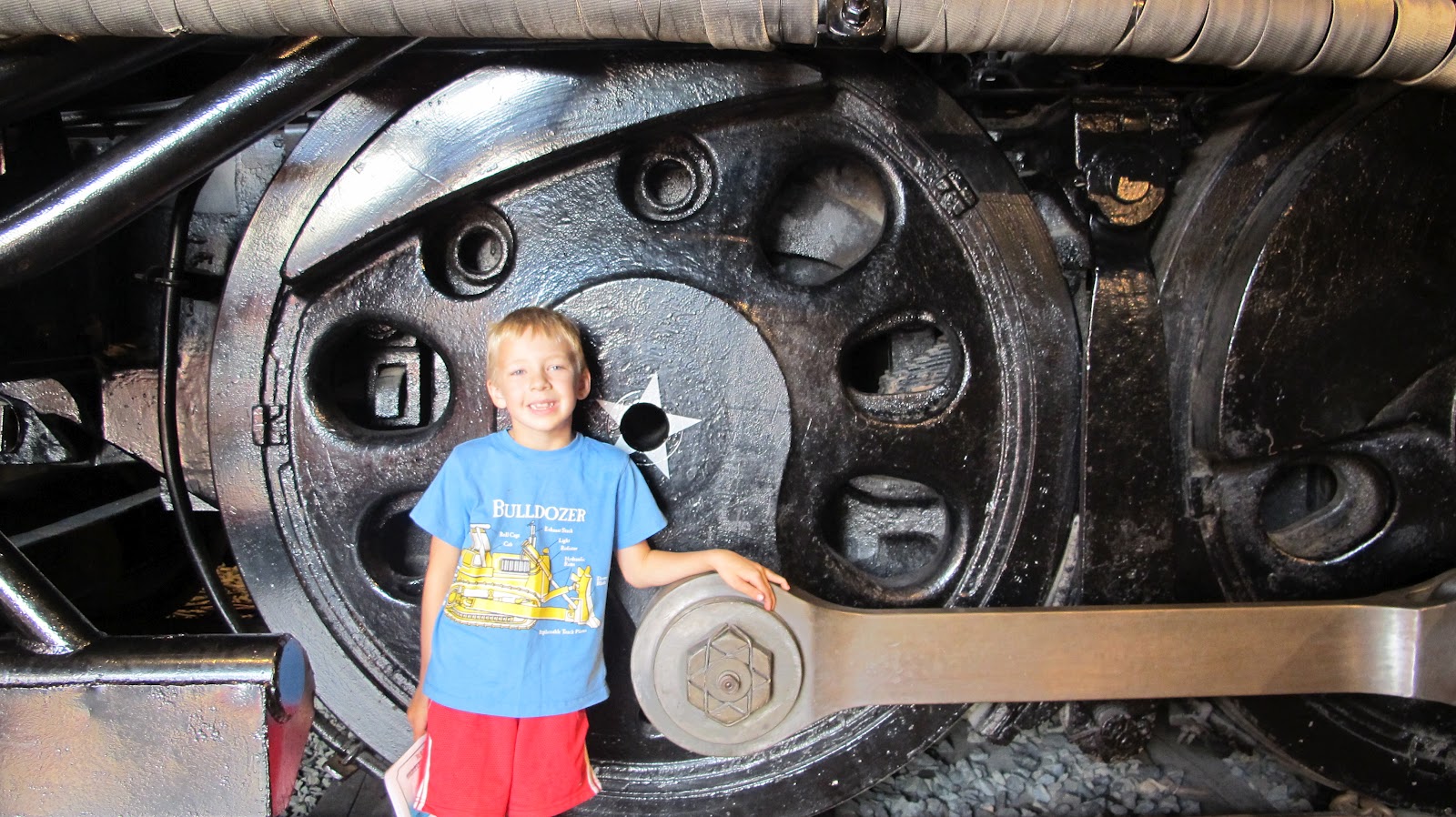
Buddy’s favorite exhibit was the 4294 locomotive.  The unique cab-forward design of the locomotive saved engineers from being asphyxiated by smoke fumes in Southern Pacific’s numerous long mountain tunnels and snow sheds.  Sweetie’s favorite exhibit commemorated the completion of the transcontinental railroad and the ceremony that took place at Promontory Point, Utah.  We were surprised to learn that the paintings we see so frequently in the history books portraying this event were staged.  Some of the people pictured were not even there when the infamous gold spike was nailed in place.  Sadly, the people that were responsible for the construction of the train – most of whom were immigrants from China and Ireland – were not featured at all.
While we were there, Buddy completed the Junior Engineer assignments.  He was disappointed though that his special award was game token for Old Sacramento Historic Park.  He’d hoped for a patch or lapel pin.  Ah well – the important thing was what he learned not the tangible reward.


October 28, 20115

We’ve been to Chinatown before … in Vancouver, New York, San Francisco and even Portland. As the kiddos are learning Mandarin, it is an opportunity to practice their language skills as well as experience a tiny bit of another culture.  We thereby visit whenever the opportunity arises.  Thus, our visit to San Francisco last week was not complete without spending a portion of the day in Chinatown.  This time, we visited a few new places … both of which the munchkins have asked, “Can we stop here every time we come to Chinatown?”

When we first left the motel on 2nd and Howard, Sweetie asked if she could hold the city map.  I asked if she wanted to be the navigator and she exclaimed with glee, “Yeah!”  We led us to the Children’s Creativity Museum and from their she directed us to Powell Street Station to catch the cable car.  I was very impressed with her sense of direction.  Upon boarding the cable car, she was careful to read each street sign and signaled to us when we had arrived at Jackson Street, where she felt we should get off.

Fresh frog legs, anyone?

We walked two blocks – stopping briefly when anything unusual (at least us) and then turned onto an alley where we immediately found the San Francisco Fortune Cookie Factory.  It is literally a hole in the wall … located on Ross Alley, it is one of the oldest fortune cookie companies in San Francisco.  If you are looking for a tourist attraction (i.e. a tour), gourmet fortune cookies, single cookies, or picture taking opportunities (they charge 50 cents) – this place is not for you.  If you are looking for a tiny shop, free samples, flat cookies, cookies in bulk, or great customer service – you’ve found the right place.

The Golden Gate Fortune Cookie Factory

Within a few paces of the entrance you can see fortune cookies being made right in front of you. First, the thin circular cookie is pulled off a hot press. Then, a fortune is placed on one side of the hot, flat dough. Next, each soft, hot cookie is shaped over a steel rod into the shape of a fortune cookie. This process must be done very quickly, otherwise the cookie will harden before it has the right fortune cookie shape. When you are inside the factory, you will be amazed at how quickly the fortune cookies are made.  An elderly man was at the entrance giving us free samples of warm cookies fresh of the grill.  We watched for a few minutes while enjoying our samples and then before departing, purchased a bag of flats for ourselves.

Enjoying their first tea sampling at Aroma Tea Company

From there we wandered about, going into shops that appealed to us including a coin / jewelry store that had solid gold coins.  Buddy wanted to buy one of course but it was several thousand dollars.  He settled for a gold-colored U.S. dollar coin instead … an even exchange.  Sweetie found the Aroma Tea Company and saw that the sign said, “Free Tea Tasting” so she asked if we couldn’t take part.  We sampled three types of tea and purchased two.  Great idea, Sweetie!  My stop was to a book store where we purchased a few children’s books and a tablet for each of the kiddos to practice writing their characters.

Another delightful afternoon exploring and learning.  Life is good.


September 25, 2011

The Weaverville Joss House, a Taoist temple, is the oldest continuously used Chinese temple in California. On display are art objects, pictures, mining tools, and weapons used in the 1854 Tong War. This Taoist temple is still a place of worship and a fascinating look into the role played by Chinese immigrants in early California history. The Joss House was built in 1874 as a replacement for another that had burned.

In an effort to preserve this important part of California’s Chinese tradition, the temple became a part of the California State Park System in 1956. Many of the historical objects have been restored and the structure itself stabilized. In addition to the temple equipment, park visitors will see Chinese art objects, pictures, mining tools, and wrought iron weapons used in the 1854 Tong War.

We visited the Joss House for the first time during the annual Moon Festival.  We first explored the exhibits inside the museum and then ventured out into the garden area for a few activities targeted for children.  Sweetie and Buddy most enjoyed the calligraphy … learning a new word and character … 月(Yuè or moon).  The other activity in which they took part was decorating paper lanterns .. both choosing to practice writing a few other characters they knew.  

We then walked across the bridge and up to the temple. Unfortunately, we had arrived too late to enjoy the lion dance that took place on the lawn in front of the temple.  
Just beyond the two large doors, the entrance to the temple proper, are two more high wooden doors, “spirit screens” to keep out evil spirits.  According to traditional Chinese belief such spirits can go only in straight lines, not around corners.
Inside, we marveled at the intricate details of the carvings, sculptures and of course the Chinese calligraphy.  We listened to a docent describe how the artifacts were transported from China, first by ship and lastly on foot 80+ miles from Red Bluff.   There are three ornately carved wooden canopies containing images of gods along the back wall opposite the spirit screens and in front of them is an altar holding candles, incense sticks, oracle fortune sticks and an oracle book, wine cups, and pictures of immortals painted on glass.  Before this altar is a small wooden table on which food offerings are placed and a stone urn used to offer alcoholic beverages, usually whiskey.    
The temple has been in continuous use as a place of worship since its construction.  The family of Moon Lee, whose grandfather contributed toward its building, are know to worship here, along with other Chinese from all over California.  Worshippers visit the temple alone, with their families, or with a small group of close friends to pray and to place some incense, candles and other offerings such as food and paper money before the images of the gods Health, Decision, or Mercy.  The docent explained that the Chinese would bring offerings to the spirits of their ancestors … generally the foods or beverages that their loved one had most enjoyed in life.  Worshippers are forbidden to pray for such things as wealth or revenge on an enemy, and the temple attendant would punish those who made such requests with fines.

Prior to our departure, we were also able to glimpse the caretaker’s quarters adjacent to the temple room as well as the conference room which sometimes served as a courtroom.  Each were much more demure and lacked the adornments so prevalent in the temple room.  
We enjoyed the excursion but were sad that the schedule of activities hadn’t been advertised better.  Sadly, 2011 may be the last year that the Joss House celebrates the annual Moon Festival.  The state has decided to close the doors of the museum and close it to the public.  
For more information about The Temple of the Forest Beneath the Clouds and how you can help keep the doors open, visit the Weaverville Joss House Association.


August 19, 20111

In Oregon, if a family chooses to homeschool, they simply need to complete a short form and submit it to their school district.  If a student has been enrolled in the schools, the parents must complete this form within 10 days of removing them from school and beginning their instruction at home.  Thereafter, they are expected to test their children at the end of 3rd, 5th, 8th and 10th grades just as they do in the public school.  The district, however, has never asked anyone that I know of for these results.

In California, the options to homeschool are more varied and the state seems to be far more involved.  Essentially, there are four ways to homeschool legally in California.  They are as follows:

Establishing a Private School

“Many homeschooling families find that the independence of operating within their own private school brings an exhilarating freedom that can open up a special way of thinking about education. They can expand and experiment in a variety of ways they might not have otherwise realized were possibilities.”

This is the option that most strongly compares to how I was doing things in Oregon.  While I enjoy the freedom, I have also come to discover that I was predominately the one organizing outings and extracurricular activities for my children and other homeschool families.  My children even began to ask, “Mom, why don’t other moms teach any classes or anything?  Why is it always you?”

Tutoring

“Parents with a valid teaching credential can act as tutors for their children, or parents may employ a credentialed teacher. However, tutors and parents who choose to tutor their own children must fulfill certain legal requirements, including the teacher must have a valid and current California state credential appropriate to the grade level of the child or children being taught.”

This option also appealed to me.  I do have a valid teaching credential in Oregon but would need to jump a few hoops to get a California credential.  However, this option is only valid to the grade level to which I am certified … essentially 8th grade.

Using a Private Satellite Program (PSP)

“In addition to the private schools operated by one family for its own children, there are a number of other types of private schools that offer homeschooling programs.”

Using a Public ISP or Charter School

“Enrolling your child in an public independent study program is the legal equivalent to enrolling him in public school. These are the “home study” programs offered by many school districts, and charter schools. A good ISP can offer support and guidance on your homeschooling adventure.”

The PSP and ISP options are very similar.  The children would legally be enrolled and would be required to meet all the same standards as other students in the district (or private school).  Textbooks (those adopted by the district) and access to other resources (online curriculum, music lessons, etc.) would be made available at no cost.  Some ISPs even provide a small budget (monthly or quarterly) that families can use to purchase curriculum or pay for lessons.  The most intriguing component of an ISP, however, is the opportunity to take part in enrichment days … one day a week of art, hands-on science, foreign language, music, field trips, etc. … classes taught by certified teachers.

~ ~ ~

Before we arrived in California, I was not sure which direction I wanted to go.  Many of my most trusted homeschool colleagues in Central Oregon said … “File an R4 and declare yourself a private school”.  I was honestly leaning in this direction until we arrived and we met with a small group of homeschoolers.  At this informal playdate, I learned that since the ISP/PSP option is so prevalent here, others feel disjointed and have difficulty connecting with other families. One mom has been here 5 years and has attended planned “Park Days” to discover no one shows up.

Additionally, on that same day, we had met with the coordinator for one ISP program and the kids absolutely loved her. She assured me I could do my own thing in regards to curriculum but that she would provide texts if I desired. She would give us projects and assignments but that she would work with me to assure what she expected of us was aligned with my own goals for the kids.  We’d meet only 2x a month to chat.

Yes, we would have to enroll the kids and essentially sign a contract.  However, it is on a trimester basis so I can opt out if I don’t like it. The kids WANT to do the “Enrichment Tuesday” and I could have the day to myself OR potentially take on a paid position and teach a rotation or two myself.

So … since we don’t know anyone and because I am intrigued by the possibilities for both my munchkins and myself (professionally), we went with the ISP option. I’ll keep you posted on how it goes.

What are your thoughts regarding these choices?  Chime in and take part in an ongoing debate on Squidoo – California Homeschooling.