California - Eva Varga - Page 3


June 2, 20136

To say we LOVE field trips is an understatement.   I have found that hands on learning and exploring makes topics more interesting and memorable for my children. Sadly, public schools are consistently cutting back on their budgets for field trips and other extracurricular activities. These one of a kind learning experiences are essential for a child’s development and some of my fondest memories from my own schooling. Being able to take field trips is actually one of the many reasons we homeschool.

Tell me and I forget, teach me and I may remember, involve me and I learn.  ~ Benjamin Franklin

Isn’t tasting freshly pressed olive oil at the site where it was made, listening to a Native American speak about his ancestors and share his knowledge of native plants, touching a plane that was used in WWII, or walking portions of the Cherokee Trail of Tears more exciting than learning about them in a book?

Today, I share with you some of our most memorable California field trips we have enjoyed this past year.

Free California FieldtripsLego Fun – Buddy is big time into LEGOs. When we are home he spends  hours playing with them so of course we had to visit Legoland when we were in Southern California.  While there, we stopped by Lego® Mindstorms® and signed up for a hands-on tutorial. The kids had a blast building and programing a computerized robot.  As a result of this experience, we are contemplating starting our own Lego League this fall.

Lucero Olive Oil – After trying our hand at harvesting our own olives recently, What to Do With Fresh Olives, I wanted to give the kiddos a taste of the agricultural sciences which brought us to Lucero for a taste experience we will not soon forget.

bird watching

Nature Walks  – Our Roots & Shoots friends have joined us on many of these adventures.  Our volunteer guide is very knowledgeable about birds. We look forward to her outings every month.

Lady WashingtonLady Washington & Hawaiian Chieftan – We were fortunate to happen upon these historic ships while in San Francisco one weekend.

Free California Field Trips

I have shared about some of our other field trips here, here, and here … but since I never tire of sharing, here are 10 more FREE California field trips you can enjoy:

  1. California Capitol – always FREE. The State Capitol Museum is open daily and offers free tours hourly; self-guided tours are also available. Reservations are required for large groups or sign up for a guided tour.
  2. Jelly Belly Factory – Learn the secrets to how we create the legendary Jelly Belly jelly bean, and discover why it takes more than a week to make a single bean.
  3. Nature Centers – California has many nature centers that do not charge to walk the trails. Some of these are Oak Canyon Nature Center in Anaheim, San Elijo Lagoon Nature Center, and Turtle Bay Exploration Park.
  4. Historic Ships Dockside Tours – When in port, these historic ships are sure to impress. $3 donation suggested
  5. Bohart Museum of Entomology – Founded in 1946, it is located on the University of California, Davis campus. Dedicated to teaching, research and service the museum boasts the seventh largest insect collection in North America, and is worldwide in coverage.
  6. Gulf of the Farallones National Marine Sanctuary – Housed in an historic Coast Guard Station, the exhibits highlight the amazing wildlife in the Gulf of the Farallones, the threats to the wildlife, as well as what people can do to help protect the sanctuary. Open to the public Wed – Sun from 10 am – 4 pm
  7. Mildred E. Mathias Botanical Garden – A living museum, having special collections designed to assist the teaching mission; offers free docent-led tours for groups of 10 or more.
  8. Santa Ana Watershed Association – Offers free environmental education programs taught by Naturalists who specialize in conservation, watershed issues & ecology.
  9. Fish Hatcheries – There are many fish hatcheries in California, including the Coleman Fish Hatchery in Anderson and the Mad River Hatchery in Arcata.
  10. Federal Reserve Bank – The San Francisco Fed offers one of the world’s foremost collections of historic United States currency and a look at cash processing too!  Free tours are available at the Los Angeles Fed as well.

Field Trip Planning Tips

Always check out the websites prior to your desired visit date and try to plan your visit around special programs or events.  Additionally, you’ll often find downloadable guides for kids and suggested activities with which to engage them before/after your visit.

Though the suggested sites listed here may not be in your proximity, you can use this list as a guide to find similiar sites near you.

Thanks for visiting. What has been your most favorite field trip so far this year?


May 4, 2013

The first park we visited during our 10-day road trip was Death Valley National Park on the border of California and Nevada in the eastern foothills of the Sierra Mountains.   Death Valley is a land of extremes and we enjoyed the contrasts.  Exploring Death Valley National Park led us to discoveries of Salt Creek pupfish, the mineral borax, and the historical meaning of the 20-mule team.  Today, I share with you a few of our discoveries at Death Vally and describe a fun science experiment you can do with your kids to explore the chemistry of borax. Devils Golf Course

It was evident that despite desolate appearances, Death Valley is one of the most impressive areas for birdwatching in the National Park System. There are several factors that result in Death Valley’s long bird list. As one travels from the low valley desert, up the canyons, through the pinyon-juniper woodlands and onto the high boreal peaks, climate and vegetation changes are obvious. This wide diversity of habitat leads to a high diversity of bird species.

yellow-headed blackbirdOne of our first adventures in Death Valley was the Salt Creek Trail.  It was here that we were able to observe the yellow-headed black bird for the first time.  We were surprised by his lack of timidity for he was only a few feet away from us and hopped about the raised pathway as we took the time to take his photograph.

Another marvel we enjoyed along this trail was the opportunity to observe the endemic Salt Creek pupfish (Cryprinodon salinus salinus). The pupfish of Salt Creek have a difficult life, but it was not always so. Ancestors of the Salt Creek pupfish lived in streams flowing into a huge freshwater lake that filled the bottom of Death Valley more than 10,000 years ago. Lake Manly, as it is known today, was the end of a drainage system that at the time included water from as far west as the Sierra Nevada Mountains. As the climate became more arid over time, the Ice Age lakes and rivers dried up and the pupfish were stranded in permanent water holes scattered across the desert.

Salt Creek pupfishToday, those isolated ‘islands’ of water vary drastically from freshwater warm springs and marshes to Salt Creek’s seasonal briny stream.  To survive in the different habitats, the original pupfish species evolved into ten distinctly different species, each with their own shape, markings, habits, and survival strategies.   Sweetie drew a pupfish in her journal as a part of the Junior Ranger Program.  We mailed our completed books to the park ranger upon our return home, however, as our travel plans did not permit us to return to the visitor center that day.

I like to call these specimens ‘pupfish’ because they play like puppies. ~ Dr. Carl Hubbs, father of Western ichthyology

In addition to the ecology of the valley, early settlers to this region took advantage of the areas rich natural resources. Stories of gold strikes in the newly acquired territory of California had been published in an official notice to Congress in 1848, sparking the California Gold Rush, enticing more than 250,000 people to join the search for riches over the next four years.  Mining continued in Death Valley for 150 years.

20 mule teamCrude shelters and tents once dotted the dry, flat lake bottom. Here, workers refined borax by separating the mineral from unwanted mud and salts, a simple but time-consuming process.  For more than a century, the 20 Mule Team has been the symbol of the borax industry.  The status is well-earned; mule teams helped solve the most difficult task that faced Death Valley borax operators – getting the product to market.  The teams covered 165 miles of forbidding terrain, traveling south through Death Valley, out Wingate Pass, then across the desert to Mojave.

The term  borax is used to refer both to a mineral and to a refined compound. The mineral takes the form of colorless to white soft crystals, which can sometimes have hints of brown, yellow, or green. The substance is also known as sodium tetra-borate and it has been known to humans for thousands of years. The mineral is a chemical compound of the element boron, and the chemical formula is Na2B4O7*10H2O.  A fun activity to try at home is to grow borax crystals in much the same way as you would make rock candy (sugar crystals).  It would also be interesting to research how borax has been used historically and how uses of varied between cultures.

Growing Borax Crystals

Growing borax crystals can teach many different chemical concepts, such as a saturated solution and crystallization.  The basic instructions for growing crystals are show here.  Using this as your control, you may consider varying the solution (what you dissolve the borax into) to see how it affects crystal growth.  Perhaps humidity and ambient temperature play a role in the growth of crystals? 

Materials Needed

  • wide-mouth glass jar
  • a pipe cleaner
  • pencil or chop stick
  • string
  • hot water
  • borax laundry booster

Procedure

As you wait for the water to boil, bend a pipe cleaner into a desired shape (heart, star, circle, etc.).  Then tie a string around your pipe cleaner shape so that you can suspend it in your jar by tying the other end to a pencil or chop stick that will lie across the top of the jar.  Once the water is hot, fill the jar with it, measuring carefully to see how much water you use. For every cup of water, add three tablespoons of borax and stir well until it’s completely, or almost completely, dissolved. Suspend your pipe cleaner and leave overnight. Check it in the morning to see what grew.

Borax is a pretty common household substance and is thereby a great resource for different kinds of science projects. Borax is relatively safe and is very non-reactive, but it is toxic if swallowed, so it should not be used by very young children and it should not be used near food. It also can be irritating to skin and eyes, so you may wish to use regular household gloves when handling it and avoid getting it near your face.


April 25, 2013

We recently enjoyed a family road trip to some of our nation’s most impressive National Parks. I’ll be sharing with you a number of our highlights and learning opportunities we enjoyed along the way.  Some experiences were enjoyed while confined to our car – love my smart phone!  The majority took place during our exploration of the parks and through participation in Ranger-led programs.  Along the way, I will also share tips that help make traveling with kids less intimidating and how to continue the excitement for learning upon your return home.

day 1 death valley

Making Observations & Asking Questions

We essentially began our road trip in Bakersfield, California and departed shortly after breakfast.  We first drove east along CA58 through Tehachapi and then north along CA14.  What was of most interest to us was the sight of thousands of wind turbines dotted across the hillside.  The kids were full of questions: How many are there? How much electricity do they make?  Are they owned by one company?   To my delight I had 4G coverage and so I began to search for answers – No, I wasn’t driving!

tehachapi wind farmWe came to learn the Tehachapi Wind Farm, with around 5,000 wind turbines, is the second largest collection of wind generators in California (7,000 at Altamont near San Francisco and 3,000 at San Gorgonio Pass near Palm Springs).Operated by a dozen private companies, they collectively produce 800 million kilowatt hours of electricity (enough for 350,000 people annually).  Over 15,000 turbines in the state yet wind power makes up only about 1% of California’s electricity.  As we drove past these turbines, we marveled at the numbers and compared this to what we had learned previously at Shasta Dam. In 2007, California hydroelectric power plants produced 43,625 gigawatt-hours of electricity, or 14.5 percent of the total.

We spent the majority of the day in Death Valley (I’ll write a separate post for each park) and then continued south along Hwy 178.  Along this route, we marveled at a sight off to the distance.  What are those?  Aren’t those strange, Mom? Upon googling, we learned these geological features were the Trona Pinnacles, one of the most unusual geological features in the California Desert National Conservation Area.

trona cali

The unusual landscape consists of more than 500 tufa spires (porous rock formed as a deposit when springs interact with other bodies of water), some as high as 140 feet (43 m), rising from the bed of the Searles Lake (dry) basin. The pinnacles vary in size and shape from short and squat to tall and thin, and are composed primarily of calcium carbonate (tufa). Tufa is a variety of limestone, formed by the precipitation of carbonate minerals from ambient temperature water bodies. The spires now sit isolated and slowly crumbling away near the south end of the valley, surrounded by many square miles of flat, dried mud and with stark mountain ranges at either side.

Another intriguing site along Hwy 178 was the Searles Valley Mineral plant.  The pipes leading to the buildings had a perplexing shape the purpose for which we still haven’t determined; something like this:  ₋₋⊓₋₋⊓₋₋⊓₋₋  .  While investigating this curiosity, I discovered that the company sponsors an annual Gem-O-Rama during the second weekend in October.  For more than seventy years, countless thousands of visitors have come to Trona for the 36 hours of frantic, non-stop activity to collect some of the best and most desirable evaporite mineral specimens in the world.  What fun!

Bringing it Home

Upon our return home, I pulled out some of the minerals I had in my collection and we discussed the differences between evaporative and precipitate minerals.

  • Evaporation can form minerals for example salt crystals appearing when seawater evaporates
  • Precipitation can form minerals for example water can only hold so much dissolved material.  Any extra separates and falls out as a solid.

The kids enjoyed the discussion and I hope they will take the time to do a journal entry of what they learned.  During our discussion, Sweetie was inspired to create rock candy.  When you make rock candy, you can see the shape of sugar crystals on a giant scale. The key is starting with a super-saturated sugar-water solution (heating the water will allow you to dissolve more sugar) and giving them lots of time to grow. As the water evaporates, sugar crystals form on the string or stick, and the shapes that they form reflect the shape of individual sugar crystals.

When traveling, encourage the kids to look out the window.  What new things do they see?  What questions come to mind as you travel from one place to another?  Does the geology change?  Do you see historical evidence of early settlers?  Are there historical markers or dilapidated buildings with stories to share?  Perhaps something will spark an idea for a young writer to create a story of his own.


January 12, 20132

After trying our hand at harvesting our own olives recently, What to Do With Fresh Olives, I wanted to give the kiddos a taste of the agricultural sciences. When I was browsing the recent edition of Edible Shasta-Butte magazine, an ad for Lucero Olive Oil caught my attention. The fact that the company is third-generation family owned and operated business resonated with me and I thereby made arrangements to visit their mill and store front in Corning, California, known as the Olive City, is home to the Bell Carter Olive Company, which is the world’s largest ripe olive cannery. Corning also has a significant agriculture industry centered around olives, olive oil, dried plums (prunes) including the “Sunsweet” label, walnuts, and almonds.

As we toured the facilities and tasted the multitudes of award winning oils and balsamic vinegars, it was evident their knowledge and experience have elevated the science to an art.  The Lucero Olive Oil company has won more acclaim for it’s Extra Virgin Olive Oils than any other producer in North America with over 100 awards.

The Lucero family owns about 500 acres of olive trees and purchases additional olives from other growers to meet their production demands. The mill is certified organic though the growers have no need to spray their crops for pesticides as there is no need (few pests feed on the evergreen tree) and the arid soils and climate in the northern Sacramento valley are perfect for the tree native to the Mediterranean and thus they require no fertilizers.

Two types of trees are used in the production of the the olive oils produced here … Seviano trees, which require hand picking to harvest the fruit, or alternatively, laying a tarp below the tree and shaking the fruit loose and Arbequina trees which can be harvested mechanically as the limbs are more flexible.  The harvesting machine essentially drives over the top of the trees and with rubber fingers extracts the fruit from the branches and drops it to a conveyor belt. Extra Virgin Olive Oil by definition is pressed only once, heated no higher than 78 degrees, and with an acidity less than 0.5.  Proudly, Lucero’s oil has never been higher than 0.2, surpassing even imported olive oils.

After our tour of the facilities, we sat down to enjoy a tasting of the many varieties and blends of olive oils and balsamic vinegars.  We learned to first warm the oil by cupping it in our hands.  We then brought it to our nose to smell the various fruity and nutty aromas. We then sampled by sipping and slurping – the kids got a kick out of that!

Upon the conclusion of our tour, we enjoyed sampling additional blends and foods available only at the store or by mail-order including mustards, olive tapenades, and to our delight vanilla ice cream served with chocolate infused extra virgin olive oil and strawberry white balsamic vinegar.  I can not wait to share our local discovery with my friends and family and to try out some of their delicious recipes.


January 11, 20133

Over the past few months, as we have traveled to various parts of California and Oregon, we have had many opportunities to learn about the Native Americans of this region.  It has been a gratifying experience – made even more rewarding because the learning opportunities have occurred naturally and in context to our daily lives.  I’ve always believed that seeing artifacts, standing in the same surroundings, and being able to truly experience what life was like in the past has a greater impact than reading about it in a textbook. 

I have had a profound memory of a field trip that I must have experienced as a little girl.  Every time I travel on the coast – either north or south from the county in which I grew up – these memories come flooding back to me.  Sadly, I don’t recall exactly where I had visited but I clearly remember sitting in a Native American longhouse and hearing tribal elders share stories of their ancestors and demonstrate their tools and lifestyle.  I have always wanted to return – particularly now so that I can share that experience with my own children. 

When we were in Trinidad a few months ago, we traveled to Patrick’s Point State Park – where we visited the recreated Yurok village, Sumêg, consisting of traditional stye family houses, a sweat lodge, a redwood canoe – and Redwood National and State Parks – where we further explored the dynamic ecosystem of the Redwood forest.  As we wandered about and as the kids completed the activities to earn their Junior Ranger badges, I couldn’t help but wonder if this was where I had come as a child. 

The Northwest Coastal Indians lived in what is now Alaska along the Pacific Ocean down the coast to Northern California. This was a rugged strip of land with many small islands, deep inlets, and narrow beaches. The mountains rise to the shore in many places. Thick forests of spruce, cedar, and fir dominate the area supplying and endless supply of wood. Many rivers and streams cross the land. By the 1750’s more than 100,000 Indians lived in this area because it was richer in natural resources than any other area of North America.

While this territory was crisscrossed with thousands of trails, the most efficient form of transportation was the dugout canoe (pictured above) used to travel up and down rivers and cross the wider and deeper rivers such as the Klamath. These tribes used the great coast Redwood trees to build their boats and houses. Redwoods were cleverly felled by burning at the base and then split with elkhorn wedges. Redwood and sometimes cedar planks were used to construct rectangular gabled homes. 

Most villages consisted of large rectangular houses constructed of planks splits from fallen redwoods.  These houses were built over pits dug beneath the building, with the space between the pit and the walls forming a natural bench.  The posts were often decorated with carved figures. The earth floors were divided by woven mats into family units. Several families lived in one of these large structures. Cook fires in the center of the building were shared and an opening in the roof allowed smoke to escape. 

As we explored Sumêg, the exhibits at the visitors center, and the Native American museum at the Trees of Mystery, the kids made many connections to our studies.  We saw artifacts representing many of the tribes from across North America, including the Hidatsa (we had recently studied the expedition of Lewis & Clark and the contributions of Sacagawea), Modoc, and Wintu.  We discussed the similarities and differences between the coastal tribes as those we were familiar with in Central and Southern Oregon and the Northern Sacramento Valley.  

Vast difference exist between the coastal peoples, nearby mountain range territories, and the vast central valleys.  Nevertheless, all of these tribes enjoyed an abundance of acorn and salmon that could be readily obtained.  We marveled at the variety of the regions basketry – both coiled and twine type baskets were produced throughout the area. 


December 28, 20121

A fascinating field trip we took part in when we were in Southern California this past fall was to La Brea Tar Pits in Los Angeles. The Page Museum at the La Brea Tar Pits is one of the world’s most famous fossil localities. This onsite museum displays Ice Age fossils — including saber-toothed cats, dire wolves and mammoths —  from 10,000 to 40,000-year-old asphalt deposits.

Exploring La Brea Tar Pits

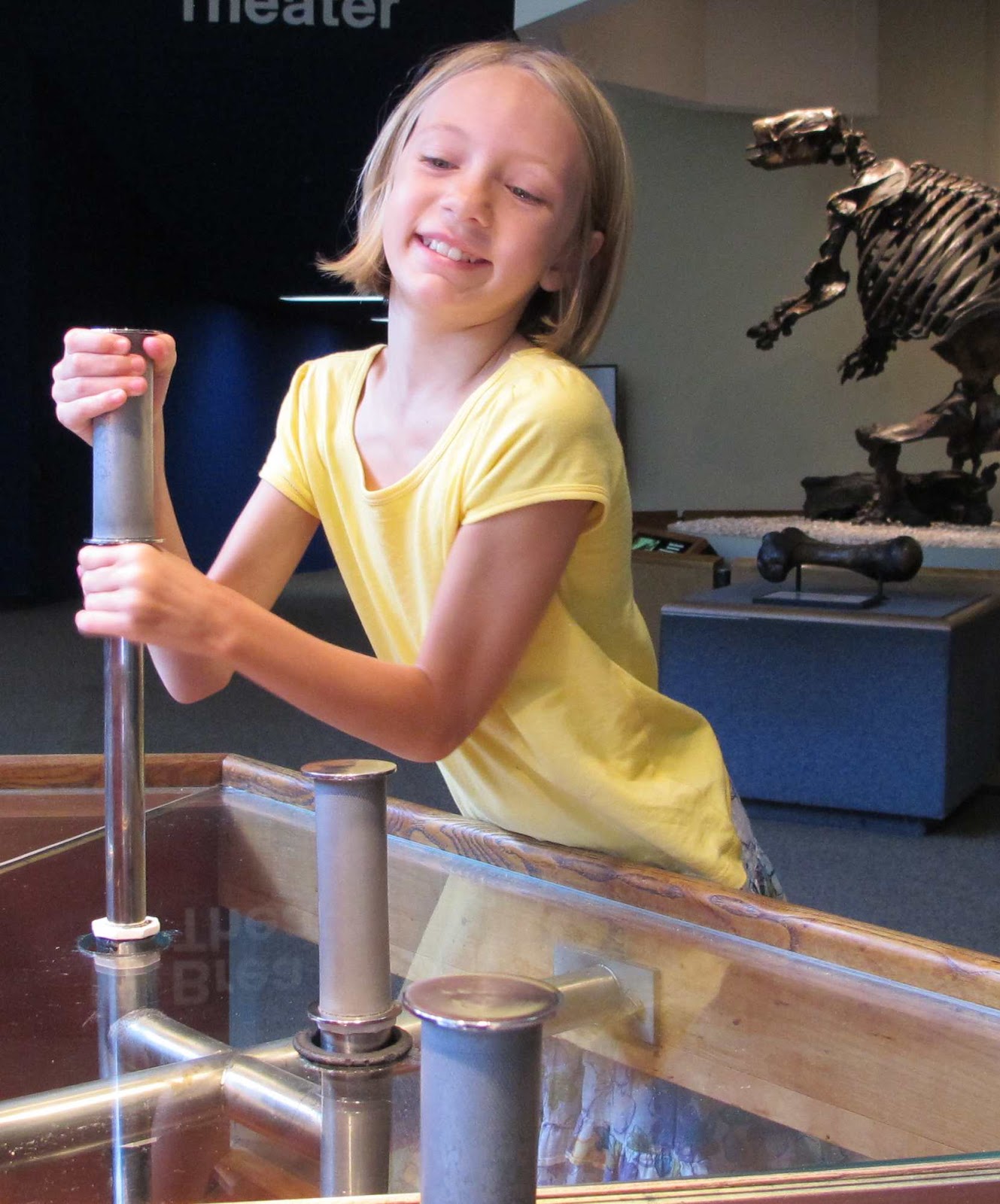
Hands-on at La Brea Tar Pits
Getting a feel for how difficult it would be to pull your leg out of the tar

Here, visitors can also watch the processes of paleontology unfold.  Inside the glass-enclosed Fish Bowl Lab, scientists and volunteers prepare fossils including “Zed,” a recently discovered male Columbian mammoth.  Outside the museum, in Hancock Park, the Pleistocene Garden and iconic life-size replicas of extinct mammals depict the life that once grew, and roamed, in the Los Angeles Basin.

Dire Wolf Skulls at La Brea Tar Pits
404 Dire Wolf skulls, a fraction of the more than 1600 wolf remains found here

Of the five dog species found here, the Dire Wolf is the most common.  It is thought that packs of Dire Wolves attempted to feed on animals trapped in the asphalt and became mired themselves.  The skulls are not exactly alike in either size or shape.  These minor differences is sure to yield information about wolf evolution and population structure.

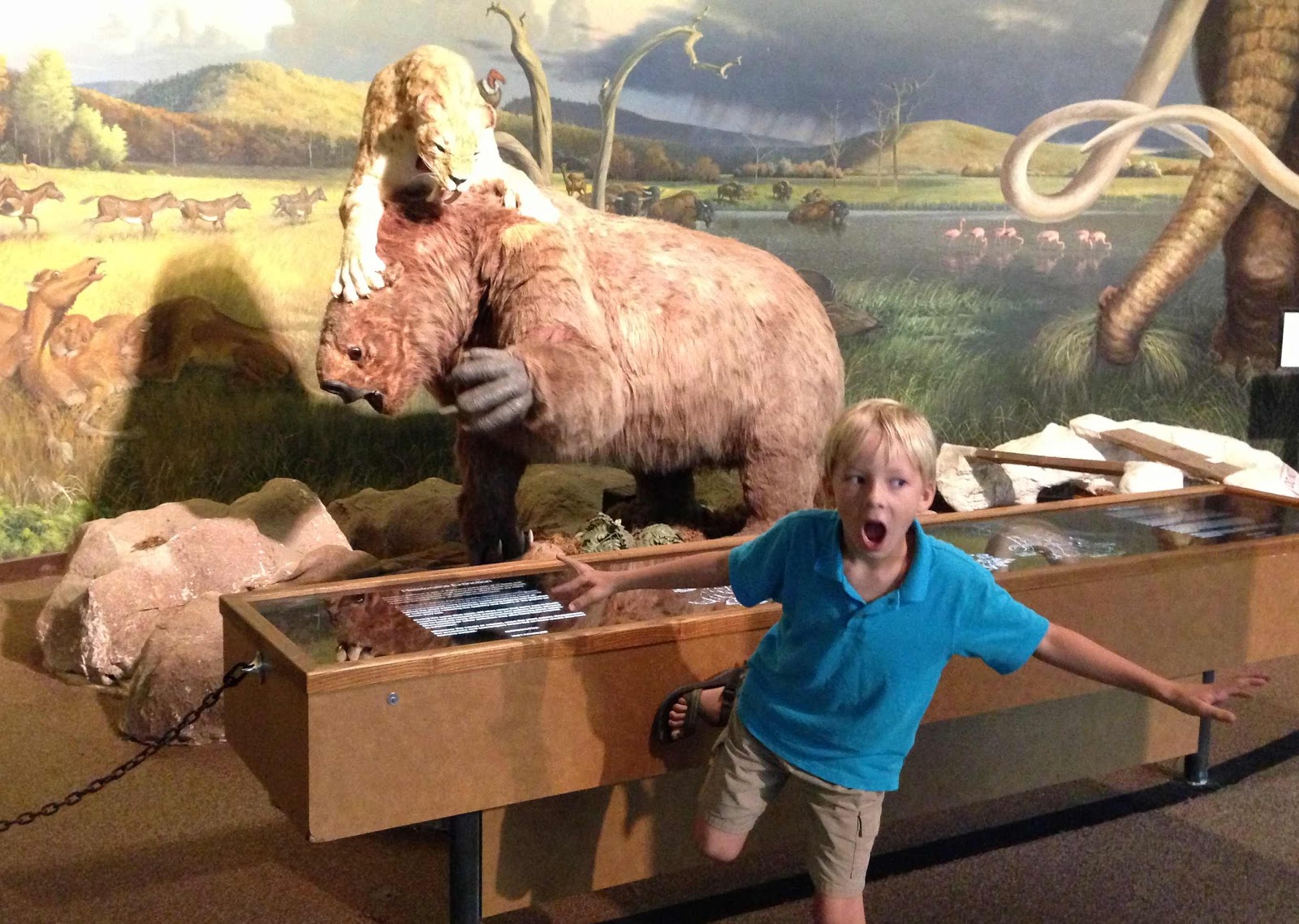
Saber Tooth at La Brea Tar Pits
Taking cover from the Saber-tooth Cat

Harlan’s ground sloth (Paramylodon harlani) is one of three species of ground sloths found at La Brea. Related to modern tree sloths, armadillos, and anteaters, ground sloths migrated to North America from South America.  Harlan’s ground sloth was an herbivore, browsing on both shrubs and grasses.

Pit 91 at La Brea Tar Pits
The colored flags mark specific bones visible in the pit that have yet to be excavated

Pit 91, pictured above, is an excavation site located outside the museum in Hancock Park.  Here the site is left ‘in situ’ so visitors can get a glimpse of the work archeologist undertake in the asphalt conditions.  Presently, the pit is 15′ in depth and is not actively being excavated at this time.

Excavation has been taking place here for over 100 years. Because of the extraordinary number of fossils still in the ground, excavation continues to take place 7 days a week.  We thoroughly enjoyed our visit here and even did a little Letterboxing nearby before they opened.