Wildlife - Eva Varga - Page 3


September 26, 20142

The volcanic activity of the Cascade Range has created unique geological formations that can only be seen in this part of the country. From gigantic obsidian glass flows (at Newberry Crater near Bend, Oregon), steaming mud pots at Lassen National Volcanic Park, and lava tube caves surrounded by a wide diversity of scenery make this journey an unforgettable experience.

The 500 mile Volcanic Legacy Scenic Byway winds its way from Lake Almanor in Northern California through dramatic volcanic landscapes to Southern Oregon’s Crater Lake National Park.

volcanic-legacy-logoLiving in this region, we have had the opportunity to explore many of the volcanic sites over the years. This past weekend, we enjoyed unplugging and reconnecting with one another while camping at Manzanita Lake. It was the perfect field trip to augment our current geology cycle in STEM Club.

I am delighted to share some of the highlights from our experiences over the years along the volcanic scenic byway with you today.

Lassen Volcanic National Park

We will begin our tour with the remarkable hydrothermal features in Lassen Volcanic National Park which include roaring fumaroles (steam and volcanic-gas vents), thumping mudpots, boiling pools, and steaming ground. These features are related to active volcanism and are indications of the ongoing potential for further eruptions from the Lassen “volcanic center.”

manzanitaManzanita Lake at Lassen Volcanic National Park

At the nearby Loomis Museum, we learned how B.F. Loomis documented Lassen Peak’s most recent eruptions (1914-15) and reviewed the geologic, historic, and cultural past at the Lassen Crossroads Information Center.

Subway Cave

Heading Northwest towards Burney, we come to the Subway Caves where you can hike 1/3 mile through the largest accessible tube in the Hat Creek Flow. The lava was discharged in large volumes from a series of north-south fissures (cracks in the earth). This river of lava crawled northward 16 miles, covering the floor of Hat Creek Valley. While the top crust cooled and hardened, rivers of red-hot lava insulated by newly formed rock above, continued to flow. Eventually, the lava drained away, leaving tube-like caves. The entrance to the cave was formed by a partial collapse of the cave’s roof many years ago.

McArthur-Burney Falls Memorial State Park

Not far from the caves, McArthur-Burney Falls features a 129-foot waterfall, cascading at a rate of 100 million gallons of water daily. While it is not the highest or largest waterfall in the state, many claim it to be the most beautiful. Additional water comes from springs, joining to create a mist-filled basin. Burney Creek originates from the park’s underground springs and flows to Lake Britton, getting larger along the way to the majestic falls. Teddy Roosevelt once described Burney Falls as the “eighth wonder of the world”.

burney_subway

Castle Crags State Park

Heading north now along the I5 corridor, we come to Castle Crags State Park which features 28 miles of hiking trails, including a 2.7 mile access trail to Castle Crags Wilderness, part of the Shasta-Trinity National Forest.  The Pacific Crest Trail also passes through the park.  The park is named for the 6,000-feet tall glacier-polished crags.  The solitude you experience as you explore the forest or traverse part of the Pacific Crest Trail cannot be matched.

Klamath Wildlife

Continuing north, we exit I5 near Weed towards Klamath Falls. Along the border between California and Oregon are numerous wildlife viewing areas including Grass Lake Rest Area near Macdoel. North of Klamath Falls, you can’t miss the nearly 30 miles long and eight miles wide Upper Klamath Lake, the largest body of freshwater west of the Rockies. Because the lake is so shallow, a highly nutritious blue green algae flourishes, sustaining a food web that lures fly fisherman, bird watchers, and nature enthusiasts from across the globe.

Collier State Park & Logging Museum

Back on the road, we come to Collier State Park is located just north of Chiloquin, Oregon near the confluence of Spring Creek and the Williamson River. Beneath towering Ponderosa pine trees, this park features an outdoor museum of historic logging equipment dating to the 1880s. You can imagine the rugged woodsmen and the immense task of moving raw timber with innovation and brute force. There is also a relocated pioneer village, giving you an idea of how these families once lived.  Railroad buffs can learn about the role the railroad played in logging.

Crater Lake National Park

Lastly, we come to one of the gems of the National Park system, Crater Lake. The collapse of Mt. Mazama created a caldera that filled with clear blue waters to form the deepest lake in America and the 7th deepest lake in the world. There is so much to explore at the 183,225 acre park, we’ve only begun to scratch the surface.

One of our most memorable activities in the past was creating a 3D topographic map of the park, Build Geoography Skills with Topographic Maps, for a geography co-op.


October 24, 20131

discovering china

Nihao!  I’m delighted you are joining me for the seventh of ten posts whereby I introduce you to the culture of China through our eyes.  Today, I bring you to Yangshou – where you will discover caves, cormorants, and snails. Of all the cities we had the chance to see during our three-week family holiday in China, Yangshou remains the most special to me. The scenery was stunning.  The people were so welcoming.  It reminded me a little of my beloved Oregon.

yangshouIn Chinese paintings there are scenes of fantastically shaped misty mountains – these aren’t merely in the eye of the artist – you can see this landscape around Guilin. The Guangxi Zhuang Autonomous Region is famous for its scenery dominated by the karst peaks that create some of the most famous landscape images of China. You’ve likely even seen them featured prominently in an episode of Star Wars.

Caves

What you don’t see in those photos are the hundreds of caves that go right along with the landscape (where there’s a limestone mountain, there is a cave). The area around Yangshuo – where we stayed – has many caves for spelunking, some you wander through, some in which you can even enjoy a mud bath.

We had to make changes to our original itinerary and we didn’t have as much time here as we’d hoped. For this reason, we sadly didn’t make it to these caves.  Even so, we had a wonderful time and Yangshou remains one of our highlights.  With the help of our hotel, a driver met us at the airport in Guilin and escorted us to our resort in Yangshou. We arrived just in time for lunch – a local favorite of braised beer fish – and thereafter enjoyed a delightful motor boat cruise on the Li River.

Li River

The motor boat was loud and in the humidity, it was not the most comfortable ride (our driver went up river very slowly – I think every other boat must have passed us).   After about 45 minutes, he stopped at a small island where he directed us off the boat and we were immediately encouraged by the vendors to sample their offerings as well as have our photo taken with the captive cormorants.  This made me uncomfortable but I obliged.

After our river cruise, we visited Xingping, an ancient village in existence for over 1500 years. In the village, we could see stone streets and crumbly brick buildings with tiled roofs, surrounded by the mountains.   We then returned to the Yangshou Mountain Resort where we were staying to change and go down to dinner. Can you believe we ordered burgers?  The freshly in  house-baked buns and local vegetables (particularly the tomatoes) made it one of the best burgers I’ve ever eaten.

Cormorants

Later that evening, we went into town again for the cormorant fishing show. Cormorant fishing is a traditional fishing method in which fishermen use trained cormorants to fish in rivers. Historically, cormorant fishing has taken place in Japan and China since about 960 AD. The types of cormorants used differ based on the location; Chinese fishermen often employ Great Cormorants (P. carbo).

To control the birds, the fishermen tie a snare near the base of the bird’s throat. This prevents the birds from swallowing larger fish, which are held in their throat, but the birds can swallow smaller fish – we observed this on a few occasions.  When a cormorant has caught a fish in its throat, the fisherman brings the bird back to the boat and has the bird spit the fish up. Though cormorant fishing once was a successful industry, its primary use today is to serve the tourism industry.

yangshou cormorant fishingThe following day, we stayed close to the resort as we were to depart in the early afternoon for the train station.  We enjoyed a lazy float on inner tubes reminiscent of my childhood on the Yulong River amid a beautiful backdrop of karst mountains.  We played a little Pīngpāng qiú (乒乓球) – a sport in which China dominates.  We slowly, reluctantly packed our things.

While in Yangshou, travelers can also enjoy a relaxing ride on a bamboo raft on the river. The skillful crewman uses a long pole to navigate the raft.  As our time in Yangshou was limited, we didn’t have the chance to take a bamboo raft down this section of the river – but we did enjoy watching others.

Snails

The kids would have liked to captain their own raft but had to console themselves with the one that was anchored near the resort.  Here they found numerous snails who they quickly befriended. We’d watched the movie Turbo just prior to departing for China, so they both had a fond affection for snails.  You can read more about our impromptu snail study in my earlier post, Nature Study in China: Phylum Mollusca.

Had we had more time in this province, we would have enjoyed a trek in the Longji Rice Terraces. This famous area is north of Guilin and famous for its minority villages and incredible scenery. The mountains here are terraced from top to bottom and create a stunning landscape.

I will be wrapping up the Discovering China series tomorrow with Hong Kong where during our final days in China, we celebrated Sweeetie’s birthday.

Autumn-Hopscotch-2013

This post is part of the iHomeschool Network’s Autumn Hopscotch, a 10 day series of posts by over 40 different homeschool bloggers. You can visit the hopscotch home page at iHN for ideas and inspiration. Have you taken a peak at some of the other posts?  If not, I encourage you to do so. You’ll surely find something to inspire you!

All 10 days of Discovering China will be linked to one landing page.  Bookmark it for reference!


October 18, 20131

discovering china你好 (Nihao) !  I’m delighted you are following along with us as we tour China, city by city.  We recently returned from a three-week family holiday in China. This is the fifth of ten posts whereby I introduce you to the culture of China through our eyes.  Today, I bring you to Chengdu – though a thriving modern metropolis, Chengdu is most well known for the Giant Panda.

Chengdu is the capital of Sichuan province in Southwest China.  Chengdu is one of the most important economic, transportation, and communication centers in Western China. As China’s National Treasure, the giant panda is one of the rarest animals in the world. The total number is estimated to be 1,500, including those living in the wild, 80% of which are in Sichuan Province.

This post contains affiliate links.

chengduPanda Breeding Center

Beloved by all, the panda has a special place in the heart of Chinese people and visitors alike.  At the Panda Breeding Center we had the exciting opportunity to encounter pandas and to learn about the care of these amazing animals. We were able to see pandas up-close and learn about their habitat, mating habits, diet, intelligence and how they have survived despite increasing natural and human threats to their existence.

Here we had the opportunity to hold and cuddle baby Giant Pandas but for the health of this remarkable species – and the exorbitant cost – we refrained.  Our friend Carlo put together a couple of great videos: the Giant Panda & Red Panda and the adorable Panda Cubs at the breeding center in Chengdu.

If you would like to learn more about the Giant Panda, I encourage you to check out the Free Panda Lapbook Lessons and Printables at Homeschool Share; Carisa Hinson and Ami Brainerd have done a fabulous job putting this together.  Partner these videos and lapbook together with a few non-fiction books and you have a great unit study.  A few titles I would suggest include Giant Pandas by John Seidensticker and another by the same title, Giant Pandas, by Gail Gibbons.

Hot Pot

 火锅  (huǒ guō) is one of our favorite foods. We first discovered it with our Mandarin tutor when he taught us how to make it ourselves.  As wonderful as his recipe is, it doesn’t quite compare to what you find in China, especially in Chengdu where huǒ guō is a specialty dish.

hot potA simmering metal pot of stock is placed at the center of the dining table; while kept simmering, ingredients are placed into the pot and are cooked at the table. It can be eaten bland to very spicy, depending on how much spice has been put in the stock.  We selected both varieties as I like it spicy but the kids do not.

Frozen meat is sliced thinly to prepare it for hot pot cooking. The common meats used include lamb, beef, chicken, duck, mutton, and others. Meat or vegetables are loaded individually into the hot cooking broth by chopsticks, and cooking time can take from 1 to 15 minutes, depending on the type of food. Meat should be cooked at the very least 20 seconds depending on the thickness of meat. Other hot pot dishes include leafy vegetables, mushrooms, seafood, and noodles. One of the foods I discovered I really like is Dried Black Fungus.

Here is an easy to follow tutorial on How to Make Traditional Chinese Hot Pot in your home.  As she stated, the food is usually eaten with a dipping sauce on the side. The important thing to remember is this sauce is personalized so be creative to find what ingredients and blends you like best.  You may wish to use soy sauce, oyster sauce, Sriracha, sesame paste, chili paste, minced garlic, cilantro, salt & pepper, sliced scallions, and/or sesame oil.

To make it at home, you’ll want a Tayama Hot Pot or other stainless steel cooking pot.  The divider isn’t necessary unless you want two different broths. An Induction Cooktop Stove is also recommended so that everyone can take part and enjoy the meal in comfort around the table.

I’ll be taking the weekend off but be sure to come back on Monday.  You won’t want to miss our visit to the Giant Buddha in Leshan.

Autumn-Hopscotch-2013This post is part of the iHomeschool Network’s Autumn Hopscotch, a 10 day series of posts by over 40 different homeschool bloggers. You can visit the hopscotch home page at iHN for ideas and inspiration in topics like Fun Autumn Craft Activities for Young Kids and Using Board Games for Learning.

All 10 days of Discovering China will be linked to one landing page.  Bookmark it for reference!


November 23, 20122

When we were in Southern California earlier in October for a family holiday at Disneyland, we also made a few little day excursions .. one to Legoland (of course), one to La Brea Tar Pits, and one to Long Beach specifically to visit the Aquarium of the Pacific.  Sweetie had received earlier in the year, free passes to the aquarium for her honorable mention in the California Coastal Commission’s annual Coastal Art & Poetry Contest.

We arrived just in time to see the diver presentation at the Honda Blue Cavern, modeled after the local Blue Cavern Point, a kelp forest along the northeastern coast of Santa Catalina island.  We enjoyed listening to the diver identify several of the species found in this community, including the Giant sea bass (Sterolepis gigas).

Focused on the Pacific Ocean, the aquarium is organized into three main galleries: Southern California/Baja, Northern Pacific, and Tropical Pacific.   The Ocean Science Center uses NOAA’s “Science on a Sphere” to explore our planet and tell stories about ocean phenomena and their impacts.  Other exhibits include The Shark Lagoon, Lorikeet Forest, Molina Animal Care Center, and Watershed Exhibit. Additionally, there is a special exhibits gallery which featured the Arctic & Antarctic: Our Polar Regions in Peril exhibit while we were there.

I was delighted to point out to the kids the large Sunflower seastars (Pycnopodia helianthoides), the largest seastars in the world.  To the touch, they feel like soft, velvet and velcro covered sponges.  They are commonly found where the substrate is soft, feeding on clams.

While enjoying the outdoor exhibits, Buddy climbed aboard a ship and received an unexpected squirt from a giant fish nearby.  Thankfully, he thought it was as funny as we did and we all chuckled.  🙂

One of our favorite exhibits was the June Keyes Penguin Habitat located outdoors.  We included the photo below in our annual Christmas DVD – you would be surprised to learn how many people asked us if the penguins pictured beside us were actually real.  “I can’t believe they let you hug them,” one family member actually said.

Throughout the aquarium, there are eight embossing stations where visitors can emboss an image of a sea creature in the corner of their visitor’s guide.  This was a great activity for the kids, keeping them engaged and focused on their signage.  If you enjoy Letterboxing and collecting National Park Passport cancellations like we do … you’ll love this.


October 21, 20113

A week ago, we had an opportunity to spend a few days with my dad in Bandon.  Though my childhood home was rented for many years, my father now resides here once again.  We visit as often as we can and try to stay for a few nights at least once a year.  It is always a special time.

Coastal Ecology – 4 Distinct Habitats

On Saturday morning after breakfast, we ventured out onto the mudflats across the street from the house.  We were careful this time around to don old tennis shoes for the occasion.  We headed out at the peak of low tide, but had neglected to check the tidal height.

Mudflats

We thereby discovered, once we were underway, that the tide wasn’t particularly low.  We wouldn’t thereby have as much time for agate collecting as we had anticipated.   

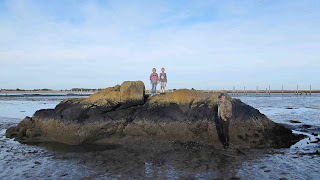
The rock in the mudflats where my brothers and I spent many hours role-playing our favorite stories.

Crossing the mudflats, we observed many signs that wildlife had been here prior to us.  At least two are visible here: one mammal species and one bird.

While I was distracted with my camera … everyone kept moving along.  Anxious to get to the sandy beach where the agates collected and due to the location, rarely seen by human eyes.

Upon crossing the creek, we were then able to step up onto the salt marsh.

Salt Marsh

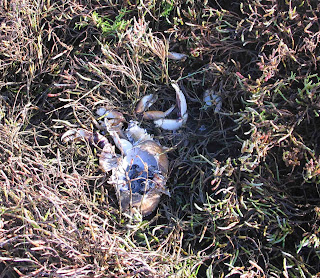
We observed an abundance of driftwood, pickle weed (Salicornia), and sea lettuce (Ulva).  We didn’t spend much time here this time as the tides were against us, however, we did manage to see evidence that a meal had been enjoyed here – at least by one resident.As we came up over the berm, sadly there is some European beach grass (Ammophila arenaria) here too. We discovered that the beach was amass with Harbor Seals (Phoca vitulina) basking in the sun. We tried not to disturb them, but with a 6 year old rambunctious boy, that is near impossible.  The seals thereby made a mad dash for the water as soon as they realized we were there.

Sandy Beach

Harbor Seals sunbathing on the beach … at least until we arrived.

We walked along the sandy beach in search of agates … collecting our favorites and investigating other objects of interest.  All the while, the seals observed us from afar, likely wondering when we were planning to leave.  A small group of seals, even followed us along the shoreline for some distance, snorting on occasion, clearly disgusted with our presence.

Agate hunting on the sandy beach

We observed numerous tracks along the sandy beach as well .. though different than those we’d seen on the mudflats.

It was a beautiful morning with very little wind.  We would have liked to have stayed longer, but we knew the tide threatened to trap us on the island or force us to swim so we headed back after about 40 minutes.  We walked back the same way we had come and thereby came to the section of the beach where the three seals I had photographed had been relaxing.

We quickly crossed the mudflats and then continued to trudge across the mudflats.  We observed the remnants of another Dungeness crab (Metacarcinus magister) meal, now becoming a little jealous.  We would have liked to go crabbing too, but we just didn’t have the time.

We were indeed fortunate to have headed back when we did.  On the way out, the creek depth had reached only to my knees.  On the return, however, it was up to my waist.  My dad helped the two little ones cross at the deepest point.  My little guy was quite concerned with the incoming tide.  Though he is a strong swimmer for his age, I actually began to worry he might not be able to swim if the need arose, due to panic.

Upland Forest

Each evening, at dusk, we also trekked across the road to take a peak at the beaver (Castor canadensis) who has recently taken up residence in a culvert on Dad’s property. Sadly, he was always too quick for us and we never observed him in person … only evidence of his presence.  Dad has seen him frequently, so we know he’s there.  Each time we tried to sneak up on him .. he’d duck away and into the culvert under the road.  The water would undulate back and forth in smooth waves as proof he had been there only a moment before.

The picture above shows the trail that he has formed as he travels back and forth through the forest to the mudflats just on the other side of these trees.

It was a great excursion and one we look forward to repeating again. Buddy has a different opinion, however.

Estuary Ecology

Immerse yourselves in a field study of the estuary and its distinct habitats with my Estuary Ecology curriculum available in my store.